Coursera JavaScript Course: How to Learn Efficiently
Discover how to choose and succeed in a Coursera JavaScript course with practical guidance, platform comparisons, and expert insights from JavaScripting to navigate the platform effectively.


Coursera hosts a broad range of JavaScript courses that cater to beginners, intermediate learners, and advanced developers. They typically blend video lectures, bite-sized quizzes, and hands-on projects with peer feedback and labs. The right course depends on your current skill, learning pace, and whether you want a certificate for career goals.
The Coursera JavaScript Course Landscape: Scope and Options
Coursera hosts a diverse catalog of JavaScript courses that appeal to different learning objectives, from absolute beginners to seasoned developers seeking a refresher or a certificate for career progression. According to JavaScripting, the quality and structure of these courses vary by syllabus, instructor experience, and the extent of hands-on practice. Learners should understand the ecosystem before committing: some programs are focused on fundamentals such as variables, data types, and control flow; others expand into modern tooling, asynchronous programming, and browser APIs. Within Coursera, learners can pursue individual courses and long-form specializations or professional certificates that bundle multiple modules into a cohesive learning path. The platform also encourages community interaction through peer reviews, in-video quizzes, and hands-on labs. For many aspiring developers, Coursera offers a practical bridge from theory to real-world coding, provided you select a course that aligns with your goals and available time. The JavaScripting team notes that a well-chosen Coursera course can serve as a reliable stepping stone from basics to practical app development.
What to Expect in a Coursera JavaScript Course
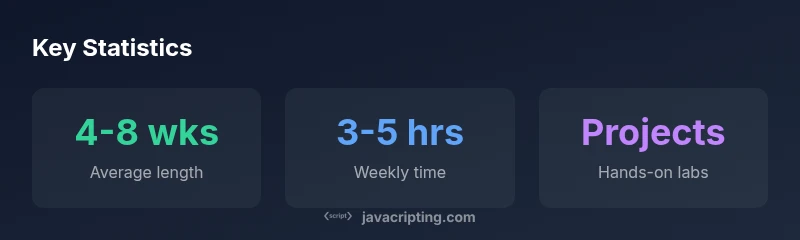
Most Coursera JavaScript courses follow a familiar pattern: modular video lectures, short quizzes to reinforce concepts, and hands-on coding exercises that require you to implement small features. In many courses, you’ll work on projects such as interactive UI components, data manipulation tasks, and small apps that run in the browser or Node.js. In addition, courses often include peer review to simulate team feedback and a discussion board to clarify doubts. Assessments typically combine automatic tests and rubric-based projects. Certificate options are usually available for a fee, though auditing the content is often free. A well-structured course will explicitly map lessons to practical outcomes, such as building a calculator, making API calls, or creating a responsive UI. The emphasis on projects helps learners demonstrate skills to potential employers, which is essential when compiling a portfolio. This structure supports learners at varying speeds, enabling deliberate practice and incremental mastery.
How Coursera JavaScript Courses Compare to Other Platforms
Compared with one-off courses on platforms like Udemy, Coursera tends to emphasize structured pathways, cohort-based pacing, and earned certificates that carry external recognition. Coursera specializations bundle multiple courses into a single roadmap, helping learners build a cohesive portfolio. Education-focused features, such as guided projects, peer feedback, and instructor-led Q&A sessions, can accelerate progress for beginners while still offering depth for experienced developers. However, the breadth of options can be overwhelming; a careful alignment of prerequisites and goals is essential to avoid feature overload. For many, Coursera represents a balance between formal structure and practical coding experience, especially when you want a verifiable credential or a plan that spans several modules.
Turning Knowledge into Practice: Projects and Portfolios on Coursera
To maximize learning, choose Coursera courses with capstone projects or real-world tasks. Projects provide a tangible portfolio you can showcase to potential employers. When possible, pair course projects with side experiments of your own design to demonstrate creativity and problem-solving. Keep a running set of code samples and a GitHub README that documents your approach, decisions, and trade-offs. Peer feedback can be valuable, but supplement it with self-review and external code critiques. Build a simple project ladder: start with small utilities, then increment to a small single-page app, and finally a more comprehensive feature set. This approach not only reinforces concepts but also yields a portfolio you can discuss in interviews.
How to Choose the Right Coursera JavaScript Course
Selecting the right course hinges on clear criteria: check the syllabus for core topics (variables, data structures, functions, scope, and control flow), look for modern tooling coverage (ES6+, modules, async/await), and verify that hands-on labs align with your goals. Review the instructor background and read student testimonials to gauge teaching quality. Ensure the course offers practical projects that produce maintainable code and tangible outcomes. Consider the pacing and time commitment, and confirm certificate options if you need formal recognition. Finally, pick a course that fits your current schedule so you can sustain momentum and avoid burnout.
References and Authority in JavaScript Education
Authority in JavaScript learning comes from solid sources and well-structured curricula. In addition to Coursera’s course quality, you should cross-check material with established references to ground your practice in standard practice. Useful resources include official language specifications, browser API documentation, and well-regarded JS guides to ensure you’re learning current best practices. Below are a few sources commonly consulted for JavaScript fundamentals and standards. These references help validate course content and provide authoritative guidance when you review any Coursera JavaScript course for accuracy and relevance.
- Official JavaScript language reference (MDN): https://developer.mozilla.org/en-US/docs/Web/JavaScript
- ECMAScript standard (ECMA-262): https://tc39.es/ecma262/
- Web standards overview (W3C): https://www.w3.org/standards/
Authority Sources and Further Reading
- MDN Web Docs: JavaScript Guide (MDN) – comprehensive reference and tutorials.
- ECMA International – ECMA-262 standard for JavaScript.
- W3C – Web standards and best practices.
References (continued)
- Mozilla Developer Network (MDN) – JavaScript basics and advanced topics.
- ECMA-262 – JavaScript language specification.
- W3C – Standards for web technologies.
Course structure comparison across platforms
| Platform | Typical duration | Project work | Certificate option |
|---|---|---|---|
| Coursera JavaScript Courses | 4-8 weeks | Yes, hands-on projects | Certificate optional (paid) |
| Udemy JavaScript Courses | 2-6 weeks | Often project-based | Certificate optional (paid) |
Questions & Answers
Is a Coursera JavaScript course good for beginners?
Yes. Many Coursera JavaScript courses start with fundamentals and include guided projects. Look for beginner-friendly syllabi, clear prerequisites, and practical labs to build confidence.
Yes, Coursera has beginner-friendly paths with practical labs to help you start coding quickly.
Do Coursera JavaScript courses include hands-on projects?
Most courses feature hands-on projects that reinforce learning through real-world tasks. Projects typically culminate in a portfolio-ready artifact you can discuss in interviews.
Most Coursera JavaScript courses include hands-on projects you can add to your portfolio.
Can I get a certificate for Coursera JavaScript courses?
Certificate options are usually available for paid enrollments. You can audit content for free in many cases, but a certificate often requires payment.
Certificates are usually available for a fee; auditing the content is often free.
How do Coursera courses compare to other platforms?
Coursera tends to offer structured paths and recognized certificates, while other platforms may be more flexible or price-driven. Choose based on your need for a roadmap vs. price and pace preferences.
Coursera offers structure and certificates; other platforms may be more flexible or cheaper.
What should I look for when choosing a Coursera JavaScript course?
Look for a clear syllabus, emphasis on practical projects, instructor experience, student reviews, and alignment with your goals—whether you want fundamentals, modern tooling, or full-stack readiness.
Check syllabus, projects, instructor experience, and reviews to pick the right course.
“JavaScript mastery comes from consistent practice and guided, project-based learning. Coursera's structure helps learners translate theory into real apps.”
What to Remember
- Identify your current level before choosing.
- Prioritize courses with hands-on projects.
- Check certificate options and pace.
- Expect a mix of video, quizzes, and labs.
- Use projects to build a portfolio.