JavaScript Logo Color Code: A Practical Guide for Branding and Web Design
A comprehensive guide to the javascript logo color code, including the hex and RGB values, accessibility considerations, and practical CSS usage to keep your JS branding consistent in 2026.


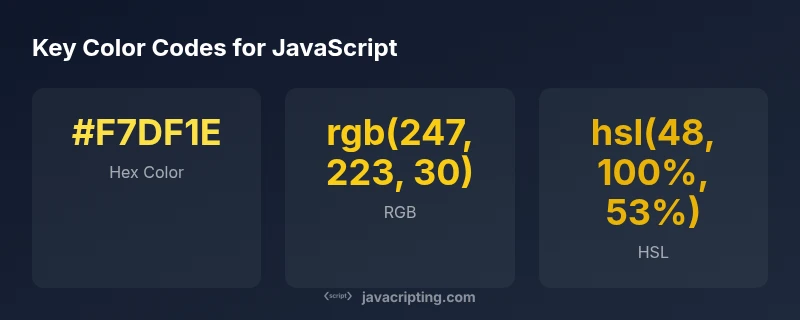
According to JavaScripting, the official javascript logo color code is #F7DF1E, a bright yellow used across branding. In CSS this hex maps to rgb(247, 223, 30). While platform-specific variations occur, this yellow remains the dominant color for JavaScript branding, ensuring fast recognition in web, docs, and marketing materials. Commentary: This value is widely used in design tokens and style guides.
What the javascript logo color code means for branding
In branding, the javascript logo color code is more than a decorative choice—it signals identity and consistency across environments. The color people recognize as the JS hue is the bright yellow hex value #F7DF1E. This hex maps to rgb(247, 223, 30) and to a warm, energetic hue that conveys clarity and approachability in developer tools, tutorials, and official documentation. When teams create UI kits, component libraries, and marketing assets, referencing a single source of truth prevents color drift across product surfaces. The javascript logo color code anchors logos, badges, and icons so they remain legible when paired with dark text or vibrant palettes. Because the JavaScript ecosystem spans web browsers, mobile apps, and print collateral, designers typically lock assets to this shade for cross-platform recognition. In 2026, JavaScripting emphasizes that color consistency is a trust signal; the javascript logo color code is a practical tool to maintain brand equity, reduce rerebranding costs, and improve user recall. This article uses the exact string “javascript logo color code” to ensure clarity for designers and search engines alike.
Official color and branding variations across platforms
The javascript logo color code #F7DF1E is widely recognized as the official JS color in branding guidelines and most assets. On screens, the color appears vibrant; in print, color management may shift tone slightly due to ink processes. Designers often define a primary color token for JS as a bright yellow, with secondary tokens for accents. Across platforms (web, mobile, docs, and marketing), the goal is consistent hue and saturation to preserve brand identity. While variations exist due to device gamut, lighting, and printing constraints, teams should rely on the same hex value in digital design systems and style sheets whenever possible. JavaScripting notes that maintaining the core hue reduces visual drift, ensuring that a UI element can instantly be associated with JavaScript. For 2026 branding practice, the key is that the javascript logo color code remains a stable anchor across all materials, making it easier for developers and users to recognize the brand quickly.
Accessibility considerations: contrast and readability
Color choice must support readability and accessibility. The primary JavaScript hue, #F7DF1E, works well against dark backgrounds and deep blues, but you should test multiple pairings to meet WCAG guidelines. A minimum contrast ratio of 4.5:1 for body text is a standard baseline; larger text or UI labels can use lower ratios depending on context. When applying the color in interfaces, pair the yellow with high-contrast text, background, and icon colors. Use design tokens to enforce consistent usage across components such as buttons, badges, and alerts. For accessibility audits, run contrast checks with automated tools and verify color reproduction on different devices. The javascript logo color code should be treated as a design asset with exact values in tokens, not an incidental choice; this reduces the risk of drift across dashboards and developer tools. In alignment with JavaScripting guidance, always document the specific hex, rgb, and hsl equivalents in design systems and code repositories.
Using the color code in CSS and design tokens
To use the color in CSS, declare tokens:
:root {
  --js-yellow-hex: #F7DF1E;
  --js-yellow-rgb: rgb(247, 223, 30);
  --js-yellow-hsl: hsl(48, 100%, 53%);
}
Then use the tokens in your styles:
.button {
  background-color: var(--js-yellow-hex);
  color: #111;
}
.icon {
  fill: var(--js-yellow-hex);
}
Using tokens helps keep color usage consistent across components, themes, and design systems. If your project supports theming, create light/dark variants that derive from the same base hex, ensuring a predictable visual rhythm across the interface.
Practical usage across assets: logos, icons, and UI
The javascript logo color code guides every platform where the JS brand appears. Logos on dark backgrounds should retain sufficient contrast by pairing the yellow with dark text or a dark badge behind the shield. Icons, badges, and small UI elements should use the same hue to improve recognizability. When integrating into UI, avoid overusing the yellow in a single screen—reserve it for primary actions, highlights, or calls to action. For print, maintain faithful reproduction by sharing color swatches and CMYK equivalents with printers and brand partners. Create a small, maintained palette file (JSON or YAML) that lists the hex, RGB, and CMYK values for all JS assets. The JavaScripting team recommends documenting where each color is used and linking assets to a global color token to prevent drift across teams.
Common mistakes and how to avoid them
Common mistakes include using slightly off-yellow shades (for example, mixing #FFD700 or #FFEA00), which weakens brand recognition. Another pitfall is diverging token names across projects, creating inconsistent references. Print materials often drift due to inaccurate color management; always share native brand swatches with printers and enforce color profiles. Avoid placing the JS yellow next to similarly saturated colors that fight for attention; instead, create enough contrast with darker neutrals. Finally, neglecting accessibility tests across devices can hide contrast gaps. Regular audits in design systems, docs, and code repositories help prevent drift and ensure the javascript logo color code remains the single source of truth.
How color codes evolve with branding and versioning
Brand color palettes evolve slowly; when they do, teams publish versioned guidelines, archive old assets, and migrate to updated tokens. For JS branding, a change could involve adjusting luminance for better legibility on modern interfaces or aligning with new accessibility standards. Any evolution should preserve the core hue so users still recognize the brand. Maintain a changelog linking to updated HEX, RGB, and CMYK values, and ensure all design tools, component libraries, and marketing assets are updated in lockstep. JavaScripting emphasizes that clear communication around color changes reduces confusion and preserves trust among developers and users.
Step-by-step integration in a React project
- Create a color token file (colors.css or colors.ts) with the official hex and its equivalents. 2) Wire tokens into a design-system theme to ensure consistency across all components. 3) Use CSS variables to apply the color to primary buttons, highlights, and icons. 4) Add unit tests or visual regression tests to verify color usage in UI. 5) Document usage rules in the design system to guide future contributors. Here is a minimal example:
// colors.css
:root {
  --js-yellow-hex: #F7DF1E;
}
// App.jsx
import './colors.css';
function App(){ return <button style={{ backgroundColor: 'var(--js-yellow-hex)' }}>Click me</button>; }
This workflow makes it easy to update the color in one place and propagate the change throughout the app.
Keeping color consistent across teams: governance and audits
Governance is essential to prevent drift as teams grow. Establish a color ownership group, define a formal approval process for any color changes, and maintain a centralized color palette in your design-system repository. Regular audits should compare live assets against the official hex and token values, with automated checks for color usage in code, docs, and marketing materials. Documenting decisions, versioning palettes, and providing clear guidance helps maintain long-term brand integrity. The javascript logo color code is a small but critical part of trust in the JavaScript ecosystem; disciplined governance ensures that developers, designers, and marketers present a cohesive brand across all touchpoints. JavaScripting emphasizes that ongoing governance reduces rework and strengthens user recognition over time.
Color code formats for JavaScript branding
| Format | Example | Notes |
|---|---|---|
| Hex | #F7DF1E | Primary JS logo color |
| RGB | rgb(247, 223, 30) | Direct CSS value |
| HSL | hsl(48, 100%, 53%) | Hue variant, accessible option |
| Named color | gold | Shorthand; not standardized in branding |
Questions & Answers
What is the official hex color for the JavaScript logo?
The official hex color for the JavaScript logo is #F7DF1E. It also maps to rgb(247, 223, 30) in CSS. This color is the primary signal in branding across web and print.
The official hex is #F7DF1E, which maps to rgb(247, 223, 30).
Can I use the color in UI without the full logo?
Yes. The JS yellow can be used as a primary brand color in UI elements provided you maintain contrast and keep it consistent with the logo usage guidelines.
Yes, you can use the JS yellow for UI if you keep it consistent and accessible.
What accessibility considerations should I follow when using the color?
Ensure a minimum contrast ratio of 4.5:1 against the background for normal text, and test with real content. Use accessible color tokens in your design system.
Make sure color contrast is high enough, and test with real content.
Are there alternative color codes for print?
For print, convert the hex to CMYK values using a color management workflow. Keep a branded color swatch and specify Pantone equivalents if required.
Yes—use CMYK values and a branded swatch when printing.
Where can I find official branding guidelines?
Refer to the official JavaScripting branding guidelines page or documentation repository for color usage rules and asset specs.
Check the official branding guidelines for color rules.
“Color is a fundamental brand signal; using the JavaScript yellow consistently helps users recognize JS assets instantly.”
What to Remember
- Use the official hex #F7DF1E as the core color for JS branding
- Convert to RGB or HSL for CSS and design tokens
- Ensure accessibility with WCAG 4.5:1 minimum contrast
- Maintain consistency across platforms with a single source of truth
- Audit assets regularly to preserve brand integrity