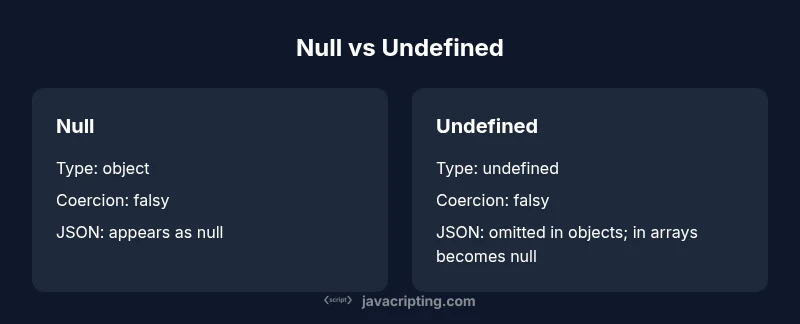
null vs undefined javascript: A practical comparison
Explore the differences between null and undefined in JavaScript, why they exist, and how to use them correctly. Learn best practices for comparisons, checks, and robust code.


null vs undefined javascript presents two distinct signals for absence in JavaScript. Null signals intentional emptiness, while undefined signals an uninitialized state. For robust code, prefer strict equality checks and explicit signals like null over loose comparisons. This quick contrast helps you reason about absence in common code patterns.
Understanding the core concepts: null and undefined in JavaScript
According to JavaScripting, the differences between null and undefined in JavaScript hinge on signaling absence vs uninitialized state. In JavaScript, null is a deliberate assignment signaling missing content, while undefined typically indicates that a value has not been assigned yet or is missing from an object property. The pair exists due to historical decisions in the language, and understanding their semantics improves error handling, data validation, and API design. Understanding null vs undefined javascript is essential for robust code.
In practice, you will see null used to indicate intentional emptiness, such as a field that is intentionally empty, while undefined appears when a variable is declared without initialization or when an object lacks a given key. This distinction matters for code readability and debugging because it helps you distinguish between an actual empty value and a missing value. Both values are falsy in boolean contexts, but they behave differently in checks and serialization. As you design data models, establishing a clear convention for when to supply null, leave a value undefined, or replace with a default improves maintainability and reduces surprises for future developers. Teams that document and enforce a single policy tend to experience fewer guardrail errors when parsing or validating data.
In addition to signaling, remember that these values interact differently with language features such as JSON, property access patterns, and array indexing. For example, JSON.stringify preserves null but omits undefined properties in objects, and array elements with undefined become null in some contexts. Keeping these nuances in mind helps you write APIs that behave consistently across browsers and runtime environments.
wordCountPreview_1_1_2_3_4_5_6_7_8_9_10_11_12_13_14_15_16_17_18_19_20_21_22_23_24_25_26_27_28_29_30_31_32_33_34_35_36_37_38_39_40_41_42_43_44_45_46_47_48_49_50_51_52_53_54_55_56_57_58_59_60_61_62_63_64_65_66_67_68_69_70_71_72_73_74_75_76_77_78_79_80_81_82_83_84_85_86_87_88_89_90_91_92_93_94_95_96_97_98_99_100_101_102_103_104_105_106_107_108_109_110_111_112_113_114_115_116_117_118_119_120_121_122_123_124_125_126_127_128_129_130_131_132_133-
Comparison
| Feature | null | undefined |
|---|---|---|
| Type | object (typeof null) | undefined |
| Equality with the other value (==) | true when compared to undefined | true when compared to null |
| Strict equality (===) | false when compared to undefined | false when compared to null |
| Boolean context | falsy | falsy |
| JSON serialization | In objects, null stays as null; undefined property is omitted | In objects, undefined properties are omitted; in arrays, both become null |
| Best use case | Explicit absence (null) | Uninitialized state or missing property |
Benefits
- Explicit signaling of empty values (null)
- Clear contrast with uninitialized state
- Improves readability with consistent conventions
- Supports robust defaults with predictable behavior
The Bad
- Potential confusion due to historic quirks
- Inconsistent usage across codebases
- Risk of accidental loose equality pitfalls
- JSON serialization nuances for undefined in objects
Null is preferred for explicit absence; undefined signals an uninitialized state.
Adopt a consistent convention across your project. Favor strict equality, and use null for missing values while treating undefined as uninitialized. Document the convention to help future maintainers.
Questions & Answers
What is the difference between null and undefined in JavaScript?
Null is an intentional absence value placed in variables or object fields. Undefined means a value has not been assigned yet. They are distinct signals and should be treated differently in code.
Null signals intentional emptiness, while undefined means not set yet; use strict checks to differentiate.
When should I use null instead of undefined?
Use null when you want to explicitly indicate that a value is intentionally absent. This makes the absence explicit and easier to validate.
Use null to signal intentional absence.
Is typeof null the same as typeof undefined?
No. typeof null returns 'object', which is a historical quirk, while typeof undefined returns 'undefined'. This matters when writing type checks.
No, null is 'object'; undefined is 'undefined'.
How do null and undefined behave in JSON?
Null appears as null in JSON. Undefined properties are omitted from objects; in arrays, undefined becomes null.
In JSON, null stays as null; undefined is omitted in objects and becomes null in arrays.
How can I check for undefined in nested objects safely?
Use optional chaining (?.) and nullish coalescing (??) to provide safe defaults when values may be undefined or null.
Use optional chaining and ?? to safely handle undefined.
What are practical guidelines for a project wide policy?
Document in the project guidelines whether you prefer null or undefined for absence and ensure consistent use across modules.
Document a consistent policy for absence signaling.
What to Remember
- Define a consistent rule for null vs undefined
- Use strict equality (===) to avoid coercion
- Prefer null for missing values in APIs and data models
- Leverage ?? and ?. for safe defaults
- Document conventions in project guidelines to ensure maintainability