undefined vs null javascript: A Practical Guide
An analytical, practical guide to undefined vs null javascript. Explore definitions, typeof behavior, equality checks, and best practices for initialization, API design, and data validation in modern JavaScript.


undefined and null are two distinct concepts in JavaScript. This quick comparison explains their differences, how typeof reports them, and when to rely on each in common coding patterns. By understanding undefined vs null javascript, you can write clearer checks, avoid surprising truthy/falsey values, and reduce bugs in your codebase.
Understanding undefined vs null javascript concepts
Defined as separate values in JavaScript, undefined and null carry different semantics and intentions. According to JavaScripting, the practical distinction hinges on intent and data modeling rather than arbitrary defaults, so adopting a consistent convention matters for readability and bug avoidance. The JavaScripting team found that many developers conflate the two, assuming they are interchangeable for missing values. In this section, we outline the core definitions, lifecycle, and how they influence variable initialization, property access, and API results. By the end, you should be able to describe when each should appear in your code and how to document your conventions for undefined vs null javascript.
The nature of undefined in JavaScript
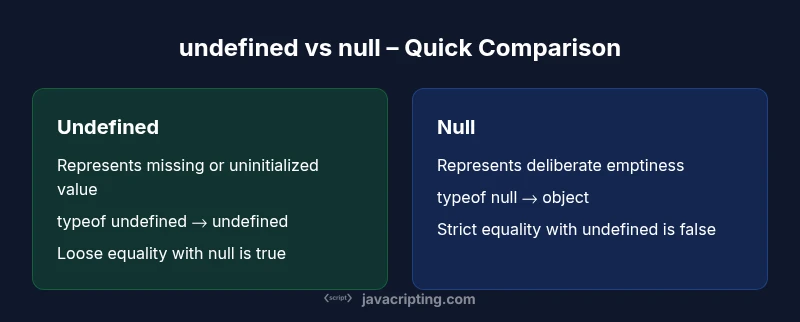
undefined is a primitive value that signals a variable has been declared but not assigned a value, or a missing property. It is often the default state of uninitialized variables and function parameters that did not receive an argument. In practical terms, accessing an absent property on an object typically yields undefined. The expression typeof undefined evaluates to the string "undefined", which helps differentiate it from other values during type checks. Understanding undefined is essential for writing robust initialization logic and for defensive programming, especially when dealing with optional object shapes or API responses.
This concept also interacts with hoisting and variable declarations in non-strict mode, where reading an uninitialized variable can lead to undefined results. While undefined is a value, it is not a value you generally assign intentionally; rather, it arises from lack of initialization or absent properties. Grasping this nuance is key to predicting runtime behavior and crafting clean API surfaces that communicate intent clearly.
The nature of null in JavaScript
Null is a primitive value that explicitly represents the intentional absence of any object value. It is a deliberate assignment to indicate that a value has been intentionally
- an empty placeholder. Unlike undefined, null is typically used to signal that a variable or property has been deliberately emptied or reset. The expression
typeof nullfamously returns "object" due to historical reasons, which means you must treat the type as a special case in type checks and validations. In practice, null is often used in APIs, database results, or UI state to denote "no value" in a controlled and explicit way, making it easier to test for emptiness and to differentiate from truly uninitialized variables.
Equality and comparison: == vs === in the undefined vs null javascript context
JavaScript provides two equality operators: loose equality (==) and strict equality (===). When comparing undefined and null, undefined == null evaluates to true, which can be surprising if you expect them to be distinct signals. With strict equality, undefined === null evaluates to false, reflecting their different types and identities. This distinction drives many practical decisions: use == carefully when you want a loose notion of emptiness, or prefer === for precise checks, such as if (x === undefined) or if (x === null). Knowing these nuances helps prevent subtle bugs that slip in when truthy/falsy logic is involved in the undefined vs null javascript space.
Practical patterns and pitfalls in real-world code
In practice, many codebases adopt a convention: use undefined for missing values that arise from the language itself, and use null when a value is intentionally cleared by the program or API contract. This separation supports clearer data modeling and easier validation in JSON payloads, form handling, and API responses. A common pitfall is treating both as interchangeable in conditionals, which can lead to unexpected truthy/falsy behavior and brittle checks. Another pitfall involves JSON serialization—undefined values are typically omitted, whereas null is preserved, which affects API schemas and data interchange. Establishing a team-wide convention and documenting it reduces these failures in the undefined vs null javascript landscape.
Best practices for initialization, defaults, and API design
A robust approach starts with an explicit contract: decide how your API signals missing versus empty data and apply that consistently across the codebase. If you model optional fields with a default, you might favor undefined for parameters and null for explicit emptiness sent by servers. When validating inputs, check for undefined or null at the boundaries of your API and use guards or helper utilities to convert ambiguous values to well-defined defaults. Writing unit tests that cover both signals reduces regressions and clarifies the intended use of undefined vs null javascript in your project.
Debugging tips and practical checks for the undefined vs null javascript space
When debugging, prefer precise checks rather than loose truthiness tests. Use typeof for a quick sanity check on undefined, and rely on strict comparisons for null. If you encounter unexpected results, log both the value and its type: console.log(value, typeof value). Remember that many frameworks have their own handling for missing values; always verify how they treat undefined and null in lifecycle methods, data-fetch hooks, and form controls. A small set of utilities that normalize values at API boundaries can prevent a cascade of undefined vs null javascript issues later in the call chain.
Real-world examples: forms, APIs, and state management
Consider a form where a missing field is optional: you might receive undefined when the user has not interacted with it yet, and null when the user intentionally clears it. In API responses, a field may be absent (undefined) or explicitly empty (null), depending on server design. In front-end state management, distinguishing between undefined and null helps you determine whether to render placeholders, show validation messages, or apply default values. Across these scenarios, consistent handling of undefined vs null javascript promotes reliability and predictability in user interfaces and data flows.
Comparison
| Feature | undefined | null |
|---|---|---|
| JavaScript typeof result | "undefined" | "object" |
| Value semantics | Represents missing value or uninitialized state | Represents deliberate emptiness or cleared value |
| Loose equality (==) outcome | true | true |
| Strict equality (===) outcome | false | false |
| Common use cases | Signals missing/undefined data in variables | Signals intentional absence in API data |
Benefits
- Clear signaling of missing vs explicit absence
- Supports safer default handling with consistent conventions
- Improves API contracts and data validation
- Encourages intentional data modeling across modules
- Facilitates defensive programming patterns
The Bad
- Can confuse newcomers due to nuanced semantics
- Equality checks require care to avoid bugs
- Null/undefined can cascade through code if not handled
- Overusing one signal may hide intentional design choices
undefined vs null javascript: choose based on intent and API contract
The JavaScript value semantics rely on intent. undefined signals uninitialized state, while null marks deliberate emptiness. The JavaScripting team recommends adopting a consistent convention and documenting it across the codebase to avoid common pitfalls and improve data validation.
Questions & Answers
What is the difference between undefined and null in JavaScript?
undefined is a primitive value signaling that a variable has not been assigned yet. Null is an intentional absence of any object value. They convey different intents, and understanding this helps with clearer checks and data modeling.
Undefined means not assigned yet, null signals intentional emptiness. Use them to express distinct intentions in your code.
How does typeof handle undefined vs null?
typeof undefined returns 'undefined', while typeof null returns 'object' due to historical reasons. These results influence how you test values in code and should guide your checks during validation.
Typeof undefined is 'undefined', but Typeof null is 'object' because of legacy behavior.
When should I return undefined in a function?
Returning undefined is common when a function cannot determine a value or when an optional value is not provided. However, returning null can be clearer to indicate an explicit absence, depending on your API contract.
Return undefined when a value is missing due to lack of input; return null when you want to signal explicit emptiness.
When should I return null instead of undefined?
Use null when you want to explicitly indicate an empty result or a deliberate reset. Undefined is often used to indicate a missing value due to uninitialized state or omitted parameters.
Use null for explicit emptiness, undefined for missing values due to omission or uninitialized state.
Does JSON.stringify handle undefined values?
JSON.stringify omits undefined values in objects, but will serialize null values. This behavior matters for API payloads and data interchange where explicit emptiness must be preserved.
Undefined fields disappear in JSON, while null fields stay visible.
Are undefined and null compatible with TypeScript?
TypeScript recognizes both as distinct types and allows strict null checks to help you model optional properties. You can configure compiler options to enforce explicit handling of null or undefined.
In TypeScript, you can enable strict null checks to manage both undefined and null carefully.
What to Remember
- Define clear rules for when to use undefined or null
- Prefer strict checks (===) for precise signaling
- Document conventions in API contracts and codebases
- Differentiate between missing data and explicit emptiness
- Guard against loose equality pitfalls with explicit comparisons