Javascript Map vs Object: A Practical Comparison for JS Developers
An analytical comparison of JavaScript Map vs Object, detailing key differences, iteration behavior, performance considerations, and best-use scenarios for aspiring developers and professionals.


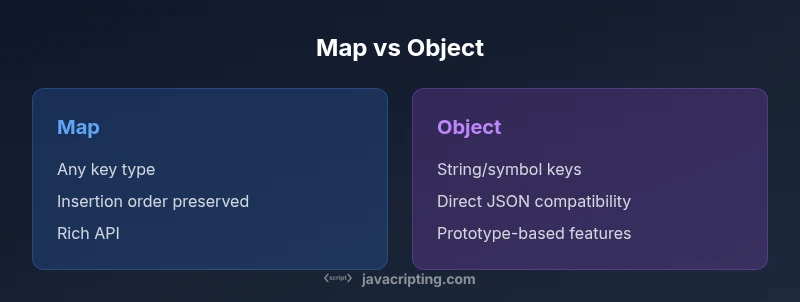
Map and Object are the two primary containers for key-value pairs in JavaScript. For many modern scenarios, Map offers consistent iteration order, flexible key types, and a richer API, while Object remains ideal for plain data structures and JSON-like payloads. According to JavaScripting, map usage shines when keys aren’t strings and when you need predictable size and iteration.
Core concepts: Understanding Map and Object in JavaScript
Map and Object are two primary containers for key-value pairs in JavaScript. The javascript map vs object comparison is central to building robust data layers, configuration stores, and dynamic registries. A Map is a collection where every entry has a key and a value, and keys can be of any type. An Object is a plain data structure with string or symbol keys and a prototype, which affects enumeration and inheritance. For aspiring developers, understanding when to favor Map over Object—or vice versa—helps reduce bugs and improve clarity. The JavaScript ecosystem, including JavaScripting, has matured patterns that surface when you treat Maps as first-class maps and Objects as simple records. In practice, the decision hinges on key types, iteration needs, API surface, and how you intend the data to evolve over time.
Key differences at a glance
The map vs object dichotomy reveals several practical distinctions that influence daily coding decisions. First, Maps support keys of any type, including objects, functions, and primitives, whereas standard Objects use string or symbol keys. Second, Maps expose a built-in size property and a rich API (set, get, has, delete, clear) that makes common tasks explicit. Objects rely on Object.keys or for...in loops for enumeration and do not have a native size counter. Third, iteration order in Maps is defined by insertion, which is predictable and stable across engines; Objects have an order that depends on the key type and engine, particularly with numeric keys. Fourth, Maps are typically slower to instantiate for very small data sets due to over-featured API surface, while Objects are lighter-weight for simple structures. Overall, the choice should reflect your data model, performance expectations, and the needs of serialization and interop.
Comparison
| Feature | Map | Object |
|---|---|---|
| Key types | Keys can be any value (objects, functions, primitives) | Keys are strings by default; symbols are supported; non-string keys through workarounds |
| Order of iteration | Insertion order is preserved and well-defined | Enumeration order is implementation-dependent for non-integer keys |
| Size | map.size provides a native size | No native size; use Object.keys(obj).length |
| API surface | Rich API: set, get, has, delete, clear, etc. | Plain property access and standard object methods |
| Serialization | Direct JSON serialization is not supported; convert to array/object first | Direct JSON serialization is straightforward for plain data |
| Memory and performance | Overhead due to dynamic API surface; generally robust for dynamic collections | Lighter weight for static, JSON-like data; faster for simple reads/writes in small objects |
| Best for | Dynamic, heterogeneous key-value stores with frequent insertions | JSON-like records and simple configurations |
Benefits
- Flexible keys and robust iteration in Map
- Explicit API with size and clear/delete methods
- Maps model dynamic registries and caches naturally
- Objects align with JSON-like data and simple records
The Bad
- Maps introduce overhead for very small static datasets
- Direct JSON serialization is easier with Objects
- Maps can be more verbose for simple shapes
Maps are the better choice for dynamic, heterogeneous key-value stores; Objects excel for simple, JSON-like data structures.
If your data needs arbitrary keys and insertion order, choose Map. If you primarily exchange JSON and have simple shapes, Objects are easier to work with.
Questions & Answers
What is the main difference between Map and Object in JavaScript?
Maps support key types beyond strings and provide a consistent API; Objects are plain records with string keys. The Map API makes dynamic collections easier to manage, while Objects are more natural when working with JSON-like data.
The main difference is how keys are treated and how you interact with the structure; Map supports flexible keys, while Object is best for JSON-like data.
Can you use non-string keys in Map?
Yes. Maps accept keys of any type, including objects, functions, and numbers. This makes Maps ideal for complex associations beyond simple string keys.
Yes, Maps let you use any value as a key, including objects.
Which is faster for lookups, Map or Object?
Performance depends on context, but both structures are optimized for typical use cases. Maps often show predictable performance for dynamic key sets, while Objects excel with simple property lookups in JSON-like data.
Performance depends on the workload, but Maps handle dynamic keys well and Objects excel at simple property access.
How do you iterate over Map vs Object?
Map provides for...of iteration and .forEach for entries. Objects use Object.keys/Object.entries with for...of loops or for...in. Maps preserve insertion order; Objects' order is more nuanced and engine-dependent for certain key types.
Use for...of on Map with map.entries, and Object.entries for Objects.
Can Map be serialized to JSON?
Maps cannot be serialized directly with JSON.stringify. You must convert a Map to an array of pairs or to an Object first.
No, Map can't be serialized directly; convert it to an array or object first.
When should I choose Map over Object in real projects?
Choose Map for dynamic, heterogeneous key sets and when you need built-in utilities like size and clear. Choose Object for JSON-like data, configuration records, and when you want straightforward serialization.
Pick Map for dynamic keys; Object for JSON-like data and simple records.
What to Remember
- Evaluate key-type requirements before choosing a structure
- Map supports any key type and preserves insertion order
- Objects are ideal for JSON-like data and simple records
- Serialization needs matter: map-to-JSON requires transformation
- Benchmark with realistic data to confirm the best choice