Learn JavaScript React: A Practical Step-by-Step Guide
A thorough, action-oriented guide to learn javascript react, blending fundamentals with practical hands-on steps. Perfect for aspiring developers seeking confident, production-ready skills in React and modern JavaScript.


This guide will teach you how to set up a React project with JavaScript, build a simple component, and manage state and effects using hooks. You’ll work through a practical, hands-on path to learn javascript react, with real-world examples and best practices. By the end, you’ll be able to scaffold projects, compose reusable components, and understand how data flows through a React app.
What You’ll Learn
If you’re here to learn javascript react, you’re taking a practical path that blends core JavaScript concepts with React-specific patterns. This guide emphasizes building real-world skills: creating functional components, managing state with hooks, composing components for reuse, and wiring data flow through props and effects. You’ll also explore common patterns for handling asynchronous data and integrating simple APIs. Throughout, expect hands-on exercises, small projects, and frequent checks to ensure you truly grasp how React fits into the modern JavaScript ecosystem. The goal is not just to read about React but to actively apply it so you can confidently embark on practical projects and grow as a developer who can learn javascript react with clarity and purpose.
As you progress, you’ll notice that learning javascript react is as much about practice as theory. Expect to sketch component trees, think in terms of props and state, and debug with browser tools. The JavaScripting team emphasizes aligned practice: start small, iterate, and refactor as your understanding deepens. By maintaining a steady rhythm of coding and review, you’ll internalize patterns that recur across real-world apps.
By the end of this section, you should be able to articulate what React brings to the table, how component composition enhances maintainability, and how JavaScript concepts translate into UI behavior. This is the foundation you’ll reuse across every project you tackle as you continue to learn javascript react and expand your toolkit.
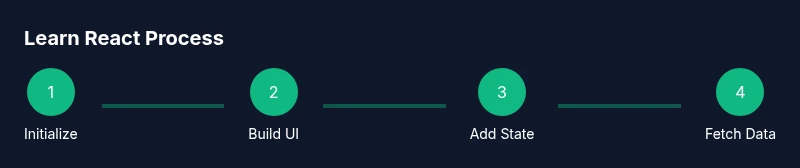
Key concepts you’ll encounter include: JSX syntax, function components, props, state management with useState, side effects with useEffect, and basic data fetching. You’ll also encounter best practices for readability, testing, and performance considerations as you deepen your understanding of how a React app behaves in the browser.
note?
Tools & Materials
- Node.js installed(Recommended latest LTS version; install from nodejs.org)
- npm or yarn(Comes with Node.js or install yarn separately if you prefer it)
- Code editor (e.g., VSCode, WebStorm)(Helpful for JSX highlighting and debugging)
- Web browser (Chrome/Edge/Firefox)(DevTools for debugging React apps)
- Terminal/command line access(Required for project setup and running dev server)
- Starter project files or a blank repo(Optional for quick start; you can scaffold your own)
Steps
Estimated time: Estimated total time: 2-3 hours
- 1
Initialize your React project
Create a new React project using a modern template. This establishes the project structure, configures the build pipeline, and prepares you to start coding. You’ll learn how to choose a template, install dependencies, and verify the setup runs locally.
Tip: Choose a template you’re comfortable with (e.g., Vite + React) to minimize boilerplate and maximize learning time. - 2
Run the dev server and verify your environment
Start the local development server and open the app in your browser to confirm everything is wired correctly. This step confirms your environment is ready to learn javascript react and gives you a live canvas for experimentation.
Tip: If your browser shows a blank page, check the console for module loading errors and verify that your port isn’t in use. - 3
Create a simple functional component
Add a new file for a basic React component using a function. Import React from 'react' (or rely on automatic JSX runtime), declare a function, return JSX, and export it. This introduces you to the core unit of React UIs.
Tip: Keep components small and focused; aim for single-responsibility components to simplify learning javascript react. - 4
Render the component in your app
Import the component into your main App file and render it. Ensure it appears on the page and that props can be passed to customize it. This demonstrates how components compose to build UI.
Tip: Double-check the import paths and ensure your component tree is correctly nested to avoid rendering issues. - 5
Add state with useState
Introduce local state to your component using the useState hook. Practice updating state in response to user interactions and observe how the UI reacts in real time.
Tip: Think in terms of data that affects rendering; state should reflect UI meaning, not arbitrary values. - 6
Introduce a side effect with useEffect
Use the useEffect hook to run code after render(s). You’ll learn how to perform actions like logging, data fetching, or subscribing to events without blocking the UI.
Tip: Remember to clean up effects if needed to avoid memory leaks. - 7
Pass props and compose a small child component
Create a child component and pass data through props. This demonstrates component composition and reusability, a cornerstone of scalable React apps.
Tip: Favor explicit prop names and default values to improve readability and maintainability. - 8
Fetch data from a public API
Integrate a simple fetch request inside useEffect, handle loading state, and render results. This introduces asynchronous logic and data flow within React.
Tip: Handle errors gracefully and show user feedback during loading. - 9
Review, refactor, and plan a small project
Review what you built, refactor for clarity, and outline a mini-project that uses what you learned. This reinforces practical mastery of learn javascript react concepts.
Tip: Document your design decisions to help future you and others pick up the project quickly.
Questions & Answers
What is React and why should I learn it?
React is a JavaScript library for building user interfaces through composable components. It helps manage UI state and render efficiently, making it a valuable skill for modern frontend development. Learning React also introduces patterns used across many frameworks, easing future transitions.
React lets you build UI with reusable components and state management, which is essential for modern web apps.
Do I need to know ES6 to learn React?
A basic understanding of modern JavaScript (ES6+) helps, especially features like let/const, arrow functions, destructuring, and modules. Many React examples assume familiarity with these concepts, though you can learn them alongside React.
Some modern JavaScript basics help, but you can learn them while you learn React.
Should I use class components or functional components?
Functional components with hooks are the current standard due to simplicity and better composability. Class components are still valid but aren’t recommended for new projects. Focus on functional components to align with current patterns.
Use functional components with hooks for new projects; class components are older patterns.
Can I learn React without a backend?
Yes. You can learn and build UI with mock data, static JSON, or public APIs. Focus on front-end concepts like components, state, props, and effects before integrating a backend.
Absolutely—start with mock data and publicly available APIs to practice.
Is React still relevant in 2026?
React remains widely used for building complex interfaces, with a rich ecosystem and community. It’s a solid investment for front-end developers seeking scalable patterns and strong job opportunities.
Yes, React is still a leading choice for modern web apps.
Watch Video
What to Remember
- Learn javascript react by building small, repeatable components
- Master basic hooks: useState and useEffect
- Embrace component composition for scalable UI
- Fetch and render data with simple error handling