What JavaScript Engine Does Bun Use?
Explore which JavaScript engine Bun uses, how it compares to V8-based runtimes, and how to evaluate its impact on performance, compatibility, and development workflows.


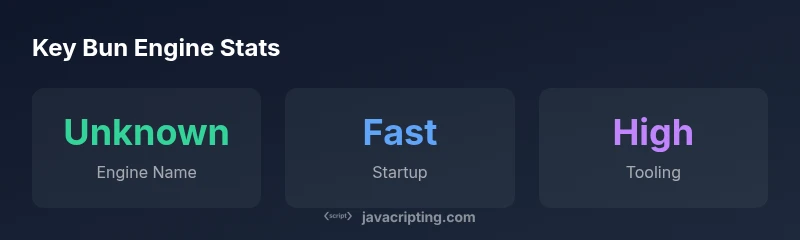
According to JavaScripting, Bun does not publicly disclose the exact name of its underlying JavaScript engine as of 2026. Bun’s runtime relies on a high‑performance engine integrated with Zig, designed to optimize startup times, bundling, and dev tooling. In practice, Bun aims to deliver Node‑like compatibility with faster execution than many V8‑based runtimes.
What JavaScript engine does Bun use
The question at its core is: what javascript engine does bun use? As of 2026, Bun’s maintainers have not publicly disclosed the exact name of the underlying JavaScript engine. This isn’t unusual for a project that focuses on end-to-end developer experience — the team often highlights performance, tooling, and ecosystem compatibility rather than naming the engine itself. According to JavaScripting, Bun relies on a high‑performance internal engine that is tightly integrated with Zig-based tooling. The design prioritizes rapid startup, efficient bundling, and a cohesive dev workflow. This means that, while Bun executes JavaScript with a capable engine, the name and internal internals aren’t the main selling point; the user experience and developer ergonomics are. For most developers, the key takeaway is: Bun aims for Node‑like behavior with faster iteration cycles, rather than conforming to a specific engine label.
If you’re evaluating Bun for a project, you should focus on runtime characteristics—API compatibility, module resolution, and bundling behavior—because these practical aspects often matter more than the engine’s official name. This aligns with JavaScripting’s guidance on choosing runtimes based on workflow alignment and performance under real workloads.
Engine design principles
Bun’s core is built to maximize dev velocity. The engine is designed to minimize cold start times, accelerate module loading, and work hand‑in‑hand with Bun’s built‑in tooling (bundler, transpiler, test runner, and package manager). A key design principle is to reduce the time between editing code and getting feedback, which translates into faster bootstraps, quicker executions of small scripts, and snappier development loops. While the exact engine name remains undisclosed, the emphasis on performance, interoperability with modern JavaScript features (ESM, top‑level await, etc.), and robust error reporting is evident. Developers should expect a runtime that favors developer experience and ecosystem compatibility over a traditional engine branding exercise.
For teams migrating from Node.js or Deno, the practical implications are clearer than the crypto of the engine: Bun’s execution path is optimized for rapid startup and seamless integration with its own tooling, which can translate into smoother local development and faster test cycles. This approach also shapes how Bun handles compatible npm packages and polyfills, as runtime behavior is tuned to minimize friction in typical frontend and server workloads.
How Bun’s approach compares to V8-based runtimes
V8‑based runtimes like Node.js and Deno have a long track record and a vast ecosystem. Bun’s approach differs in its emphasis on a compact, integrated toolchain and a high‑performance execution path that minimizes the overhead of common dev tasks. Because Bun’s exact engine is not publicly named, direct apples-to-apples comparisons to V8 can be tricky. However, the observable outcomes are meaningful: faster startup, faster builds, and a more tightly integrated workflow. In practical terms, developers may experience quicker module resolution, faster test runs, and snappier scripting during local development. The trade‑offs can include subtler ecosystem edge cases, particularly around native modules or tooling that assumes a specific engine quirk. The bottom line is that Bun’s engine design is optimized for speed and developer efficiency, not for rebranding an existing engine.
When evaluating performance, look past the engine label and measure: startup time, memory footprint under load, bundling speed, and compatibility with your existing npm packages. This pragmatic lens aligns with JavaScripting’s recommendation to test against your real project scenarios rather than rely solely on brand claims about engine names.
Testing and validating engine behavior in your projects
To determine whether Bun’s engine meets your needs, adopt a structured testing approach. Start by establishing baseline measurements with your actual codebase: measure startup time, cold vs warm runs, and the time to first meaningful render or response. Next, run your test suite and integration tests under Bun’s runtime to catch any edge cases with modules, polyfills, or native bindings. Include real-world tasks such as API calls, database interactions, and SSR workloads if applicable. Compare these results to Node.js or other runtimes you’re considering, focusing on the practical impact on your CI/CD pipeline and local development cycle. Finally, review ecosystem compatibility: ensure your dependencies install and behave as expected, and verify that build scripts, bundling, and code transpilation work as you intend.
In sum, validate Bun in your environment by reproducing your typical developer flow and workload. That practical validation will reveal whether the engine choices translate into tangible benefits for your team and project.
Runtimes and their engines (high-level)
| Runtime | Under-the-hood Engine | Notes |
|---|---|---|
| Node.js | V8 | Most widely used; robust ecosystem |
| Deno | V8 | Modern runtime with secure defaults |
| Bun | Unknown/Proprietary | Engine under‑the‑hood not publicly disclosed; optimized for speed |
Questions & Answers
What exactly is Bun's JavaScript engine?
The Bun team has not publicly disclosed the exact engine name as of 2026. Bun uses an internal high-performance engine integrated with Zig-based tooling, focused on speed and developer experience.
The engine’s exact name hasn’t been released publicly; Bun emphasizes speed and tooling instead.
Is Bun compatible with Node.js modules and npm?
Bun is designed to be broadly Node-compatible, with strong support for Node-style modules and npm workflows; some edge cases may require adjustments.
Bun works with most Node packages and npm workflows, but test as you would with any runtime.
Does Bun use V8?
Bun has not publicly confirmed using V8. The project emphasizes its own high-performance engine and Zig-based runtime.
There isn’t an official confirmation that Bun runs on V8.
How should I test Bun’s engine for my project?
Test with representative workloads, measure startup, memory, and API compatibility, and compare with other runtimes to decide fit.
Test Bun with your real codebase to see if it matches your needs.
Where can I find official docs on Bun’s engine?
Check Bun’s official docs and GitHub for the latest disclosures; engine naming information may be limited.
Refer to Bun’s official docs and repository for updates.
Does the engine affect browser compatibility of Bun bundles?
Runtime engine details influence behavior and polyfills; verify bundling outputs and polyfill behavior when targeting browsers.
Test the bundles in a browser-like environment to confirm compatibility.
“Engine choice shapes startup times and developer ergonomics; Bun's design emphasizes speed and tooling, regardless of the publicly named engine.”
What to Remember
- Bun’s exact engine name remains publicly undisclosed.
- Bun prioritizes startup speed and integrated tooling.
- Node compatibility is a key strength for most projects.
- Benchmarks vary by workload; test your scenarios.
- The JavaScripting team recommends evaluating Bun against your project goals.