javascript and or: A Practical Comparison of Logical Operators
Explore javascript and or operators with an analytical, objective comparison. Learn syntax, truthiness, short-circuit behavior, and best practices for frontend development with JavaScripting insights.


javascript and or are two foundational logical operators in JavaScript. This TL;DR compares their evaluation rules, return semantics, and practical usage to help you write safer, clearer code. By understanding when each operator short-circuits and what they return, you’ll reduce bugs and improve readability in real-world apps. See our detailed charts and examples for deeper guidance.
Overview: The Role of AND and OR in JavaScript
In the world of JavaScript, the operators AND (&&) and OR (||) are more than boolean gates. They are value-returning tools that perform short-circuit evaluation and expose how truthiness works in real code. This section introduces the concepts and establishes why understanding javascript and or matters for frontend proficiency. The JavaScripting team emphasizes that these operators influence control flow, defaults, and error handling. Grasping their semantics early helps you write idiomatic, efficient code that stays readable as projects grow. This guide uses concrete examples, avoids vague abstractions, and keeps a practical focus on everyday development tasks. It also highlights how truthiness and short-circuiting interact with common patterns such as guarding, defaulting, and conditional expressions.
Syntax and Semantics
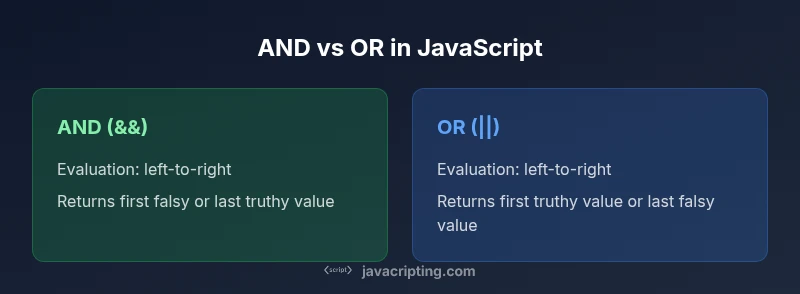
Both && and || share syntax with familiar boolean operators, but their return semantics differ from strict boolean logic. The AND operator evaluates left to right and returns the first falsy value it encounters; if all operands are truthy, it returns the last evaluated value. The OR operator also evaluates left to right but returns the first truthy value it sees; if all operands are falsy, it returns the last value. In practice this means you can leverage these operators to gate code paths, assign defaults, or propagate meaningful values rather than simple true/false results. This section explains how to read and write expressions like a && b and x || y with confidence, including common edge cases that arise when operands aren’t booleans.
Truthiness and Falsy Values in JavaScript
JavaScript treats many values as truthy or falsy, which directly affects how && and || behave. Truthy values include non-empty strings, non-zero numbers, objects, and arrays; falsy values include false, 0, '', null, undefined, and NaN. When you use a logical operator, JavaScript coerces operands to boolean for evaluation, but returns the actual operand values, not necessarily a boolean. Understanding this nuance is essential for mastering patterns like defaulting and guarding in complex UI logic.
Short-Circuit Evaluation: How It Works in Practice
Short-circuiting is a core feature of both operators. With AND, if the left-hand side is falsy, JavaScript stops evaluating and returns that value, preventing potential side effects from evaluating the right-hand side. With OR, if the left-hand side is truthy, evaluation stops and returns that value, enabling concise fallback logic. This behavior supports practical patterns such as early returns in functions, guarded property access, and clean defaults. However, you must be mindful of side effects in the right-hand expressions, as they may never run under short-circuit.
Practical Use-Cases: Guard Conditions, Defaults, and More
A common use of && is to guard access to properties or methods: const userName = user && user.name; This ensures you don’t access nested properties on undefined. For defaults, || is a natural fit: const port = process.env.PORT || 3000; If PORT is falsy, 3000 is chosen. Both operators can also be chained to build compact, readable conditions. When combining them, preserve the intent: readability should trump cleverness, especially in team environments.
Common Pitfalls and How to Avoid Them
One frequent pitfall is assuming the operators always return boolean values. Remember, they return operand values, which can lead to unexpected types downstream. Another issue is relying on falsy values like 0 or '' as defaults when that behavior is not desired. Avoid mixing non-boolean operands without explicit conversions. Finally, long chains can hamper readability; prefer named helper functions or clearer branching when in doubt.
Performance and Readability in Real Apps
In modern engines, the performance difference between using && and || for simple guards or defaults is negligible. The real impact is readability and maintainability. Favor explicit patterns where complexity grows: break complex boolean expressions into well-named variables or small helper functions. This improves maintainability, makes your intent obvious, and reduces cognitive load for future maintainers.
Cross-Context Behavior: Browser vs Node.js
Across browsers and Node.js, the fundamental truthiness rules and short-circuit semantics are consistent, which supports cross-platform code as long as you rely on standard behavior. Differences typically arise from non-boolean operands or environment-specific side effects rather than the operators themselves. Always test in the target runtime and avoid environment-specific quirks by keeping expressions simple and predictable.
Best Practices for Clear and Maintainable Code
Adopt these practices: prefer explicit boolean checks when clarity is essential, use && for guarded access with minimal side effects, and use || for safe defaults when a value could be falsy. Document your intended semantics, and avoid overloading operators with multiple responsibilities in a single expression. When in doubt, refactor into named variables or small functions to reveal intent and reduce risk.
Decision Guide: Which Operator to Use When
Rule of thumb: use AND when all conditions must be true for a path to execute, and use OR when any one condition should allow a path. Consider the types of values involved and the importance of readability. If a chain becomes ambiguous, split it into discrete statements or helper functions to preserve intent and reduce mistakes.
Comparison
| Feature | AND (&&) | OR (||) |
|---|---|---|
| Primary behavior | Returns the first falsy operand or the last operand if all truthy | Returns the first truthy operand or the last operand if all falsy |
| Evaluation order | Left to right, stops on first falsy value | Left to right, stops on first truthy value |
| Common use cases | Guard clauses, access checks | Defaults, fallbacks |
| Return type | Value of one of the operands (not necessarily boolean) | Value of one of the operands (not necessarily boolean) |
| Best for | Guarding logic and conditional execution | Providing defaults and fallbacks |
| Pitfalls | Misinterpreting return values as booleans | Overly clever chaining can hurt readability |
Benefits
- Enables concise, readable guard patterns
- Allows natural defaulting without extra boilerplate
- Returns meaningful non-boolean values for composition
- Supports short-circuiting to avoid unnecessary work
The Bad
- Return values are not guaranteed to be boolean; can confuse callers
- Chaining can hurt readability if overused
- Non-obvious behavior with non-boolean operands
AND and OR are complementary tools for controlling flow and value propagation
Use AND to require all conditions; use OR to provide a fallback when any condition is true. Favor readability and explicit intent over clever shorthand, especially in teams.
Questions & Answers
What is the difference between && and || in JavaScript?
&& evaluates left to right, returning the first falsy value or the last truthy value. || also evaluates left to right, but returns the first truthy value or the last value if all are falsy. They do not coerce to booleans unless you explicitly compare.
AND returns the first falsy value or last truthy one; OR returns the first truthy value or last falsy if none are truthy.
Do these operators always return boolean results?
No. They return one of the operands themselves, which can be non-boolean values. This is why patterns like a && b or x || y often rely on value semantics rather than pure booleans.
No, they return an operand, not necessarily true or false.
Can I use these operators with non-boolean values safely?
Yes, but you should be deliberate about what truthiness means for your values. If you need an explicit boolean, compare with a boolean expression like Boolean(value).
Yes, but be explicit if you need a boolean result.
What are common mistakes with short-circuiting?
Treating return values as booleans, overcomplicating expressions, and ignoring potential side effects in the right-hand side. Prefer clear, named variables to maintain readability.
Watch out for non-boolean returns and side effects.
How do I combine && and || without confusion?
Break complex expressions into smaller parts or use helper functions. Clear naming and comments help ensure intent remains obvious.
Split complex logic into parts for clarity.
How do && and || interact with ?? (nullish coalescing)?
?? has higher precedence than || but lower than &&, so it’s important to understand operator precedence or use parentheses to express the intended order of evaluation.
Mind operator precedence with ?? alongside && and ||.
What to Remember
- Prioritize readability over cleverness
- Leverage short-circuiting for guards and defaults
- Remember: operands may be non-boolean values
- Test with real-world data to confirm return semantics
- Document intent when using complex chains