javascript for of vs for in: A Practical Side-by-Side
A detailed, analytical comparison of javascript for of vs for in, with clear guidance on when to use each, common pitfalls, and practical code examples for arrays, objects, maps, and strings. Learn robust iteration patterns for modern JavaScript in 2026.


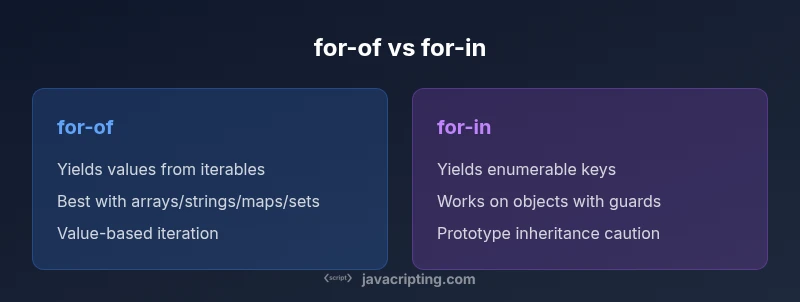
javascript for of vs for in are two core loop constructs in JavaScript. The for-of loop iterates over values from an iterable, while the for-in loop enumerates enumerable property names on objects. Understanding their intent, limitations, and safe usage helps prevent bugs when working with arrays, objects, and other iterable data structures.
Core concepts: what for-of and for-in do
javascript for of vs for in is a classic topic in frontend JavaScript development. For newcomers and seasoned developers alike, misusing these loops leads to subtle bugs and inconsistent results. This section lays out the foundational differences: for-of pulls values from an iterable, such as arrays and strings, while for-in traverses enumerable properties on objects (including properties inherited through the prototype chain). Throughout the discussion, you’ll see how the two constructs align with the language’s iteration protocol and how modern engines optimize typical use cases. According to JavaScripting, choosing the right loop construct is essential for robust JavaScript code. This emphasis on correctness benefits aspiring developers, frontend enthusiasts, and professionals who aim to write maintainable, predictable iterations in real projects. Expect concrete examples, best-practice caveats, and a practical decision framework for javascript for of vs for in.
The semantics of for-of: values, iterables, and Symbol.iterator
The for-of statement operates on any object that adheres to the iterable protocol. In practical terms, this means arrays, strings, maps, sets, and other objects that implement the Symbol.iterator method. When the loop runs, the engine calls the iterator and repeatedly yields values until the iterator is exhausted. A key implication is that for-of is about values, not keys or indices. This makes for-of particularly natural for lists where you care about the actual elements rather than their property names. For example, iterating over an array with for-of yields each element directly. When dealing with strings, for-of yields characters, which is often more convenient than indexing. In the context of javascript for of vs for in, the for-of approach aligns with value-centric workflows and reduces the risk of off-by-one or undefined index pitfalls.
The semantics of for-in: keys, prototypes, and hasOwnProperty
In contrast, for-in walks the enumerable property keys of an object. It traverses the keys present on the object itself as well as any enumerable keys inherited from the prototype chain. That inheritance aspect is the crux of the caveat with for-in: you may access keys you didn’t define directly, which can surprise developers who expect a strict own-property enumeration. Because of this, safe usage often involves filtering with hasOwnProperty or Object.prototype.hasOwnProperty.call(obj, key) to ensure only own properties are processed. For-in is particularly convenient when you need to enumerate property names of plain objects, but the need to guard against inherited properties makes it less straightforward for general iteration over data structures that resemble arrays.
Arrays and strings: how each loop behaves
When the data structure is an array, for-of is typically the clearer choice because it yields values in order, without exposing indices directly. However, for-in can still iterate over an array’s enumerable properties, including any added properties, but this is usually undesirable for standard array processing. For strings, for-of yields individual characters, which is often more ergonomic than looping over indices. If your task is to inspect string content or to split it into characters, for-of shines. Conversely, for-in will enumerate string properties (which are mostly indices and additional metadata), but it’s not the intended pattern for string iteration. Understanding these subtleties helps you select the most appropriate approach for a given data shape.
Objects: enumerating properties safely
Objects are the canonical use case for for-in, but only when you’re mindful of what is enumerable and what isn’t. The safest pattern is to enumerate only own properties, either by wrapping the for-in loop with a hasOwnProperty check or by using Object.keys(obj) and iterating that array. Using Object.keys(obj) guarantees you’re looking at keys you defined, avoiding surprises from the prototype chain. In javascript for of vs for in, this distinction matters: for-of does not iterate object properties by default, so you use it with Object.values or Object.entries when you need value-oriented or key-value access for objects.
Maps, Sets, and other iterables: for-of compatibility
Beyond plain objects and arrays, many modern data structures—Maps, Sets, and custom iterables—support the iterable protocol, making for-of the natural choice for value iteration across these types. Maps provide [key, value] pairs via entries(), but using for-of directly on a Map yields the values unless you explicitly iterate over entries. Sets yield values directly. If you’re consolidating heterogeneous data, for-of provides a uniform method to traverse the payload without worrying about property names. In the broader scope of javascript for of vs for in, this uniformity reduces cognitive load when dealing with different iterable sources. This is one of the reasons many developers prefer for-of for typical iteration tasks.
Performance considerations and engine differences
Performance characteristics for for-of and for-in depend on the engine, data shape, and how the code is written. In practice, for-of tends to be efficient for arrays and other iterables because engines implement optimized iterators and avoid prototype chain scans. For-in performance can vary: enumerating object keys with inherited properties may incur additional checks, and if you’re filtering with hasOwnProperty on every iteration, you may incur a small overhead. JavaScript engines have matured since earlier years, and the differences are often negligible for small data sets. However, in hot paths, micro-benchmarks in your target environment are essential. JavaScripting analysis shows that making assumptions about performance without real measurement can lead to misguided refactors in javascript for of vs for in scenarios.
Common pitfalls and anti-patterns
A frequent error is using for-in to iterate arrays as if it were array indexing, which leads to unexpected results and brittle code. Another pitfall is forgetting to guard for-in against inherited properties, causing bugs when iterating objects that share prototypes. In addition, using for-of with non-iterable values throws a TypeError, underscoring the need to validate the input type beforehand. A practical pattern is to verify the data structure before looping: if (typeof obj[Symbol.iterator] === 'function') { for (const v of obj) { ... } } or to convert objects to arrays with Object.values/Object.entries when needed. These precautions are common in production-grade code and align with best practices promoted by the JavaScripting team.
Practical examples: real-world snippets
Code examples help crystallize the distinctions between javascript for of vs for in. Consider a typical object with nested properties and a simple array:
const nums = [10, 20, 30];
for (const n of nums) {
  console.log(n); // 10, 20, 30
}

const obj = { a: 1, b: 2, c: 3 };
for (const key in obj) {
  if (Object.prototype.hasOwnProperty.call(obj, key)) {
    console.log(key, obj[key]); // a 1, b 2, c 3
  }
}
In this snippet, for-of yields values from an iterable, while for-in enumerates own keys guarded by hasOwnProperty. When you need both key and value from an object, a common pattern is to use Object.entries(obj) with for-of:
for (const [key, value] of Object.entries(obj)) {
  console.log(key, value);
}
These patterns illustrate the practical choices you make in javascript for of vs for in real code and how to avoid common mistakes.
Best practices and a decision guide
To decide between javascript for of vs for in, start from the data shape. If you’re iterating over an array or any iterable, prefer for-of for its clarity and value-centric iteration. If you need property names from objects, and you’re certain you want only own properties, use for-in with a guard or use Object.keys/Object.entries for explicit keys. For maps and sets, for-of is the straightforward choice, and for a Map you’ll typically use for (const [k, v] of map) to access both sides.
- Prefer for-of for values when iterating iterables.
- Prefer for-in only for enumerating object keys, with guard.
- When you need both keys and values from an object, prefer Object.entries(obj) with for-of.
- Always test your iteration code with typical real-world inputs and edge cases.
- Consider readability and future maintenance as primary criteria when choosing between javascript for of vs for in.
Transitioning from for-in to for-of in existing codebases
If you’re refactoring legacy code, focus on rewriting loops that rely on numeric indices or key enumeration into more expressive and robust patterns. Start with straightforward cases like arrays and strings, replacing for-in with for-of where possible. For object key enumeration, replace for-in with Object.keys and a for-of loop, or preserve for-in with a strict hasOwnProperty guard if you must maintain compatibility with older patterns. Maintain tests that verify the exact keys enumerated and the resulting values. This transition reduces the risk of accidentally processing inherited properties and aligns code with modern JavaScript practices.
Practical testing and debugging tips
Test loop behavior with representative data: arrays of numbers, strings, plain objects, objects with prototype augmentation, and Maps/Sets. Use simple console outputs to verify the exact values or keys produced by each loop. When debugging, log typeof checks and property ownership to confirm correct iteration semantics. In production, rely on unit tests that assert the set of values produced by for-of and the exact keys produced by for-in, including edge cases involving inherited properties. These debugging practices are especially important in large codebases where subtle iteration differences can cascade into bugs across modules.
Comparison
| Feature | for...of | for...in |
|---|---|---|
| Iteration target | yields values from iterables (values) | yields enumerable property names (keys) |
| Iterable requirement | works with any iterable (arrays, strings, maps, sets, custom iterables) | works with objects, enumerating keys (own and inherited) |
| Property scope | focus on values; not about object properties | focus on keys; includes inherited keys unless filtered |
| Guarding | no own-property checks needed for value iteration | often requires hasOwnProperty guard or Object.keys/entries |
| Best use case | iterating values from arrays, strings, maps, sets | enumerating object keys with care for own properties |
| Typical pitfalls | compatibility with non-iterables raises errors | inherited properties can leak into results without guards |
| Performance guidance | engine optimizations for iterables; generally efficient | depends on prototype chain and guards; measure in your environment |
Benefits
- For-of provides value-centric iteration across any iterable
- For-in is concise for enumerating object keys when safe
- Using for-of with Object.values/Object.entries simplifies object processing
- Maps and Sets integrate naturally with for-of
The Bad
- For-in can expose inherited properties without guards
- For-of requires a valid iterable; non-iterables throw errors
- Using for-in with arrays can lead to unexpected keys if extended properties exist
- Guarding with hasOwnProperty adds boilerplate or extra calls
For-of is generally the safer default for iterables; use for-in only for own-property enumeration with guards.
In most scenarios, choose for-of when iterating values. Reserve for-in for object keys with proper guards or use Object.keys/Object.entries for explicit ownership checks.
Questions & Answers
What is the main difference between for-of and for-in?
The for-of loop iterates over values from an iterable, while for-in enumerates enumerable property keys on an object (including inherited ones). The former is value-focused; the latter is key-focused with prototype caveats.
For-of gives you values from an iterable; for-in gives you property keys, including inherited ones, so guard accordingly.
When should I use for-of instead of for-in with arrays?
Use for-of when you need the actual elements of an array. It avoids index handling and off-by-one mistakes and works cleanly with other iterables as well.
Use for-of for arrays to get the elements directly without worrying about indices.
When should I use for-in?
Use for-in to enumerate keys on plain objects, but always guard with hasOwnProperty to exclude inherited properties.
Use for-in for object keys, but check ownership to avoid inherited stuff.
How do I guard against inherited properties?
Use Object.prototype.hasOwnProperty.call(obj, key) or Object.hasOwn(obj, key) to ensure you only process own properties.
Guard with hasOwnProperty or Object.hasOwn to get only own properties.
Are there performance differences between for-of and for-in?
Performance depends on the engine and data shape. For-of is typically efficient for iterables; for-in may incur extra work due to prototype chain checks and ownership filtering.
Performance varies; test in your environment to be sure.
Can I mix both in the same function?
You can, but it often reduces readability. Prefer a consistent approach per data structure and document the rationale.
Yes, but it's usually better to stay consistent within a function.
What to Remember
- Choose for-of for value iteration over iterables
- Guard for-in to avoid inherited properties
- Use Object.entries for object keys and values
- Maps and Sets work cleanly with for-of
- Always profile performance in your target environment