How to Translate JavaScript to Python: A Practical Developer Guide
Learn how to translate JavaScript concepts into Python with patterns, examples, and best practices. This guide covers syntax, data structures, async patterns, and a practical workflow to migrate code effectively for developers


Translating JavaScript to Python means expressing the same algorithm using Python syntax, idioms, and runtime constraints rather than porting line-for-line. The goal is to preserve behavior while adhering to Pythonic conventions. According to JavaScripting, translation works best when you map patterns (control flow, data structures, IO) instead of attempting direct line-by-line porting, which reduces errors and improves maintainability.
What translating JavaScript to Python means
Translating JavaScript to Python means expressing the same algorithm and behavior in Python syntax, idioms, and standard libraries instead of porting code line-for-line. The goal is to preserve semantics—what the program does—while respecting Python's rules for indentation, typing, and runtime behavior. This approach helps teams migrate features, re-use algorithms in Python-based stacks, and improve maintainability in mixed-language environments. According to JavaScripting, translating between JavaScript and Python is best learned by mapping patterns rather than porting line by line; you’ll gain clarity faster by identifying the underlying patterns (control flow, data structures, IO) and then re-implementing them in Python. JavaScripting Analysis, 2026, emphasizes documenting these patterns early to reduce rework and keep behavior consistent across languages.
Core differences you must bridge
JavaScript and Python differ in several core areas that affect translation. JavaScript uses dynamic typing and allows semicolon-terminated statements, while Python relies on indentation to define blocks and encourages explicit type hints. Scope and closure rules differ: JS uses function scopes with lexical this, whereas Python uses lexical scope with self for object methods. Async patterns also diverge: JavaScript relies heavily on promises and async/await at the language level, while Python offers asyncio and concurrent.futures. When translating, plan how to handle these differences upfront, so your Python version preserves behavior without sacrificing readability. According to JavaScripting, start by listing each JS construct you plan to translate and identify its Python counterpart, then validate behavior with focused tests.
Translating data structures and types
In many cases, arrays map to Python lists and objects map to dicts. JavaScript objects with methods often become Python classes or dicts with function values, depending on usage. Null in JS becomes None in Python, and booleans translate directly but often need Pythonic truthiness checks. Map common array methods to Python equivalents carefully: map becomes list comprehensions or map(), filter-> [x for x in iterable if condition], reduce may require functools.reduce. Remember that Python favors explicit loops and idiomatic comprehensions over chained functional calls. Include representative examples to illustrate each mapping and verify results with unit tests.
Functions, scope, and idioms
JS functions translate to Python def blocks. Arrow functions in JS resemble Python lambdas but with limitations; for multi-line functions, a named def is clearer. The this keyword in JS often becomes self in Python, or is eliminated entirely in pure functions. Default parameters in Python are handled with standard defaults, and Python supports *args and **kwargs for flexible interfaces. Decorators in Python provide a natural way to apply wrappers, as opposed to JS’s higher-order functions in some patterns. This section highlights how to preserve behavior while embracing Pythonic style.
Async and IO patterns
Asynchronous code in JS commonly uses promises and async/await. Python’s asynchronous programming relies on asyncio with async def and await, plus event loops. When translating, identify the IO-bound parts of your JS code and implement equivalent async functions in Python, using asyncio.sleep for placeholders or aiohttp for HTTP requests. If you must maintain synchronous behavior for simplicity, consider refactoring into separate, testable functions before introducing async semantics. This transition often improves readability and scalability in Python projects.
A practical workflow for translating code
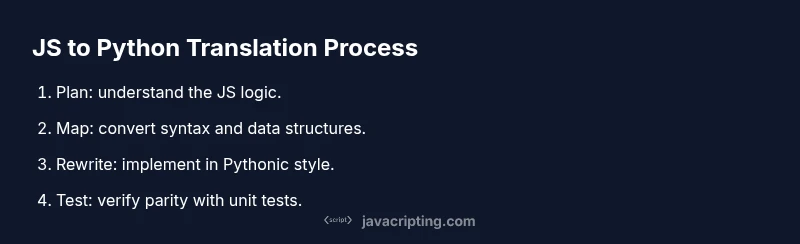
Adopt a pattern-first workflow: (1) map the core algorithm to Python, (2) replace data structures with Python-native types, (3) rewrite control flow and functions, (4) convert IO and async sections, (5) add type hints and test coverage, (6) refactor for Pythonic readability. Document the mappings you create so future translations stay consistent. This workflow reduces drift between languages and supports incremental migration, especially in mixed-language ecosystems. JavaScripting Analysis, 2026 shows that teams benefit from documenting these mappings early to minimize rework and preserve semantics during migration.
Real-world translation walkthrough: a small module
Consider a JS module that filters and transforms a list of users fetched from an API. In JS, you might use array methods like filter and map with async calls. In Python, you would fetch data with aiohttp or requests, then use comprehension for filtering and mapping. Here is condensed pseudocode to illustrate the shift:
async function getActiveUserNames(users) {
  const active = await fetchActiveUsers(users);
  return active.filter(u => u.isActive).map(u => u.name);
}async def get_active_user_names(users):
active = await fetch_active_users(users)
return [u.name for u in active if u.is_active]This side-by-side helps reveal practical changes and Pythonic patterns, guiding your own module translations.
Common pitfalls and debugging tips
Common pitfalls include mismatched data structures, forgetting to handle None vs undefined, and mismanaging async code. Always validate edge cases like empty lists, missing keys, and network errors. Avoid a straight port of library calls; Python's standard library or third-party packages may offer equivalent functionality with different interfaces. Use unit tests to pin expected behavior and leverage linters to enforce Pythonic style. Debug by translating small chunks first, then integrate into larger modules.
Tools & Materials
- Python 3.x installed(Prefer latest patch release for stability and features)
- Code editor with Python support(Examples: VS Code, PyCharm, or Sublime Text with Python plugin)
- Sample JavaScript snippet to translate(Start with a simple function and progressively tackle more complex constructs)
- Python reference materials(Official Python docs and language tutorials)
Steps
Estimated time: 40-90 minutes
- 1
Identify the core algorithm
Begin by understanding the JavaScript logic you need to translate. Separate business rules from IO and side effects; this makes later steps clearer and reduces the risk of semantic drift.
Tip: Document one line per rule or decision in a translator mapping sheet. - 2
Map syntax and basic constructs
Replace var/let/const with Python variables, adjust for indentation, and replace semicolons with nothing. Translate conditional statements and loops into Python equivalents.
Tip: Use list comprehensions where appropriate to keep Pythonic style. - 3
Translate data structures
Convert JavaScript arrays to Python lists and objects to dicts or classes depending on usage. Ensure None replaces null and equality checks map correctly.
Tip: Prefer explicit types; consider adding type hints for clarity. - 4
Translate functions and scope
Convert JS functions to Python def blocks; handle this/self context by using explicit self or removing it if not in a class. Translate closures and decorators as needed.
Tip: Keep function names descriptive to aid readability in Python. - 5
Handle asynchronous patterns
Map JS promises/async to Python's asyncio where appropriate. Refactor to async def and await, or choose synchronous equivalents when async is not required.
Tip: Isolate IO-bound parts to minimize concurrency complexity. - 6
Test and refine
Write unit tests that cover representative inputs and edge cases. Run tests frequently to catch semantic differences early and iterate until parity is achieved.
Tip: Automate tests to ensure future translations remain correct.
Questions & Answers
Can I automatically translate JavaScript to Python with a tool?
There isn’t a reliable one-to-one translator for all JS to Python scenarios. Automated tools can help with scaffolding, but expect manual rewriting for correctness and Pythonic style.
No, automatic tools can help with skeletons, but you’ll need to rewrite to preserve behavior and Pythonic quality.
How should I handle asynchronous code when translating?
Translate async JavaScript into Python using asyncio where appropriate, or isolate IO-bound code to simpler synchronous blocks if concurrency is not required. Test thoroughly to ensure timing and error handling are preserved.
Use Python's asyncio for similar async workflows and test timing-sensitive parts carefully.
What projects benefit most from JS-to-Python translation?
Educational exercises, algorithm migrations, or components within a mixed-language system benefit most. Large Node.js backends typically aren’t practical to port wholesale; instead, isolate critical logic and reimplement it in Python when needed.
Great for learning and intermediate migrations, less ideal for entire production-grade Node.js systems.
How long does a translation typically take?
Time varies with complexity. Start with small modules, estimate minutes to hours per module, and iterate. Prioritize critical paths first to gain early momentum.
It depends on how big and how complex the codebase is; start small and iterate.
What resources help with JS-to-Python translation?
Rely on Python's official docs for language features, and use JavaScript-to-Python pattern guides to map common constructs. Practice with small examples and incrementally build up to larger modules.
Check official Python docs and pattern-based guides to build strong translation skills.
Should I translate libraries and APIs as well?
Translate the core logic first; for external APIs or libraries, port only the essential usage patterns, then replace with Python equivalents if available. Maintain behavior and error handling across languages.
Port core logic first, then deal with libraries as you introduce Python counterparts.
Watch Video
What to Remember
- Map patterns, don’t port lines
- Adopt Pythonic idioms (comprehensions, explicit typing)
- Test early and often to catch semantic differences
- Document translation mappings for consistency
- Leverage async patterns thoughtfully in Python