JavaScript Excel-Like Tables: A Practical Comparison
Analyze three practical paths to build an Excel-like table in JavaScript: vanilla DOM, libraries, and grid components. This analytical comparison covers setup, API richness, accessibility, and performance to help you pick the right approach for your project.


Overview: For a javascript excel like table, you have three practical paths: vanilla DOM tables, spreadsheet-like libraries, and grid components built with modern frameworks. Each option trades off setup effort, API richness, and performance. In this comparison, we evaluate suitability for typical business apps, focusing on ease of use, accessibility, and data handling. According to JavaScripting, choosing the right approach hinges on your project size and UX goals.
What is a javascript excel like table and why it matters
A javascript excel like table is a UI component that mimics core spreadsheet behaviors—cell-based data, editable grids, column/row manipulation, and sometimes formulas—within a web app. The goal is to deliver familiar spreadsheet workflows without forcing users to switch tools. In practice, you’ll model data in a tabular structure, render cells in the DOM, and wire interactions such as sorting, filtering, and selection. The keyword javascript excel like table recurs as teams seek seamless data entry, quick analysis, and reproducible layouts inside browser environments. JavaScript enables dynamic rendering and client-side computation, while the layout and interaction patterns mirror familiar spreadsheet experiences. As you design, consider how users will navigate via keyboard, how data updates propagate, and how constraints like validation and formatting will be enforced. JavaScripting analysis shows that the most successful implementations balance familiarity with accessibility and performance.
Core building blocks for an Excel-like table in JavaScript
At a high level, an Excel-like table combines data models, rendering logic, and interaction handlers. Core blocks include: a data model that stores rows and cells, a rendering layer to paint the grid, event handlers for edits, sorts, and selections, and an API surface for programmatic access. You’ll often implement a header row, frozen panes for large sheets, and a mechanism for formulas or computed values. While the exact architecture varies, most patterns share a consistent flow: load data, render, capture edits, validate, and re-render. When you plan for future growth, design a data binding strategy that minimizes DOM thrashing and keeps UI in sync with the underlying model. This approach is especially important for javascript excel like table projects that must scale across devices and teams.
Option A: Plain vanilla JavaScript DOM table
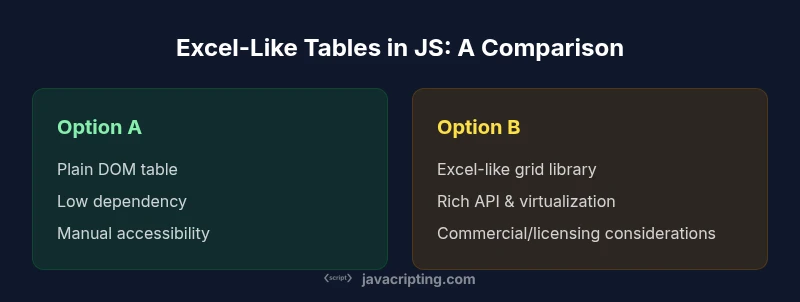
A plain vanilla JavaScript DOM table offers the most control and the lightest dependency footprint. It starts with standard HTML table elements and gradually adds features such as editable cells, sorting, and simple formulas. The benefits are speed of initial setup and full transparency, making it ideal for small datasets or internal tooling. However, as data grows, you’ll encounter performance challenges, manual accessibility work, and significant maintenance overhead. You’ll need to implement keyboard navigation, focus management, and ARIA attributes yourself to reach production-grade accessibility. If your project prioritizes minimal risk and explicit control, this path is often the most predictable starting point for javascript excel like table endeavors.
Option B: Excel-like grid libraries (Handsontable, AG Grid, etc.)
Excel-like grid libraries provide powerful features out of the box, including virtualized rendering, complex editing, built-in sorting, filtering, and even formula support in some ecosystems. They accelerate development, reduce boilerplate, and tend to handle large datasets more reliably than vanilla DOM tables. The trade-offs include larger bundle sizes, licensing considerations, and a learning curve to leverage advanced APIs. For teams that want a production-grade experience quickly, these libraries are typically the best path, especially when data volumes are sizeable or multi-user collaboration is required. Always evaluate accessibility and custom theming after choosing a library to ensure your UI remains inclusive and coherent with your brand.
Option C: Web components and framework-agnostic grids
Framework-agnostic grids built with web components offer a middle ground between vanilla DOM and opinionated library ecosystems. By encapsulating behavior in custom elements, you gain reusability across React, Vue, or vanilla JavaScript without committing to a single framework. Web components promote clean separation of concerns, easier testing, and a consistent API surface. However, you may sacrifice some performance optimizations found in specialized libraries unless you invest in virtualization and careful rendering strategies. This path fits teams that value cross-framework compatibility, maintainability, and a modern component-driven architecture.
Data modeling: cells, formulas, and data binding
A robust javascript excel like table hinges on a solid data model. Think in terms of sheets, rows, and cells, with cells hosting plain values or computed formulas. Support for ranges, named references, and error handling adds resilience. You’ll want to implement a binding layer that updates dependent cells when source data changes, while keeping edits isolated to their respective cells. Consider how formulas propagate, how circular dependencies are detected, and how to refresh UI efficiently. With a thoughtful data model, even simple gear like conditional formatting and data validation become practical, enabling more accurate data entry and clearer insights. Remember to separate the data layer from the rendering layer to keep code maintainable and testable.
Performance and virtualization strategies
Performance matters more as table size grows. Virtualization renders only visible rows and columns, dramatically reducing DOM nodes and improving scroll responsiveness. For javascript excel like table projects, adopt virtualization early if you anticipate tens of thousands of cells. Debounce input processing, batch updates, and avoid frequent reflows. When formulas or computed values are involved, consider lazy evaluation and memoization to minimize recalculation work. Evaluate rendering strategies: incremental rendering, diff-based updates, and efficient event delegation. Finally, profile across common devices to ensure your UI remains smooth under real-world usage.
Accessibility and keyboard navigation
Accessibility should be baked in from day one. Ensure all interactive cells are focusable, provide consistent keyboard shortcuts for navigation, editing, and selection, and expose meaningful ARIA labels. Implement logical tab order that mirrors the visual grid, and offer screen-reader-friendly summaries for complex operations. Use semantic table markup where possible, and when you replace native semantics with custom elements, provide appropriate roles and properties. A well-considered accessibility plan helps users with disabilities engage with your javascript excel like table just as effectively as sighted users, enhancing usability and compliance.
Styling and theming considerations
A consistent look and feel helps users trust and understand your table. Start with a clean grid structure, then layer typography, colors, borders, and hover states to convey focus and status. Consider a theming system that supports dark mode, high-contrast accessibility, and brand-consistent palettes. You’ll want to separate styling from logic so design updates don’t ripple through behavior. If you use a library, ensure it supports custom theming hooks or CSS variables for easy customization. For a pure DOM approach, embrace CSS grid/flex layouts and modern selectors to achieve a polished, accessible aesthetic that remains performant across devices.
Testing, debugging, and quality checks
Testing an excel-like grid requires both unit and integration tests. Verify cell editing, navigation, formatting, and sorting work as expected across browsers. Include tests for data binding, formula evaluation, and error handling. Consider automated visual regression tests to catch styling or layout regressions as you refactor. In debugging, instrument events such as cell edits, selection changes, and virtualization triggers to diagnose performance bottlenecks. Establish a robust test suite and continuous integration to maintain quality as you evolve the feature set.
Real-world use cases and trade-offs
Businesses often deploy javascript excel like table features for dashboards, inventory catalogs, or data-entry applications. The optimal approach depends on data volume, required interactions, and time-to-market pressure. For small tools, a vanilla DOM table may suffice; for enterprise apps with large sheets and collaboration, a mature grid library is typically preferable. Always balance developer velocity with long-term maintainability. In practice, teams should prototype multiple paths, measure real user impact, and align the choice with product goals and accessibility commitments.
How to choose your path: a practical checklist
Use this checklist to decide among options easily:
- Data size and performance needs
- Required interactions (sorting, formulas, filtering)
- Timeline and team skill set
- Accessibility and keyboard support
- Licensing, cost, and long-term maintenance
- Cross-framework compatibility When in doubt, start with a minimal viable approach and iteratively add features with proper testing. The right choice becomes evident as you validate with real users and metrics. Authority sources such as MDN, ECMA, and W3C provide foundational guidance for building robust JavaScript interfaces in line with browser standards.
Feature Comparison
| Feature | Option A: Plain vanilla DOM table | Option B: Excel-like grid library | Option C: Web components / framework-agnostic grid |
|---|---|---|---|
| Ease of setup | Low: basic HTML table | Medium: library initialization and config | Medium: web components integration across frameworks |
| API richness | Minimal API surface | Rich APIs for editing, events, and hooks | Moderate API surface with cross-framework hooks |
| Performance (large data) | Basic virtualization optional | High performance with built-in virtualization | Depends on implementation; can be optimized |
| Accessibility | Manual ARIA and keyboard nav | Built-in accessibility in mature libs | Depends on implementation; can be addressed with ARIA |
| Styling/theming | Pure CSS control | Theming via library styles | Customizable via CSS variables or scoping |
| Data size handling | Small to medium datasets | Large datasets with virtualization | Large datasets with lazy loading |
| Licensing / cost | Free (no licenses) | Licensing varies by library | Open core or commercial options |
Benefits
- Low upfront complexity for simple tables
- Full control over rendering and behavior
- Low dependency risk and smaller bundle sizes
- Flexible, incremental enhancement path
The Bad
- Manual accessibility and testing overhead
- More boilerplate and potential for bugs
- Performance tuning required for large data
- Maintenance overhead without built-in enterprise features
Choose the path based on data size and velocity: vanilla DOM for small, controlled tools; a mature grid library for large datasets and quick time-to-value; web components for framework-agnostic flexibility.
Vanilla DOM shines with simple, small datasets and full control. Excel-like grid libraries excel for large datasets and rapid feature delivery, while web components offer cross-framework versatility without locking you in.
Questions & Answers
What is a javascript excel like table?
A javascript excel like table is a web-based grid that mimics spreadsheet behaviors. It supports editable cells, sorting, filtering, and sometimes formulas, all within a browser. Your data model drives the grid, while rendering and interactions provide the user experience.
A JavaScript-based grid that imitates a spreadsheet, with editable cells and usually sorting and filtering.
Which approach is best for a small internal tool?
For small internal tools, a vanilla DOM table often suffices. It keeps dependencies low and gives you direct control over behavior, though you’ll handle accessibility and performance manually.
For small tools, start with a plain table to keep things simple.
Do I need virtualization for large datasets?
Yes, virtualization helps render only visible cells, dramatically improving performance on large datasets. It’s common in mature grid libraries and a recommended pattern for custom implementations too.
If you expect large data, use virtualization to keep the UI responsive.
Is accessibility harder with Excel-like tables?
Accessibility can be challenging but is manageable with proper ARIA roles, keyboard navigation, and screen-reader support. Prioritize focus management and semantic structure early in the design.
Accessibility is important, plan from day one and test with assistive tech.
Are there licensing concerns with grid libraries?
Some libraries require commercial licenses for certain uses. Review the licensing terms, and consider open-core or vendor-supported options if you need enterprise features.
Check the license before you commit, and choose a path that fits your project’s budget.
What to Remember
- Assess data volume before choosing a path
- Prioritize accessibility from day one
- Use virtualization for large grids to maintain performance
- Prototype multiple options to validate UX and maintainability
- Choose a path that aligns with team skills and licensing needs