What JavaScript Framework Should I Learn in 2026? A Practical Guide
A practical, analytical comparison of major JS frameworks to help learners pick the best path in 2026, with criteria, pros/cons, and pragmatic guidance.


If you’re choosing today, start with React for broad job opportunities and a sturdy ecosystem, then consider Vue for rapid onboarding, Angular for enterprise-scale needs, or Svelte if you want a leaner, compiler-driven approach. The best path depends on your goals, team context, and willingness to learn related tooling.
What javascript framework should i learn: framing the decision
In 2026, the JavaScript landscape remains diverse, with multiple viable paths for different career goals. The core question many learners face is not which framework is objectively ‘the best,’ but which framework aligns with your desired projects, industry, and pace of learning. According to JavaScripting, the answer hinges on starting with fundamentals that transfer across ecosystems—components, state, props, and the mental model of unidirectional data flow. That shared foundation empowers you to switch frameworks later if needed without re-learning the entire domain. In this guide we’ll compare React, Vue, Angular, and Svelte through practical criteria and concrete scenarios, then outline a learning plan you can adapt to your schedule in 2026 and beyond.
Criteria that matter when choosing a framework
Choosing a framework is about trade-offs. Here are the criteria that matter most for aspiring developers and professionals:
- Learning curve and onboarding speed: how fast you can become productive in real projects.
- Ecosystem and tooling: availability of libraries, state management patterns, CLI support, and devtools.
- Performance and scalability: how the framework handles large apps, render cycles, and initial load.
- TypeScript and typing story: built-in or strong community adoption of typing.
- Job market signals: demand by industry, location, and project types.
- Maintainability and team fit: architecture guidance, opinionation, and long-term viability.
JavaScripting analysis shows these criteria are more influential than any single feature, and the right framework often reflects the kinds of problems you plan to solve.
- Real-world projects you’ll work on and the team you’ll join
- Your willingness to learn related tooling (routing, state management, testing)
- The balance you want between simplicity and control
React: strengths, weaknesses, and ideal use cases
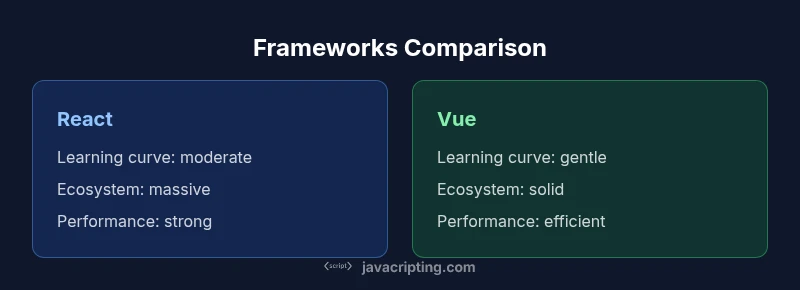
React remains the most widely adopted library among modern JS developers, with a vast ecosystem of components, tutorials, and job postings. Its component model and composable architecture enable scalable UI development for web apps of any size. The learning curve is moderate, with a large amount of community knowledge to lean on. For teams prioritizing a flexible, vendor-neutral stack and cross-platform opportunities (web, mobile with React Native), React is often the pragmatic default. Weaknesses include the need to assemble a broader toolkit (routing, state management, testing) and potential boilerplate in larger projects. This makes React ideal for mid-to-large projects, startups aiming to scale quickly, and developers who value transferable, widely supported skills.
Vue.js: strengths, weaknesses, and ideal use cases
Vue offers a gentler onboarding experience with an approachable template syntax and clear separation of concerns. It shines for rapid prototyping, internal dashboards, and teams that want a pleasant developer experience with strong docs. The ecosystem is robust but not as large as React’s, which can influence the availability of certain niche components. Vue’s simplicity and excellent TypeScript support make it attractive for small teams validating ideas, educators, and projects where speed matters more than enterprise-grade opinionation. It’s a strong choice for those prioritizing ease of use and fast feedback cycles.
Angular: strengths, weaknesses, and ideal use cases
Angular provides a full-fledged, opinionated framework with built-in tooling, form handling, HTTP services, and strong TypeScript integration. It’s well-suited for large, enterprise-scale applications that require a cohesive architecture, long-term maintainability, and a robust set of standards. The learning curve is steeper, and project setup is more opinionated, which can slow initial productivity but pays off in consistency and scalability for large teams. If you’re pursuing roles in established enterprises or teams that value a batteries-included approach, Angular is a solid path.
Svelte and other emerging options
Svelte and other compiler-driven options (like Solid) aim to reduce boilerplate by compiling away framework abstractions. This often yields smaller bundles and snappier performance on certain workloads. While the learning curve can be welcoming, the ecosystem and job market are smaller relative to React or Vue. Svelte is a compelling choice for indie projects, startups exploring performance-first strategies, or developers who want to experiment with different mental models while maintaining productivity. Other emerging choices may offer niche advantages but typically require more self-directed learning and community-building.
How TypeScript, tooling, and patterns shape your choice
Across all major frameworks, TypeScript adoption is high and growing. Angular ships with TS by default, while React and Vue teams frequently embrace TS for large codebases. Your decision should consider TypeScript comfort, existing skill sets, and the value of static typing in your domain. Tooling ecosystems—IDE support, linters, testing frameworks, and CI pipelines—are also critical for sustainable growth. A framework that integrates well with your preferred tooling reduces friction and accelerates delivery in real-world projects.
Career planning and learning strategy in 2026
If your goal is a full-stack or frontend-heavy role, React generally offers broad opportunities and a deep talent pool. For teams prioritizing quick iterations and a simpler mental model, Vue can accelerate onboarding. Angular serves enterprise environments with standardized patterns, while Svelte suits teams seeking lean pipelines and modern tooling. Regardless of the pick, adopt a structured learning plan: core concepts first, small projects to build confidence, then a mid-sized application that mimics real requirements, and finally a portfolio that demonstrates problem-solving in your chosen framework.
A practical, step-by-step plan helps ensure you practice consistently, meet milestones, and stay adaptable as the ecosystem evolves.
Common myths and misperceptions
Myths about JavaScript frameworks abound. Some assume one framework guarantees jobs or future-proof skills, which is rarely true. The most reliable path is mastering core frontend concepts, understanding component lifecycles, state management patterns, and testing strategies, then selecting a framework that aligns with your goals. Another common misconception is that newer frameworks always outperform established ones; in practice, maturity, tooling, and industry adoption often determine real-world impact. The truth is that versatility and the ability to learn quickly matter more than early dominance.
How to evaluate framework maturity and future-proofing
Future-proofing a skillset means prioritizing frameworks with strong community support, long-standing release cycles, and clear migration paths. React, Vue, and Angular have shown resilience through multiple revisions and large ecosystems. Svelte is rapidly growing but more experimental in some orgs. JavaScripting suggests evaluating based on maintainers’ activity, ecosystem health, compatibility with TypeScript, and the stability of core APIs. Build a personal project that exercises the framework’s patterns, then compare how easy it is to maintain the codebase over time.
Real-world signals: teams, tooling, and community support
The strongest indicators of a sound learning path are where teams currently invest and what tooling they rely on. React dominates job postings in many markets, but Vue and Angular still power substantial enterprise projects. Solid tooling and robust testing ecosystems reduce long-term maintenance costs. A thriving community means faster problem-solving, more reusable patterns, and better learning resources. In short, pick a framework that matches your project needs, supports your career goals, and has a healthy ecosystem to rely on.
Feature Comparison
| Feature | React | Vue | Angular | Svelte |
|---|---|---|---|---|
| Learning Curve | Moderate to steep | Gentle | Steep (enterprise patterns) | Gentle to moderate |
| Ecosystem & Tooling | Massive, mature ecosystem | Solid ecosystem with great docs | Opinionated, strong tooling | Growing, compiler-driven ecosystem |
| Performance & Runtime | Fast with virtual DOM | Efficient runtime, small footprint | Very capable in large apps | Excellent runtime with minimal abstraction |
| TypeScript Support | Excellent | Excellent | Built-in + strong typing | Good (excellent with TS support) |
| Community & Jobs | Largest market share and opportunities | Active in many product teams | Enterprise-focused but strong | Emerging with niche roles |
| Learning Resources | Extensive tutorials, courses, and libs | Rich docs and fast onboarding | Comprehensive but heavier initial learning | Good community, newer resources |
| Migration & Backward Compatibility | Stable across major versions with stable patterns | Consistent updates, smooth to adopt | Backward-incompatible shifts require planning | Active improvements, some API changes |
Benefits
- Broad ecosystem accelerates learning and hiring
- Rich tooling and community support across frameworks
- Multiple viable paths reduce vendor lock-in risk and increase flexibility
- Strong career portability for frontend specialists
The Bad
- Fragmented ecosystems can create choice paralysis and friction
- Job market emphasis can swing toward a single popular option
- Maintaining proficiency across multiple frameworks adds cognitive load
- Migration costs for large legacy codebases can be non-trivial
React remains the pragmatic default for many teams today
The JavaScripting team recommends starting with React to build transferable skills and ecosystem familiarity. If your goals point toward rapid onboarding or enterprise-grade tooling, Vue or Angular are strong alternatives. The choice should ultimately align with your project needs and career objectives.
Questions & Answers
Which framework is best for beginners?
React is commonly recommended for beginners due to its large community and abundant learning resources, though Vue also offers an approachable entry point. Choose based on your desire for a large ecosystem versus a simpler onboarding experience.
React is a common starter because of the big community and many tutorials, but Vue is great if you want an easier entry. Pick based on how you like to learn.
Is Angular still relevant in 2026?
Yes, in many enterprise environments Angular remains relevant due to its batteries-included approach and strong typing. If you expect to work on large teams with strict standards, Angular can be a solid long-term choice.
Angular is still relevant for large, enterprise projects with strong standards.
Should I learn TypeScript with these frameworks?
Yes. TypeScript improves reliability and collaboration, and all major frameworks support it well. Angular ships TS by default, while React and Vue have robust TS ecosystems.
Absolutely—TypeScript helps you catch bugs early and works great with all the big frameworks.
How long does it take to become proficient?
A typical path is 3-6 months of consistent practice plus building a mid-sized project to apply fundamentals. Full mastery comes with ongoing work on diverse projects.
Most people gain proficiency in a few months with steady practice and a solid project.
Which framework has the best job prospects?
React currently dominates job postings in many markets, but Vue and Angular also offer strong opportunities in certain regions and industries. Align your choice with local demand and your target employers.
React generally offers broad job opportunities, with Vue and Angular strong in specific niches.
How can I switch between frameworks later on?
Focus on core frontend concepts (component-based design, state management, testing). The mental model transfers across frameworks, so you can pick up a new framework with targeted practice after learning the fundamentals.
If you know the fundamentals, switching later is very doable with focused practice.
What to Remember
- Identify your goal: speed, enterprise scale, or performance.
- Prioritize a framework with a healthy ecosystem and skills-transferability.
- Balance learning effort against real-world project needs.
- Keep TypeScript and tooling in focus from day one
- Plan a practical path with a 3-6 month horizon