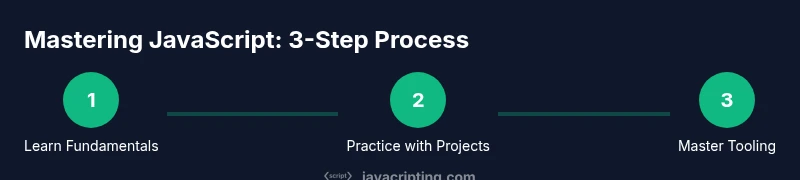
Master JavaScript: A Practical Path to Fluency
Discover a structured, practical plan to master JavaScript—from fundamentals to advanced topics, with hands-on projects, tooling, and a repeatable study routine designed for 2026 learners.


Follow the best way to master javascript through a structured, practical plan: master fundamentals, then progressively tackle modern tooling, patterns, and real-world projects. This guide provides a 6-week path, daily practice, and a habit-building framework to accelerate learning. By the end you’ll code confidently across front-end and Node, with a portfolio of projects and tests to prove your skills.
Why a Structured Path Matters
According to JavaScripting, the best way to master javascript isn’t a shortcut or a magical hack; it’s a deliberate, repeatable process. A structured path helps you build on solid fundamentals, reduces wasted time, and accelerates your ability to tackle real-world problems. In this section we explore why planning beats scattered practice and how a reliable foundation multiplies your future progress.
- Consistency compounds: a routine that blends theory, coding, and reflection yields bigger long-term gains than sporadic sessions.
- Plateaus are normal: a well-designed plan introduces new challenges at the right pace to keep you moving.
- Retention through application: applying concepts in small projects consolidates knowledge far more effectively than passive reading.
In practical terms, you’ll map milestones, schedule deliberate practice, and regularly review your code to distill lessons. This approach aligns with the core principle of the best way to master javascript: you don’t just learn syntax—you internalize patterns, mental models, and practical workflows that scale with complexity.
Core Fundamentals You Must Master
Before you can confidently harness the more exciting features of JavaScript, you need a rock-solid foundation. This section breaks down the core concepts you’ll rely on every day, explains common pitfalls, and shows how they interlock to form robust code.
- Syntax and semantics: variables, data types, operators, control flow, and functions.
- Scoping, hoisting, and closures: how and when values are captured, and how to write clean, leak-free code.
- This, prototypes, and object-oriented patterns: understanding how JavaScript’s inheritance works and how to design reusable objects.
- Arrays and higher-order functions: map, filter, reduce, and the power of function composition.
- Modules and modern syntax (ES6+): import/export, arrow functions, template literals, destructuring, and defaults.
- DOM basics and event handling: manipulating the page in response to user actions and understanding the browser model.
A practical way to master these basics is to pair short concept runs with small, repeatable coding tasks—toggle a UI element, implement a simple memoized function, or build a tiny utility library. The emphasis is on clarity, correctness, and readability, which set the stage for mastering the more advanced topics that follow.
Progressive Topics to Master After Basics
Once you’ve nailed the fundamentals, you’ll want to expand into the modern JavaScript ecosystem and browser capabilities. This section guides you through a logical progression of topics that unlock real-world capabilities and prepare you for professional work.
- Asynchronous programming: promises, async/await, and error handling to manage API calls and long-running tasks.
- Modules, bundling, and tooling: understanding how code is organized, built, and deployed in modern apps.
- The event loop, memory management, and performance considerations: learning how JavaScript executes and how to write efficient code.
- Advanced patterns: closures in depth, currying, composition, and common design patterns for scalable code.
- Fetch API, APIs, and real-world data handling: parsing, transforming, and rendering dynamic data.
- Debugging and testing practices: strategies for reliable code through unit, integration, and end-to-end tests.
A practical approach is to tackle one advanced topic at a time through small projects that exercise the concept, then integrate the topic into a larger project. This keeps learning concrete and relatable to real tasks.
Practice Strategies That Build Mastery
Practice is where mastery becomes tangible. The most effective practice blends deliberate drills with meaningful projects that resemble real-world work. Use a loop of plan → code → reflect to steadily improve.
- Deliberate drills: solve micro-problems that target a specific skill (e.g., a memoization exercise or a small DOM interaction).
- Real projects: build something visible and valuable—an interactive dashboard, a weather app, or a small game.
- Code review and refactoring: revisit earlier work to apply new patterns and improve readability and performance.
- Testing discipline: write unit tests for core functions and use simple end-to-end tests for user flows.
- Debugging mastery: learn to reproduce bugs quickly, use breakpoints, console tracing, and performance profiling tools.
In practice, set weekly project goals, schedule practice sessions, and reflect on what worked and what didn’t. The habit of deliberate practice is the single most reliable predictor of long-term mastery.
Tooling and Workflows That Accelerate Learning
Modern JavaScript mastery is as much about how you work as what you know. The right tooling and workflow can dramatically increase your throughput and reduce cognitive load, enabling you to focus on problem solving.
- Development environment: choose a capable editor, enable essential extensions, and customize linting and formatting.
- Node.js and npm: keep an up-to-date runtime and dependency manager to test server-side code and automate tasks.
- Bundlers and transpilers: understand when and why to use webpack, Vite, or similar tools, and how to configure them.
- Testing and quality: adopt a lightweight testing strategy early with a simple framework, then evolve to more robust tooling.
- Version control discipline: maintain clean commit history, practice meaningful messages, and use branches for new features.
- Documentation habits: keep a local notes repository of patterns, gotchas, and example code snippets.
Adopt a repeatable workflow: scaffold a project, implement feature(s), write tests, run checks, refactor, and prepare for deployment. This reduces surprises and makes your learning feel like professional work.
Build a Portfolio With Real-World Projects
A portfolio is your map from learning to opportunity. Building a curated set of projects demonstrates your growing capability and helps you articulate your approach to potential employers or clients. Start small, then escalate to more complex systems that exercise architecture, UX, and performance.
- Project ideas: a responsive to-do app with persistence, a data visualization dashboard, an API client library, or a small single-page app with routing.
- Documentation: accompany each project with a README that explains goals, decisions, patterns, and test results.
- Demos and testing: include a live demo, source code, and a basic test suite to show reliability.
- Presentation: highlight challenges you solved, trade-offs, and lessons learned. Link to a live version and a well-structured repository.
To ensure consistency, structure projects around common software patterns (modules, components, services) and apply the same quality standards you expect in professional work. Your portfolio should tell a story of growth—from fundamentals to mastery.
Maintaining Momentum: Staying Motivated and Measuring Progress
Sustaining momentum over weeks or months is challenging unless you build positive feedback loops and visible milestones. This final block offers strategies to keep you on track and motivated as you pursue the goal of mastery.
- Set bite-sized milestones: weekly goals tied to concrete outcomes (a feature, a test suite, or a polished demo).
- Track practice quality: measure time-on-task, code quality (lint, test coverage), and the complexity of projects completed.
- Create a learning ritual: fixed practice times, a dedicated workspace, and a concise pre-work routine to lower resistance.
- Seek accountability: join a study group, pair-program, or publish progress publicly to stay motivated.
- Celebrate small wins: log every completed task, even minor ones, to reinforce progress and maintain momentum.
By incorporating these momentum strategies, you’ll transform learning into a repeatable, enjoyable process rather than a grind.
Tools & Materials
- Modern web browser with developer tools(Chrome/Edge/Firefox; ensure latest version for debugging features)
- Code editor(VS Code or similar; install JavaScript/TypeScript extensions)
- Node.js and npm(LTS version; enables local testing and tooling)
- Internet access(Access to MDN, official docs, and tutorials)
- Starter project or templates(GitHub template or boilerplate to kick off projects)
- Testing environment(Jest, Mocha, or similar for unit tests)
- Notebook or note-taking app(Daily notes to track learnings and code snippets)
Steps
Estimated time: 3-6 weeks (daily 60-90 minutes)
- 1
Define clear goals and a learning timeline
Identify what mastery looks like for you in 6-8 weeks. Set concrete milestones (e.g., complete 6 projects, write 50 utility functions, pass a basic test suite). Align daily practice with those milestones to build momentum and confidence.
Tip: Write SMART goals and schedule regular check-ins to assess progress. - 2
Seal your foundation: syntax, scope, and closures
Solidify core topics—variables, types, scope, hoisting, closures, this, prototypes, and basic DOM manipulation. Practice small, focused problems that require applying these concepts in real code.
Tip: Explain concepts aloud or in comments to reinforce understanding. - 3
Tackle asynchronous programming
Learn promises, async/await, error handling, and how to fetch data from APIs. Build a small app that makes multiple API calls in parallel and handles failures gracefully.
Tip: Write try/catch blocks and use finally for cleanup tasks. - 4
Master modules, tooling, and the ecosystem
Understand ES modules and basic bundling, then introduce a simple build step. Start using npm scripts, linting, and a formatter to keep code clean.
Tip: Automate repetitive tasks with npm scripts. - 5
Practice with real projects
Develop 2-3 small projects that mirror real-world tasks: a weather widget, a to-do app with persistence, or a data dashboard. Focus on clean architecture and testability.
Tip: Document decisions and trade-offs in README files. - 6
Learn debugging and testing early
Adopt a minimal testing strategy and integrate debugging routines into daily practice. Use breakpoints, console tracing, and small unit tests for core functions.
Tip: Aim for a lightweight test suite you can run in seconds. - 7
Incorporate patterns and patterns in practice
Study common patterns (modules, factory functions, higher-order components) and apply them to your projects. Refactor progressively to improve structure.
Tip: Refactor code in stages and compare before/after outcomes. - 8
Showcase your work and plan next steps
Publish a portfolio, write reflective notes on challenges faced, and set new goals. Iterate on projects with feedback from peers or mentors.
Tip: Keep a living document of your ongoing learning plan.
Questions & Answers
How long does it typically take to master JavaScript?
Mastery depends on your practice volume, but consistent daily work over several months builds confidence. Focus on steady progress rather than a race to fluency.
It takes consistent daily practice over a few months to feel confident with JavaScript.
Should I learn Node.js before front-end JavaScript?
Start with browser JavaScript to understand core concepts, then expand to Node.js. The fundamentals transfer, and Node adds server-side capabilities.
Learn the browser first, then add Node.js to extend your skills.
What’s the best way to practice JavaScript regularly?
Schedule short, focused practice sessions each day. Combine small coding drills with longer project work to reinforce learning.
Practice in short, focused blocks each day, mixing drills with real projects.
Are frameworks essential to master JavaScript?
Frameworks are valuable tools, but mastery starts with fundamentals. Use frameworks later to solve specific problems, not as a substitute for understanding core language concepts.
Frameworks are helpful, but you should first master JavaScript itself.
How can I measure progress effectively?
Set milestones and track code quality, tests, and project complexity. Regular reviews of your code and portfolio show tangible growth.
Track milestones and code quality to gauge progress.
What resources does JavaScripting recommend?
Use a mix of official docs, hands-on tutorials, and short projects. Create a personal notes repository to capture patterns and tips.
A blend of docs, hands-on practice, and notes helps learning stick.
Watch Video
What to Remember
- Define a clear, time-bound learning goal.
- Master fundamentals before advanced topics.
- Build real projects to apply concepts.
- Incorporate tooling and testing early.
- Track progress and adjust your plan.