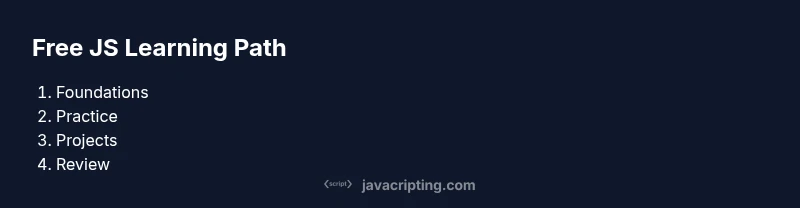
Javascript for Free: A Practical Guide to Learning JavaScript at No Cost
Discover free, practical ways to learn JavaScript with hands-on exercises, free resources, and actionable guidance from JavaScripting.


You will learn to map a complete, free JavaScript learning path—from foundational concepts to practical projects—using only no-cost resources. This plan emphasizes deliberate practice, steady pacing, and hands-on coding to build real skills without spending money. By following the steps and tools outlined, you can become capable in JS while staying within budget.
Why learning JavaScript for free matters
According to JavaScripting, learning JavaScript without spending money is not only feasible but also an efficient way to start programming. This guide shows how to assemble a practical, high-value path using free resources—MDN, FreeCodeCamp, interactive sandboxes, and community practice—so you can build real projects without paywalls. The phrase javascript for free anchors the plan, but the real value comes from consistent practice, deliberate feedback, and a mindset of experimentation.
When you start with free resources, you gain two important advantages: you can iterate quickly, and you can tailor your learning to your goals. You’ll learn fundamentals like variables, data types, control flow, functions, arrays, objects, and DOM basics, then move toward hands-on projects that reinforce what you just studied. By focusing on practical tasks over theory-heavy lectures, you stay motivated and see tangible results sooner. JavaScripting Analysis, 2026, indicates that a structured, free-learning path can be as effective as paid courses for building core competencies in JavaScript for free.
By the end of this section, you should feel confident mapping a free, sustainable learning journey that leads to real code you can reuse in projects. This approach emphasizes gradual buildup: start small, scale up, and review your progress weekly. The JavaScripting team emphasizes actionable steps, so you’ll leave with a concrete plan you can implement right away.
Core free resources you can trust
Free learning begins with quality sources. Here are reliable channels and materials that align with the javascript for free goal:
- MDN Web Docs — the definitive reference for JavaScript syntax, browser APIs, and DOM manipulation. Start with the Basics and move to Advanced topics as you grow more confident.
- FreeCodeCamp — an interactive curriculum offering guided tutorials, coding challenges, and project-based certifications that culminate in portfolio-worthy projects.
- Interactive sandboxes (CodePen, JSFiddle, JSBin) — allow you to experiment with HTML, CSS, and JavaScript in real time, see results instantly, and share snippets with peers.
- Free online books and guides — chapters from trusted texts that are legally accessible at no cost, ideal for deep dives into language mechanics and patterns.
- Browser developer tools — practice JavaScript right in your browser; learn debugging, console usage, and performance optimizations without installing extra software.
- Community forums and study groups — Stack Overflow, Reddit communities, and local meetups help you get feedback, solve problems, and stay motivated.
Quality matters when you pursue javascript for free. Prioritize resources that emphasize hands-on practice, small incremental challenges, and clear explanations. As you build a habit, you’ll discover a personal combo of MDN references, project-based exercises, and lightweight tutorials that fit your pace.
Crafting a free learning plan that sticks
A sustainable plan blends goals, time, and practical tasks. Start by defining your target: what level of JS proficiency do you want? Are you aiming for front-end work, back-end with Node, or broader problem-solving skills? Once you have a direction, break it into weekly milestones tied to free resources. Schedule regular, focused study blocks—ideally 3–5 sessions per week, 30–60 minutes each—so momentum builds without burnout. Use a simple template: one theory topic, one coding exercise, and one mini-project per week. Track progress in a notebook or digital note—jot down what clicked, what didn’t, and how you’ll adjust.
To stay on track, set a lightweight accountability mechanism: a public or shared progress log, a weekly reflection, or a peer check-in. When choosing resources, prefer those that provide immediate coding tasks and short challenges. This keeps the learning loop tight: read a concept, implement it, test it, and iterate. JavaScripting analysis shows that learners who pair theory with frequent practice tend to retain more and build confidence faster when learning JavaScript for free.
Finally, design your first free project around the topics you’ve mastered. Projects create context, demonstrate practical skills, and give you concrete portfolio pieces to show potential employers or collaborators. Start modestly, then scale complexity as you gain competence. Keep the end in mind: each week should edge you closer to a tangible outcome you can showcase in a resume or personal site.
Practice strategies that accelerate retention
Retention hinges on deliberate practice, not marathon sessions. Adopt a deliberate practice rhythm: focused, time-boxed sessions with clear objectives and immediate feedback. A practical cadence is 25–45 minutes of coding, followed by a 5–10 minute review. Use free resources to surface small, concrete tasks: implement a function, refactor a block of code, or recreate a common UI interaction.
In addition to repetitive drills, incorporate spaced repetition and retrieval practice. Create flashcards for syntax rules, common methods, and browser APIs, then review them on a schedule. Build a habit of rewriting or re-implementing a feature you already built, but with a different approach or API. This kind of variation improves flexibility and prevents plateaus. For javascript for free learners, the combination of varied practice and periodic review often yields stronger long-term retention than cramming.
As you grow, incorporate simple debugging sessions. Intentionally introduce small bugs, then locate and fix them using browser DevTools. This builds diagnostic thinking and familiarity with error messages, which is essential for real-world development. Free resources paired with hands-on debugging create a strong, practical foundation for learning JavaScript for free.
Free project ideas to solidify knowledge
Projects are the best proof of capability and the most tangible way to demonstrate what you’ve learned. Here are approachable ideas you can complete using free resources:
- To-do List App (vanilla JS) — manage items, mark complete, filter, and persist to localStorage.
- Weather Dashboard (fetch API) — pull data from a public weather API and display current conditions and forecast. Show error handling for failed requests.
- Quiz Game — multiple-choice questions, scoring, timer, and responsive UI; practice DOM manipulation and state management.
- Interactive Gallery — image carousel with keyboard navigation and responsive layout; implement smooth transitions with CSS and JS.
- Small Blog Front-End — render posts from a static JSON file, implement search, and add client-side routing for a simple SPA feel.
For each project, outline the features first, then implement iteratively in small rounds. Push commits to a version-control repository (GitHub is free) to track progress and share your work with others. Remember to write tests or at least manual checks to ensure your code behaves as expected, which is crucial when you learn JavaScript for free.
Tools & Materials
- Computer with internet access(Any modern OS; Chrome/Edge recommended for debugging)
- Code editor(Examples: VS Code, Sublime Text, or Atom)
- Web browser(Latest version of Chrome, Firefox, or Edge)
- Notepad or note-taking app(For jotting quick ideas and progress)
- MDN and FreeCodeCamp accounts(Free resources to reference and complete challenges)
- Project scaffolding(GitHub or GitLab for version control (optional but recommended))
Steps
Estimated time: 6-12 hours
- 1
Define goals and constraints
Clarify your target outcome (e.g., front-end basics or Node.js basics) and set a weekly time commitment. Write down measurable milestones and a deadline to maintain focus.
Tip: Write goals in 1–2 sentences and schedule a weekly review. - 2
Set up workspace and tools
Install a lightweight code editor, set up a standard folder structure for projects, and ensure your browser’s devtools are ready for debugging.
Tip: Create a dedicated 'JS-free-day' to practice review without distractions. - 3
Learn core JavaScript concepts
Study variables, data types, operators, control flow, functions, objects, arrays, and a basic introduction to the DOM. Pair each concept with a small coding exercise.
Tip: Code small examples daily to reinforce new syntax and patterns. - 4
Practice with exercises and small projects
Tackle bite-size challenges on MDN or FreeCodeCamp, then apply them in mini-projects that align with your goals.
Tip: Mix theory with a hands-on task to prevent drift into passive reading. - 5
Build a capstone project
Create a small but complete project from scratch, such as a to-do app or weather dashboard, incorporating at least one API call and DOM manipulation.
Tip: Document decisions and write a readme that explains your approach. - 6
Review, reflect, and iterate
Schedule a monthly review to assess progress, adjust goals, and plan the next set of challenges.
Tip: Keep a learning journal; note what worked and what didn’t.
Questions & Answers
What are the best free resources to learn JavaScript?
Core free resources include MDN for fundamentals, FreeCodeCamp for guided challenges, and interactive sandboxes like CodePen for experimentation. Supplement with YouTube tutorials and practice projects to reinforce learning.
Use MDN and FreeCodeCamp first, then try small experiments in a browser sandbox.
Is free JavaScript learning as effective as paid courses?
Free resources can be highly effective when used consistently and paired with projects. Paid courses sometimes offer structured paths and mentorship, but a well-planned free approach can achieve similar outcomes with discipline.
Free resources work if you stay consistent and practice with projects.
How long does it take to learn JavaScript basics for free?
For basics, a focused plan can take several weeks to a few months depending on weekly time investment. The key is steady practice and progressively challenging tasks.
A few weeks to a few months with consistent effort.
Can you become job-ready with free resources?
Yes, with a structured plan, meaningful projects, and a portfolio. Employers value demonstrable code and the ability to ship features, which free resources can help you develop.
A strong portfolio and problem-solving skills can land you roles.
What tools do I need to practice JavaScript for free?
At minimum, a computer, a browser, and a code editor. Add MDN/FCC for learning and a version control repo for showcasing work.
A computer, browser, editor, and a place to host your projects.
Where should a complete beginner start?
Start with fundamentals on MDN, complete beginner challenges on FreeCodeCamp, and build a small project to apply what you’ve learned.
Begin with basics, then build a tiny project to apply it.
Watch Video
What to Remember
- Set a clear free JS goal and timeline
- Use MDN, FreeCodeCamp, and sandboxes as core tools
- Practice regularly with small projects
- Build a portfolio-worthy capstone
- Review and iterate your plan