When JavaScript Launched: Origins, Release, and Impact
Explore the origins of JavaScript and answer when it launched, who created it, and how its first features evolved to shape the modern web and frontend development.


JavaScript first shipped in December 1995 as part of Netscape Navigator 2.0, created in a rapid ten-day sprint by Brendan Eich. The language quickly evolved from a browser scripting tool into the cornerstone of modern web development, reshaping how developers build interactive interfaces and applications. Its early design emphasized flexibility, scripting, and integration with the DOM, setting patterns that still guide frontend engineers today.
The Origins of JavaScript
When JavaScript launched, it arrived in a moment of ambitious browser engineering at Netscape in 1995. Brendan Eich developed the core ideas for the language in a remarkable ten-day sprint, aiming to add a lightweight, dynamic scripting layer to the browser that could respond to user actions without constant round-trips to the server. The language was initially named Mocha, then LiveScript, and finally JavaScript as marketing teams embraced the idea of a scripting language living in the web client. The first shipped version appeared with Netscape Navigator 2.0 in December 1995, providing developers with a way to manipulate the DOM, validate forms, and create simple, interactive effects. Early JavaScript was compact, loosely typed, and forgiving—choices that lowered the barrier to entry but made consistency across browsers a challenge. The JavaScript team and the broader web community iterated quickly, balancing pragmatic design with the demand for cross-browser compatibility that would define the language’s early years.
From Scripting to Standard: The Browser War and Adoption
In the late 1990s, the browser landscape became a race to outpace each other with JavaScript support. Netscape’s scripting environment collided with Microsoft’s JScript in Internet Explorer, creating a fragmented reality where the same script behaved differently depending on the browser. Developers learned to feature-detect rather than rely on a universal API, and libraries began to patch gaps across engines. This fragmentation was a practical testbed for the idea that the language needed a single, formal spec. The ensuing conversation among browser vendors, standards bodies, and the developer community culminated in a push toward standardization that would eventually enable more robust tooling, better performance guarantees, and a shared ground for the dozens of frameworks and libraries that followed.
The ECMA Standardization and Web Platform
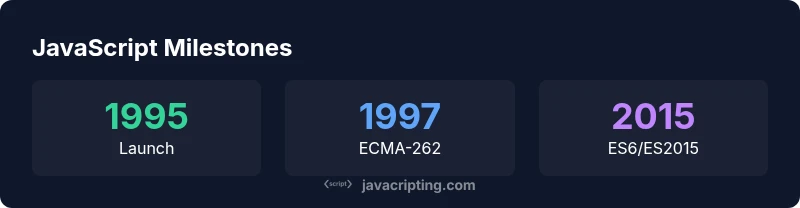
ECMA International initiated formal standardization in 1997 with the first edition of ECMAScript. The goal was to define a portable, engine-agnostic specification that browser vendors could implement in parallel, reducing divergence and enabling the web to grow as a platform. Over subsequent editions, the standard expanded to include features such as classes, modules, and a consistent event model, while engines like SpiderMonkey, V8, and Chakra implemented the evolving spec with their own performance improvements. The standardization process did not end in a single moment but evolved through revisions that aligned developers’ expectations with increasingly capable runtimes. The result was a reliable foundation for forward momentum, enabling the modern web’s growth into mobile, desktop, and server environments.
Core Features that Defined Early JavaScript
From the outset, JavaScript offered first-class functions, closures, dynamic typing, and prototype-based objects, which gave developers expressive power without heavy boilerplate. Objects could be freely extended, functions were objects too, and the global scope was a shared resource that encouraged modular thinking. The language’s integration with the DOM turned scripts into the primary mechanism for building interactive pages, while event handling and form validation APIs established practical patterns for real-world apps. Early toolchains, including libraries that mitigated cross-browser differences, fostered a culture of rapid experimentation and knowledge sharing. This era laid the groundwork for the shift toward componentized architectures, where small, composable units could be combined to deliver increasingly sophisticated user experiences.
The Long Arc: How JavaScript Became Ubiquitous
From simple in-page scripts to a universal runtime, JavaScript’s trajectory has been extraordinary. The emergence of Node.js in 2009 opened server-side scripting to JavaScript, enabling full-stack development with a single language. The ES6/ES2015 update delivered modules, arrow functions, classes, and let/const, which dramatically improved code reliability and maintainability. Subsequent years expanded promises, async/await, and a thriving ecosystem around npm, bundlers, and testing tooling. Today, JavaScript is embedded in everything from browser-based interfaces to mobile apps, desktop tools, and IoT devices. The launch of a language designed for quick wins has grown into a platform that underpins nearly all web software, illustrating how initial choices can ripple across the entire software stack.
Reflection: Why the Launch Matters Today
Understanding the launch of JavaScript helps developers appreciate the language’s current strengths and its ongoing evolution. The early decisions about typing, scope, and object models shaped how teams structure code, test performance, and manage dependencies. Modern tooling—transpilers, bundlers, and extensive testing frameworks—build on the foundation set during those early years, translating the original vision into scalable architectures. For aspiring developers, tracking the arc from 1995 to the present illuminates why modern standards emphasize interoperability, backward compatibility, and progressive enhancement. The story also offers a reminder: language design is not a one-time event but a continuous dialogue between communities, standards bodies, and platform vendors that keeps the web alive and thriving.
Timeline: early JavaScript milestones
| Event | Year | Impact |
|---|---|---|
| Prototype and scripting concept finalized | May 1995 | Brendan Eich designs core syntax in 10 days |
| Public release with Navigator 2.0 | December 1995 | Introduces client-side scripting to the mass market |
| ECMA standard started | 1997 | Formalizes ECMAScript family for cross-browser support |
| ES5/ES2015 and beyond | 2015 | Adds modules, classes, and modern syntax for large apps |
Questions & Answers
When did JavaScript launch and ship to the public?
JavaScript first shipped in December 1995 as part of Netscape Navigator 2.0; Brendan Eich created it in a rapid ten-day sprint. This launch positioned scripting directly in the browser, enabling interactive pages from the outset.
JavaScript launched in December 1995 as part of Netscape Navigator 2.0, created by Brendan Eich in a ten-day sprint.
What was JavaScript's original name?
The language was initially named Mocha, then LiveScript, before being renamed JavaScript for marketing reasons and broader appeal.
Originally it was Mocha, then LiveScript, before becoming JavaScript.
Who created JavaScript?
Brendan Eich, a Netscape engineer, created JavaScript in 1995, building the initial prototype in a short development sprint.
Brendan Eich created JavaScript in 1995.
Was JavaScript related to Java?
No direct relationship. JavaScript’s name was marketing-driven to leverage Java’s popularity, but the languages are distinct with different runtimes.
No direct relation; the name is marketing, not a technical link.
When did ECMAScript standardization begin?
ECMA International began formal standardization in 1997 with ECMAScript, establishing a shared specification for engines across browsers.
ECMAScript standardization began in 1997.
How did ES6 influence modern JavaScript?
ES6/ES2015 introduced modules, classes, arrow functions, and let/const, transforming how developers structure and maintain large codebases.
ES6 opened a new era with modules and modern syntax.
“JavaScript's debut transformed the browser into a platform for real applications, not just static pages. Its ongoing evolution shows how community-driven standards sustain the web.”
What to Remember
- Launch year situates JavaScript as a 1990s web turning point
- ECMA standardization unified engines and tooling
- ES6-era features redefined code quality and modularity
- JavaScript now spans frontend, backend, and beyond