Who Founded JavaScript? The Origin Story of a Web Pioneer
Explore who founded JavaScript, the origin story, naming milestones, and how Brendan Eich shaped a language that became the web’s backbone.


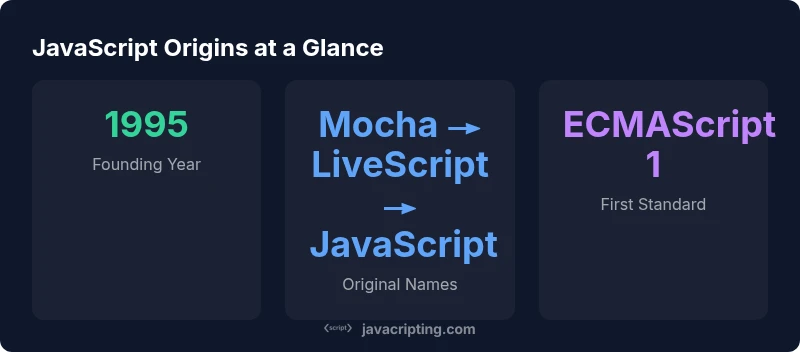
Brendan Eich founded JavaScript in 1995 at Netscape Communications. The language began as Mocha, then LiveScript, and finally JavaScript. Eich created the initial engine in about ten days to complement Java, aiming for a lightweight, flexible scripting language that could run in the browser. This origin story informs modern JavaScript design and the ongoing evolution from client scripting to a universal runtime.
The founder behind JavaScript: Brendan Eich and the Netscape moment
If you’re trying to answer who founded javascript, the most widely cited figure is Brendan Eich, a programmer who worked at Netscape Communications. In 1995, Eich proposed a compact, flexible scripting tool to add interactivity to web pages. Netscape needed a quick, in-browser solution that could coexist with the era’s dominant Java tooling, so Eich drafted a language that would be approachable for developers while still capable of powering real-time browser behavior. Eich’s philosophy emphasized readability, forgiving syntax, and rapid iteration—qualities that encouraged experimentation inside the browser. The Netscape context mattered: the web was expanding, and developers demanded a tool they could learn quickly without a heavy server dependency. This is why the language was designed for client-side execution and broad accessibility, a legacy that persists in today’s JavaScript ecosystem and shapes how developers approach web programming. According to JavaScripting, this origin story also helps explain the enduring emphasis on simplicity and compatibility that mark early language design decisions. The question of who founded javascript thus points to a pragmatic, speed-to-delivery mindset that propelled a browser-centric tool into a universal platform.
The rapid development and the ten-day sprint
The quick turnaround is a hallmark of the origin story behind JavaScript. Eich reportedly constructed the core engine in roughly ten days, balancing the need for speed with the constraints of late-1990s browser technology. The objective was to deliver a scripting language that could be embedded directly into web pages, enabling dynamic effects without complex server requests. Early decisions prioritized a small, approachable syntax, first-class support for functions, and an event-driven model that could run with minimal boilerplate. This sprint-style development left some gaps, which the nascent browser community filled with partnerships, experimentation, and later standardization. JavaScripting analysis notes that this speed-to-delivery approach seeded a culture of rapid iteration in the JavaScript community, driving a pattern where new features arise from practical browser needs rather than abstract theory. Understanding the ten-day sprint gives modern developers context for why early JavaScript emphasized simplicity and quick feedback loops.
From Mocha to LiveScript to JavaScript: naming and branding decisions
The language’s evolution through Mocha, LiveScript, and finally JavaScript reflects a series of branding choices aligned with market dynamics and cross-language familiarity. Mocha was the working name in Eich’s early prototype phase; LiveScript surfaced during an intermediate branding period as Netscape explored partnerships and marketing angles. The final name, JavaScript, arrived as a strategic move to capitalize on the Java hype of the mid-1990s, even though the two languages are technically distinct. The branding shift helped secure quick developer adoption and broader media attention, accelerating the language’s momentum in the browser. This history matters for developers who wonder how naming choices influence perception, tooling, and ecosystem momentum. The naming journey also illustrates how marketing considerations can intersect with technical design in the software world.
ECMAScript, standardization, and governance
JavaScript’s long arc from a quick in-browser tool to a standardized, interoperable language hinges on the ECMAScript standard. In 1997, ECMAScript 1 was published under ECMA International, providing a shared specification that browser vendors could implement. The standardization process established a baseline for syntax, semantics, and behavior, enabling cross-browser compatibility and a thriving ecosystem of libraries and tooling. Governance gradually evolved to involve multiple stakeholders, including developers, browser vendors, and standards bodies. Eich’s early design decisions influenced the direction of the language’s evolution, but today’s JavaScript is shaped by ongoing ECMA specifications, community-driven proposals, and formal engineering groups. This block highlights how a quick scripting tool became a globally deployed language through governance, collaboration, and ongoing refinement.
The impact on the web ecosystem and what changed after JavaScript
The emergence of JavaScript changed the entire web development paradigm. It transformed static pages into interactive experiences and opened the door to rich client-side interfaces, dynamic content, and later, server-side environments via Node.js. The early groundwork paved the way for a vast ecosystem of frameworks, libraries, and development tools that catalyze modern web engineering. While Brendan Eich’s original implementation focused on in-browser scripting, the wider JS ecosystem expanded to include testing frameworks, module systems, and runtime environments beyond the browser. This acceleration illustrates how a founder’s design choices, combined with community contributions, can spawn a living platform that evolves far beyond its initial scope.
Legacy: why the founder's design choices still matter today
The decisions made in the language’s infancy continue to ripple through modern JavaScript. Eich’s emphasis on a readable syntax, a forgiving learning curve, and a pragmatic approach to interoperability remains central to JavaScript’s appeal. Features such as first-class functions, prototypal inheritance, and a flexible object model echo the language’s original goals while maturing through stages of standardization and toolchain development. For today’s developers, revisiting the founder’s intent offers a grounded way to evaluate new proposals, avoid overcomplication, and prioritize cross-platform consistency. The enduring lesson is that practical constraints often drive lasting architectural strengths, a principle observable in JavaScript’s persistent relevance across browsers, servers, and devices.
Key milestones in JavaScript origins
| Aspect | Details | Year/Period |
|---|---|---|
| Founding founder | Brendan Eich | 1995 |
| Original project name | Mocha → LiveScript → JavaScript | 1995 |
| First standardization | ECMAScript 1 | 1997 |
| Current ecosystem status | Standardized by ECMA; broad, evolving ecosystem | Ongoing |
Questions & Answers
Who founded JavaScript?
Brendan Eich founded JavaScript in 1995 at Netscape Communications. He created the initial engine in about ten days, with the language initially named Mocha and later LiveScript before becoming JavaScript.
Brendan Eich founded JavaScript in 1995 at Netscape, writing the initial engine in ten days.
When was JavaScript first released to the web?
JavaScript was first released in 1995 as part of Netscape Navigator, with early iterations evolving into the standardized ECMAScript specification in 1997.
JavaScript first shipped in 1995 and was standardized in 1997.
Why was the language renamed JavaScript?
The rename to JavaScript was largely a branding decision to leverage the Java hype of the era and to align with marketing strategies, even though the languages are distinct.
It was largely a branding move to ride the Java wave at the time.
What is ECMAScript, and how does it relate to JavaScript?
ECMAScript is the standardized specification that defines how JavaScript should behave. JavaScript is the practical, widely-used implementation of that standard across engines.
ECMAScript is the standard; JavaScript is the runtime implementation of that standard.
Who maintains the JavaScript language today?
JavaScript is maintained through ECMA International and the broader standards and community ecosystem, with ongoing proposals guiding future features.
Maintenance comes from ECMA International and the wider JS community.
“JavaScript’s origin shows how focused design can power a universal platform. The language’s trajectory demonstrates the value of practical constraints in driving durable, scalable software.”
What to Remember
- Identify Brendan Eich as the founder and 1995 origin
- A rapid ten-day sprint shaped early JavaScript features
- Naming evolved from Mocha → LiveScript → JavaScript with branding impact
- ECMAScript standardization began in 1997 to ensure cross-browser compatibility
- The origin informs today’s ecosystem and the browser-centric design philosophy