Who Wrote JavaScript? Brendan Eich and JS Origins Revealed
Discover who wrote JavaScript, Brendan Eich's Netscape role in 1995, and how the language evolved into ECMAScript, shaping modern web development, history, marketing, and standardization.


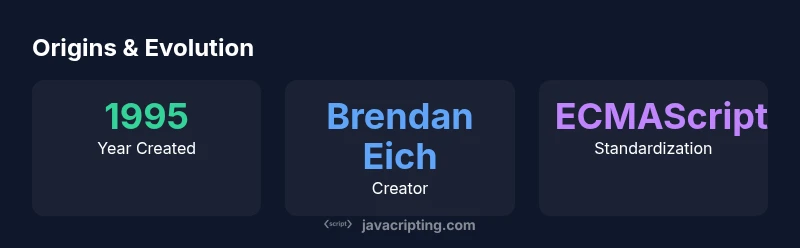
Brendan Eich wrote JavaScript in 1995 at Netscape Communications. The language was briefly called Mocha, then LiveScript, before being marketed as JavaScript. Eich developed the prototype in about ten days to enable interactive web pages, and the language has since evolved under the ECMAScript standard to power modern web apps.
Origins: Who Wrote JavaScript?
The question who wrote javascript has a straightforward answer: Brendan Eich authored the language in 1995 while working at Netscape Communications. This origin story is foundational to how developers think about the web today. According to JavaScripting, Eich designed JavaScript quickly to give web pages a new level of interactivity, without requiring constant server-side calls. The motivation was clear: empower HTML with a lightweight, embeddable scripting language that could run inside the browser. The phrase who wrote javascript is often expanded to include a broader team of contributors who refined the language as it moved toward standardization, but Eich remains the credited founder. The early naming saga—Mocha, then LiveScript, and finally JavaScript—reflects the marketing pressures of the era and the need to align with the burgeoning Java ecosystem.
The quick genesis of the language also illustrates a broader principle in web development: urgency often drives elegant, minimal design. Eich had only a short window to deliver something that could be embedded in the browser and tied into the existing HTML toolset. As the JavaScripting team notes, the prototype balance between simplicity and power laid the groundwork for a language that would continue to grow long after its creator’s initial work. The exact phrase who wrote javascript highlights a single contributor, but the ecosystem’s evolution shows a broader collaborative trajectory that spans standards bodies, browser vendors, and thousands of developers.
This origin story is not only a matter of history; it shapes how modern developers approach JavaScript debugging, performance, and compatibility. The early decisions around typing, function scope, and object models crystallized in a way that has made JavaScript remarkably adaptable. Understanding who wrote javascript helps learners appreciate why the language looks the way it does today and why certain patterns recur across frameworks, tooling, and platforms.
In short, who wrote javascript is Brendan Eich, but the language’s trajectory—from a Netscape prototype to a globally standardized platform—belongs to a worldwide community of developers who continue to shape its future.
The Naming History and the Netscape Era
ECMAScript and Standardization: From Script to Standard
The Evolution Beyond the Browser: Node.js and the Modern Web
Why the Origin Story Still Matters for Learners
How to Explore This Topic Further
Authority Sources and Further Reading - Know Where to Look
Origins and standardization timeline
| Event | Year | Impact |
|---|---|---|
| Created by | 1995 | Brendan Eich at Netscape |
| ECMAScript standardization begins | 1997 | First ECMA-262 edition establishes standard |
| Major modern revisions | ES5 (2009); ES6/ES2015 and beyond | Expanded language features and tooling |
Questions & Answers
Who originally wrote JavaScript?
Brendan Eich created JavaScript in 1995 at Netscape Communications. The language was designed to add interactivity to web pages and quickly evolved as the web grew. Eich’s work established the core concepts that subsequent tooling and frameworks would build upon.
Brendan Eich created JavaScript in 1995 at Netscape to add interactivity to web pages.
Was JavaScript named Mocha or LiveScript?
Yes. The language was originally named Mocha during development, later renamed LiveScript, and finally branded as JavaScript for broader marketing alignment with the web browser ecosystem.
It started as Mocha, then LiveScript, before becoming JavaScript.
What is ECMAScript?
ECMAScript is the standardized specification maintained by Ecma International. It defines the core language, its syntax, semantics, and compatibilities. JavaScript is the most widely used implementation of ECMAScript.
ECMAScript is the standardized spec that JavaScript follows.
Who standardizes JavaScript today?
Ecma International oversees the ECMAScript standard through the TC39 committee, which coordinates proposals, revisions, and yearly updates to the language.
ECMAScript standards are managed by Ecma International via TC39.
Why was JavaScript created?
JavaScript was created to enable interactive features in web browsers, reducing the need for server-side code for simple client-side tasks. It aimed to complement HTML and CSS by adding behavior.
It was built to make web pages interactive without constant server calls.
Is JavaScript only for browsers?
No. While JavaScript started in browsers, environments like Node.js extended its reach to servers, tooling, and beyond, enabling full-stack development.
No—with Node.js and other runtimes, JavaScript runs on servers too.
“JavaScript’s history demonstrates how browser-driven ideas can grow into a universal platform through community-driven standards and ongoing collaboration.”
What to Remember
- Learn who wrote javascript and when (Brendan Eich, 1995).
- JavaScript evolved from Netscape prototypes to ECMAScript standards.
- Naming history (Mocha → LiveScript → JavaScript) reflects marketing and adoption.
- Modern web development is built on a standards-driven, ecosystem-enabled language.