Can JavaScript Get You a Job? A Practical Guide for 2026
Explore how JavaScript skills translate to job opportunities in 2026, from fundamentals to portfolio projects, interview prep, and practical career paths.


Yes. Can javascript get you a job? Yes, especially when you pair solid fundamentals with real-world projects, debugging fluency, and modern tooling proficiency. Employers reward practical JavaScript skills demonstrated in portfolios, code reviews, and collaborative work. In 2026, steady demand persists across frontend, full-stack, and toolchain roles, with value placed on real projects, problem solving, and measurable impact.
The Reality of JavaScript Jobs in 2026
According to JavaScripting, the job market for JavaScript remains robust, driven by continued demand for interactive web applications and modern frontends. The can javascript get you a job question hinges on how you translate skills into tangible outcomes. This section unpacks the landscape, common misconceptions, and practical pathways that work in real-world teams.
Despite headlines about AI and automation, JavaScript continues to be a flexible, ubiquitous tool across the stack. Frontend roles require more than writing code; they demand an eye for user experience, accessibility, and performance. Backend or full-stack positions value how well you design APIs, handle data flow, and integrate services. A common misconception is that mastering syntax alone guarantees a job; in reality, recruiters seek evidence of consistent progress, collaboration, and the ability to ship features quickly.
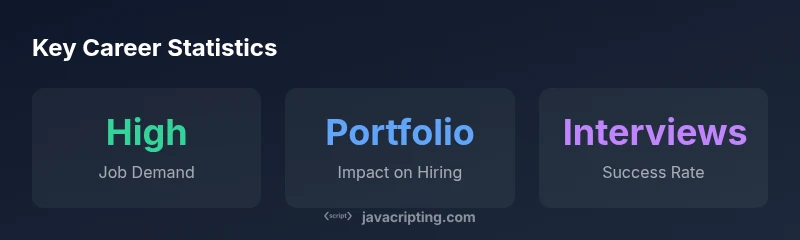
JavaScripting analysis of 2026 shows that candidates who pair solid fundamentals with a portfolio of real projects tend to stand out. Employers look for demonstrable outcomes: a live site, a Git history with well-structured commits, test coverage, and a narrative that explains trade-offs. This isn’t about memorizing every API; it’s about solving problems end-to-end and communicating decisions clearly. The practical takeaway is simple: start small, build with intention, and document your journey so hiring teams can see your value.
Core Skills Employers Seek in Modern JavaScript Roles
The core skill set that most hiring teams expect is not a single "best framework," but a reliable foundation you can apply across contexts. At minimum, you should be fluent in modern JavaScript (ES6+), understand the DOM, and be comfortable with asynchronous patterns (promises, async/await). You’ll need to know how to fetch data from APIs, manage memory and performance, and structure code into modular, testable units.
Beyond language syntax, practical tooling matters: comfortable with npm-based workflows, bundlers (Vite/Webpack), and linting. A working knowledge of Git for version control, feature branches, and pull requests is essential. Knowledge of accessibility basics (ARIA) and frontend performance optimization is a plus, because hiring managers want interfaces that work for all users and load quickly on diverse devices. If you’ve dabbled with a framework, pick one to solidify first—React remains the most common entry point, while Vue and Svelte are also valuable paths. TypeScript is increasingly expected in teams because it improves maintainability and collaboration, though you can begin with JavaScript and add TS later.
Remember that your ability to explain trade-offs matters as much as the code you write. Document your decisions in READMEs and comments; write tests that demonstrate expected behavior; and show how you debug issues, not just how you code them. This section is about building resilience: you’ll be able to adapt across projects, teams, and tech stacks.
Building a Job-Ready Portfolio: Projects That Impress
An effective portfolio is a narrative of real problems you’ve solved, not a checklist of features. Start with 2-3 end-to-end projects that demonstrate core JS skills in realistic settings: a dynamic user interface, data fetching and state management, and a polished user experience. Each project should live on a public repo with a clean README, a live demo (where possible), and an explanation of architecture, trade-offs, and testing.
As you assemble projects, think about diversity: a small accessible frontend app, a data-driven dashboard, and a lightweight Node.js service or API. Include a brief section describing the problem, your approach, the tech stack, and how you tested it. Show the code paths for interesting decisions, such as state management strategies or error handling. Don’t forget to capture metrics: load times, bundle sizes, and accessibility considerations. Finally, cultivate open-source contributions or bug fixes; potential employers value collaboration and a track record of contributing to real projects.
Learning Paths and Milestones to Track
To remain focused, set a milestone-based learning path. Month 1–2: nail the fundamentals of JavaScript, DOM, and basic tooling. Month 3–4: build small projects that emphasize asynchronous patterns and fetch APIs. Month 5–6: create portfolio-friendly projects, integrate with a simple backend, and practice debugging workflows. Month 7–8: pair programming and code reviews, refine tests, and document your decisions. Month 9–12: prepare for interviews with coding challenges, algorithm practice, and mock system design discussions relevant to JS roles. Throughout this journey, track progress with a public repo and weekly write-ups that explain what you learned and what you’d improve.
Another practical focus is building a personal brand: publish small, readable blog posts or video excerpts detailing your debugging approaches, testing strategies, and lessons learned from real bugs.
Interview Preparation: From Coding Challenges to System Design
JavaScript interviews test your reasoning, problem-solving, and ability to communicate. Expect questions that cover language fundamentals, browser APIs, asynchronous code, and practical debugging scenarios. Approach each problem with a clear plan: restate the problem, outline edge cases, choose a strategy (solve, optimize, or refactor), implement, and test. Practice with real-world problems that relate to your portfolio work. For design questions, explain how you’d structure a small service, the data model, and how you’d handle errors and monitoring. Prepare concise, concrete examples from your projects to illustrate your points.
Career Horizons Beyond Frontend
While many people start with frontend, JavaScript skills open doors to full-stack development, server-side tooling, testing, and platform engineering. Node.js expands possibilities for backend services; you can build APIs, scripts, or automation. Familiarity with databases, RESTful design, and cloud deployment helps. Many teams value developers who can integrate testing, CI/CD, and monitoring into the workflow. The ability to reason about performance and security within JavaScript contexts—both client and server—can differentiate you in interviews and on the team.
Practical Start Today: A 4-Week Plan
Week 1: solidify fundamentals (scope, variables, functions, DOM). Week 2: build a mini project that fetches data and updates UI. Week 3: polish the project for accessibility and speed; add tests. Week 4: publish to GitHub, write a detailed README, and prepare a short demo video. Throughout, keep a running journal of decisions, outcomes, and what you’d improve. By the end of the month, you should have a demonstrated project and a ready-to-share GitHub profile.
Job-readiness elements for JavaScript roles
| Aspect | Recommendation | Why it matters |
|---|---|---|
| Core skills to learn | Master JavaScript fundamentals, ES6+, DOM, async/await | Foundational for most JS roles |
| Portfolio strategies | Show real projects with live demos and READMEs | Demonstrates practical ability and communication |
| Interview preparation | Practice coding challenges + system design basics | Helps you speak to problem solving under pressure |
Questions & Answers
Do I need a formal degree?
A formal degree is not mandatory. Employers focus on demonstrated skills, portfolio quality, and the ability to work on real projects. Show evidence of learning and collaboration.
No degree is required; show skills and projects instead.
Which frameworks matter most for job hunting?
Focus on one modern framework like React, Vue, or Svelte, and learn the surrounding ecosystem. Framework familiarity helps, but strong fundamentals and a solid portfolio often matter more.
Choose one framework, but emphasize fundamentals and projects.
How important is TypeScript?
TypeScript is increasingly common for larger teams and maintainability. Start with JavaScript, then add TypeScript as you grow comfortable with types.
TypeScript is helpful, not always required at first.
How can I start building a portfolio quickly?
Begin with 2-3 realistic projects that showcase UI, data handling, and testing. Publish on GitHub with a clear README and live demo if possible.
Start with solid projects and a clean README.
Are freelancing gigs good for beginners?
Yes, small, well-scoped gigs can accelerate learning and add real-world experience, provided you manage scope and expectations.
Freelancing can help, just manage scope.
How long does it take to become job-ready?
Time varies by dedication, but a structured plan over several months with consistent practice and portfolio work accelerates readiness.
It varies, but a steady, plan-based approach speeds things up.
“JavaScript remains a central skill for modern web teams; practical output and demonstrable problem-solving matter most.”
What to Remember
- Focus on real projects to prove skills.
- Document decisions and outcomes to tell your story.
- Polish debugging and collaboration in teams.
- Build a strong, accessible portfolio before applying.
- Prepare for interviews with structured practice.