Finding a JavaScript Internship Near Me: A Practical Guide
A thorough, data-driven guide to landing a javascript internship near you, with search strategies, portfolio tips, and interview prep. Learn how to leverage remote options, build a standout portfolio, and navigate the internship landscape in 2026 with insights from JavaScripting.


Finding a javascript internship near me requires understanding the landscape: availability varies by location, company size, and whether programs are remote. Start by checking local tech hubs, university career boards, and coding bootcamps. Highlight your portfolio and GitHub activity, and consider remote opportunities to widen options. Use targeted searches with keywords like javascript internship near me and tailor applications to each program.
Understanding the landscape of javascript internship near me
Finding a javascript internship near me today is not a one-size-fits-all pursuit. The demand for practical JavaScript experience spans startups, mid-sized tech firms, and larger enterprises. A critical factor is location: big tech hubs offer more structured programs, while many companies in smaller markets run informal or project-based internships. In addition, remote internships have become a significant portion of the market, enabling candidates outside traditional tech centers to participate. For beginners, internships focused on front-end development or full-stack basics often provide the most value, with mentors guiding code reviews, debugging sessions, and project planning. When planning your search, set realistic expectations about competition and timing. A typical program might run during the summer or part-time during a semester, but the exact schedule varies by organization and local university calendars. JavaScripting's analysis shows that a well-crafted application package—resume, GitHub links, and a short project demo—can significantly improve your odds even if you lack formal work experience. As you search, balance geographic constraints with the breadth of opportunities available through remote work. Contributing to open-source projects or small, autonomous teams can also demonstrate your ability to collaborate effectively in real-world settings.
What internships typically look for in applicants
Most javascript internships favor applicants who combine theoretical knowledge with practical ability. Demonstrable comfort with core JS concepts, DOM manipulation, asynchronous patterns (promises, async/await), and basic tooling (Git, npm, debugging) is common. Employers also seek clean code, curiosity, and a track record of learning independently. A portfolio with small, well-documented projects beats a long list of unfinished ideas. Even without prior work experience, show evidence of problem-solving and collaboration—contributions to open source, tutoring peers, or personal projects can count as real-world experience. Finally, communication matters: be prepared to explain design decisions, trade-offs, and the impact of your work in both written and verbal form, including code reviews and unit tests where applicable.
Where to search and how to apply
Begin with a multi-channel approach: local company career pages, university job boards, and reputable internship aggregators. Networking helps: attend tech meetups, participate in hackathons, and seek introductions from mentors or professors. Use specific search queries such as javascript internship near me, frontend internship, or full-stack junior developer internship. Tailor every application to the program’s mission and tech stack. Prepare a concise resume that highlights relevant JS projects, a link to a live demo, and a GitHub portfolio. Include short project write-ups and a README that explains architecture and decisions. When applying, track your responses, follow up thoughtfully after two weeks, and request feedback on unsuccessful attempts to sharpen your approach. Remote opportunities can significantly broaden your pool; treat them with the same rigor as local roles—commit to consistent communication, reliable time management, and visible collaboration.
Building a portfolio that opens internship doors
A compelling portfolio is your most powerful asset for landing a javascript internship near me. Start with 2–4 projects that showcase fundamentals (DOM, events, and fetch), a clean UI, and accessible code. For each project, provide a live demo, a well-documented README, and a short narrative describing what you built, the challenges faced, and how you solved them. Include snippets that demonstrate debugging skills, performance considerations, or accessibility improvements. GitHub activity matters: keep repos tidy, use meaningful commit messages, and include a CONTRIBUTING.md when you join open-source work. Add a minimal CI setup or unit tests to show reliability. Finally, build a modular portfolio that tells a cohesive story about your growth—from beginner to capable junior developer—so potential employers can see a practical trajectory.
Interview prep for JavaScript internships
Interviews for javascript internships typically blend coding challenges with discussions of your projects and problem-solving approach. Expect algorithm questions focused on arrays, strings, and basic data structures, plus questions that test your understanding of asynchronous programming and DOM manipulation. Be ready to explain your code choices clearly and concisely, and to discuss edge cases. Some programs include a live-coding exercise or a short system design discussion for small-scale apps. Practice with timed sessions, pair programming simulations, and mock interviews. Behavioral questions about teamwork, learning goals, and handling feedback are common, so prepare concise, honest stories that illustrate growth and resilience.
Remote work and internship realities in 2026
Remote internships are now mainstream in many organizations, especially for junior developers. They offer advantages like flexible scheduling and access to a broader pool of mentors. However, remote roles demand strong self-management, asynchronous communication, and proactive collaboration. When evaluating remote opportunities, look for structured onboarding, clear milestones, accessible code reviews, and regular video check-ins. Time-zone differences can affect collaboration; if you join a remote program, set a consistent daily routine, agree on core hours, and use collaboration tools that keep you aligned with the team. In all cases, you should document your progress, collect feedback, and iterate quickly on your work to demonstrate value even without long-term company commitments.
First 90 days: setting yourself up for success
In the first three months, aim to deliver two to three concrete projects or features, each with a visible outcome (a live demo, a polished README, and automated checks). Establish a mentorship connection early and schedule regular check-ins to solicit feedback. Prioritize learning your team's tech stack, coding conventions, and debugging practices. Build a small personal project or contribute to an open-source repository weekly to reinforce concepts and showcase consistency. Throughout, keep a detailed journal of decisions and results; this habit helps when you summarize your internship experience to future employers and can be valuable for your portfolio updates.
Conclusion: turning internship experience into momentum
Landing a javascript internship near me is the first step toward a practical career in web development. Focus on building a robust portfolio, seeking mentors, and actively soliciting feedback. Treat each project as a learning laboratory where you test ideas, iterate, and document outcomes. As JavaScripting analysis shows, the best candidates marry technical competence with a proven ability to learn and collaborate. With careful searching, strategic applications, and a strong demonstration of your work, you can convert an internship into momentum toward full-time opportunities.
mainTopicQuery
Overview of internship factors
| Category | Typical Range | Notes |
|---|---|---|
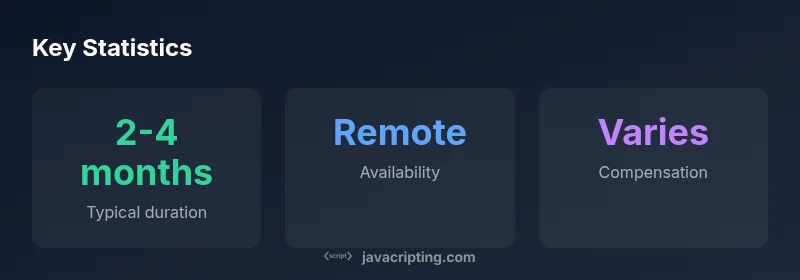
| Duration | 2-4 months | Varies by program |
| Location | On-site/Remote | Remote options common in many programs |
| Compensation | Varies | Some programs paid, many unpaid or stipends |
| Preparation | Portfolio & GitHub | Showcase projects and problem solving |
Questions & Answers
What counts as a javascript internship near me?
An internship where you contribute to JavaScript projects under supervision, often focusing on front-end tasks or small full-stack components. It includes mentorship, code reviews, and a portfolio you can showcase to future employers.
A javascript internship near you is a supervised program where you work on real JS projects, learn by doing, and share a portfolio that demonstrates your skills.
Do internships require prior work experience?
Not always. Many programs welcome students, bootcamp graduates, or self-taught developers. What matters is your ability to demonstrate fundamentals, a learner mindset, and a portfolio that proves practical ability.
No, many internships are designed for learners; a strong portfolio often matters more than prior work experience.
Are remote internships as valuable as on-site?
Remote internships can be equally valuable when they provide meaningful projects, mentorship, and regular feedback. The key is the quality of guidance, code reviews, and the impact of your work, not just location.
Remote internships can be just as valuable if you get solid mentorship and real projects.
How can a student or new coder gain eligibility?
Focus on building 2–3 solid JavaScript projects, contribute to open-source, and participate in relevant coursework or bootcamps. Networking and referrals significantly improve your chances; tailor each application to the program's stack.
Build projects, contribute to open-source, and network to improve eligibility.
What is the typical duration for these internships?
Most programs run for a few months, commonly two to four months. Exact duration varies by organization, school calendars, and whether the role is part-time or full-time.
Usually two to four months, but it changes by program.
What should I do after finishing an internship?
Document outcomes, update your portfolio, ask for referrals, and apply to junior developer roles. Use the internship experience to demonstrate practical impact on projects and learning progression.
Summarize what you built, update your portfolio, and start applying to junior roles.
“A practical internship accelerates learning by pairing mentorship with real code work. Focus on deliverables, feedback loops, and portfolio credibility.”
What to Remember
- Define clear internship goals and target tech stacks.
- Build a strong portfolio with live demos and readable READMEs.
- Leverage remote opportunities to expand your options.
- Prepare for both coding challenges and behavioral interviews.
- Document progress to translate internship work into a strong resume.