JavaScript null vs undefined: A Practical Guide
Explore the differences between null and undefined in JavaScript, their behavior in checks and JSON, and practical patterns to write clearer, bug-resistant code.


Null is an intentional placeholder value you assign to express “no value here,” while undefined means a variable has not been assigned yet. In practice, use strict equality (===) to tell them apart, and rely on clear conventions to avoid common pitfalls in JavaScript null vs undefined handling.
What javascript null vs undefined are in JavaScript
In the JavaScript language, the concepts of null and undefined sit at the heart of how we represent missing or empty values. This quick survey introduces both terms in a way that aligns with everyday coding tasks. Null is a value you assign intentionally to signify “no value here,” whereas undefined signals that a variable has not been assigned a value yet. Understanding javascript null vs undefined is essential for debugging and writing robust functions, because the two states guide control flow, data validation, and API interaction. According to JavaScripting, many developers confuse the two, which leads to subtle bugs in conditionals and data processing. By clarifying intent through in-code conventions, you reduce ambiguity and improve code readability across teams.
Core differences at runtime
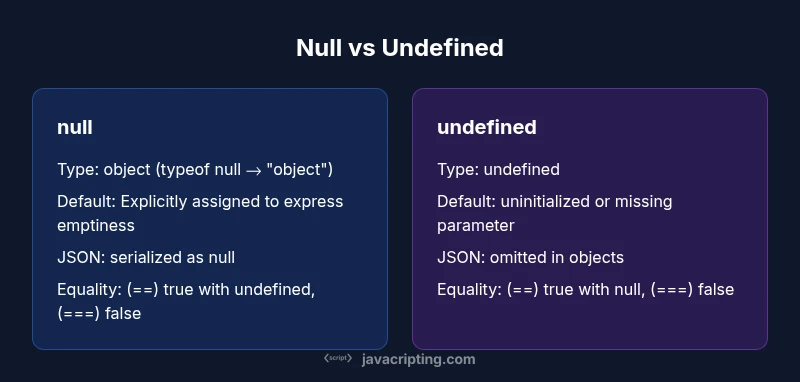
At runtime, null and undefined are distinct types, and their behavior differs in important ways. Null is of type object in typeof, but it is deliberately assigned to indicate emptiness. Undefined is its own type and typically appears when a variable is declared without an initial value or a function parameter is missing a value. In javascript null vs undefined terms, you’ll see different implications when performing checks, passing values to functions, and serializing objects. JavaScripting analysis, 2026, highlights that misinterpreting these states commonly causes logic errors in front-end applications, especially when dealing with API responses and props. Emphasize explicit initialization where possible to prevent surprise results in complex logic and nested data structures.
Type and value differences
The null value is often described as a primitive-like object, due to typeof null returning 'object'. Undefined, on the other hand, is of its own type named undefined. These type differences matter because some checks rely on the exact type rather than just a truthy/falsy evaluation. In practical terms, javascript null vs undefined distinctions matter when validating function inputs, assigning defaults, and mapping API payloads. By recognizing the exact type, you can craft more precise guards and clearer error messages, reducing the likelihood of silent failures and ambiguous runtime behavior.
Loose vs strict equality: == vs ===
A core area where javascript null vs undefined confusion arises is equality. Using == compares values with type coercion, and in this context null == undefined evaluates to true. However, null === undefined is false because the strict equality operator requires both value and type to match. This nuance is central to many functions that sanitize input or check for missing data. When you adopt consistent equality checks, your code becomes more predictable and easier to reason about, particularly in user input validation and data parsing routines.
JSON serialization and API data shapes
APIs often communicate via JSON, which adds another layer to javascript null vs undefined considerations. JSON.stringify(null) yields the literal null in output, whereas JSON.stringify(undefined) is not serialized if it’s a property value in an object (the property can be omitted). This behavior implies that API contracts can reflect null explicitly while undefined is typically not transmitted. Designers who rely on JSON must plan for these differences to avoid mismatches between client expectations and server responses. This is a practical reason to standardize on one approach within a project and document it clearly.
Common patterns: using null in APIs vs undefined in locals
A widely adopted convention is to use null for API payloads or when an explicit “no value” state needs to be communicated, while leaving variables undefined within a function’s own scope to denote “not yet assigned.” This separation mirrors intent: null signals deliberate emptiness, whereas undefined indicates that a value has not yet been defined. Adopting this pattern reduces ambiguity when data flows through a system, from input handling to business logic to UI rendering. It also helps team members quickly understand why a value is missing, not just that something is missing.
Debugging tips: checking for both values safely
When debugging, avoid generic checks like if (value) which treats 0, '', NaN, null, and undefined as falsy. Instead, leverage explicit guards: if (value === null) { /* explicit null / } else if (value === undefined) { / not assigned yet */ }. You can also use a consolidated check such as if (value == null) to catch both null and undefined, since == null is true for either state. This approach is particularly useful when validating optional function parameters or when validating API-derived data structures.
Practical guidelines: when to initialize to null vs leave undefined
In practice, initialize variables to null when a value may be assigned later but you want to express the absence of a known value early. Leave undefined for parameters and fields that will be assigned in subsequent code paths or by a higher-level function. Documenting these conventions helps maintain clarity across modules and teams, especially in large codebases where data shapes change over time. Adopting a written guideline reduces ambiguity when refactoring or extending data models, and supports consistent error handling across features.
Edge cases: global scope, function parameters, defaults
Some edge cases surface when null or undefined interacts with default parameters and global state. For example, a function parameter with a default value effectively turns undefined into a concrete value, while null remains a distinct explicit value. In global scope or module exports, avoid returning undefined unintentionally by normalizing API responses and ensuring that default values are explicit. Awareness of how null and undefined propagate through your code helps you design safer APIs and more predictable modules.
Best practices and anti-patterns
Best practices include using strict equality to avoid coercion pitfalls, documenting conventions in a central style guide, and choosing a single approach for representing missing values across a project. Anti-patterns include relying on truthy/falsy checks to differentiate the two, or using null/undefined interchangeably without documentation, which invites confusion and bugs. A disciplined approach to javascript null vs undefined improves maintainability and reduces the likelihood of subtle runtime errors in your applications.
Authority sources and further reading
To deepen your understanding, consult official and reputable sources for JavaScript semantics and behavior. MDN provides comprehensive references on undefined and null, while the ECMA-262 specification outlines language-defined behavior for these values. These sources help you validate patterns and adopt consistent practices across teams, projects, and learning journeys.
Comparison
| Feature | null | undefined |
|---|---|---|
| Primitive type | object (null) | undefined (undefined) |
| Default initialization | Explicitly assigned to null | Declared but not initialized (undefined) |
| JSON serialization | JSON.stringify(null) -> null | Properties with undefined are omitted in JSON |
| Equality with == / === | null == undefined (true) | null === undefined (false) |
| Boolean context | Falsy in conditionals | |
| Property access | Throws TypeError when accessing properties on null | Throws TypeError when accessing properties on undefined |
| typeof operator | typeof null -> 'object' | typeof undefined -> 'undefined' |
| Common use case | Deliberate emptiness (null) | Uninitialized state (undefined) |
Benefits
- Explicit intent: null communicates 'no value intentionally'
- Undefined signals uninitialized state, helping detect missing assignments
- Different JSON behavior aids API data shape validation
- Supports precise guards with strict equality to avoid coercion pitfalls
- Encourages documenting conventions for team consistency
The Bad
- Both are falsy in boolean contexts, which can mask missing values if not checked carefully
- Property access on null or undefined can throw runtime errors if not guarded
- Inconsistent usage across codebases may lead to confusion
- Over-reliance on loose checks (e.g., if (!value)) can blur the distinction between null and undefined
Null is the explicit sentinel value; undefined marks an uninitialized state. Use them deliberately to express intent and to simplify debugging.
Adopt a clear convention: null for deliberate emptiness, undefined for uninitialized data. Rely on strict checks to distinguish them, and document patterns for API data handling and internal variables. This reduces bugs and makes code easier to read.
Questions & Answers
null vs undefined diff
Null represents an intentional absence of a value, while undefined means a value hasn’t been assigned yet. The two states require different handling and checks in code.
Null is a deliberate placeholder; undefined indicates something hasn’t been set yet. Treat them with explicit checks to avoid confusion.
When to use null
Use null when you need to express an explicit empty value, such as empty fields in an API payload or a deliberate reset state.
Use null when you want to show an intentional empty value, not just an uninitialized state.
null vs undefined equality
With ==, null and undefined are considered equal; with ===, they are not. Prefer === for predictable behavior and to avoid coercion surprises.
Between null and undefined, use strict equality to avoid coercion surprises.
JSON.stringify behavior
JSON.stringify(null) yields null in the JSON string, while properties with undefined are typically omitted from objects in JSON.
Null becomes null in JSON; undefined usually disappears if it’s a property value in an object.
typeof null
typeof null returns 'object' due to historical reasons in JavaScript, while typeof undefined returns 'undefined'. This distinction matters for certain type checks.
Null looks like an object in typeof, while undefined has its own type named undefined.
Check both values in one test
You can use if (value == null) to catch both null and undefined. Use explicit checks if you need to differentiate behavior precisely.
A simple trick is to test for both without coercion, using value == null, then refine if needed.
What to Remember
- Define intent early: assign null where you mean 'no value'
- Rely on strict equality to differentiate null and undefined
- Be mindful of JSON serialization when transmitting data
- Document conventions to avoid cross-team confusion