Which Companies Use JavaScript for Backend: Real-World Examples and Patterns
Discover which companies use JavaScript on the backend, why Node.js and serverless are popular, and how to decide if JavaScript is right for server-side workloads. Practical examples, architectures, and migration tips from JavaScripting Analysis, 2026.


JavaScript powers backend systems at a wide range of companies through Node.js and serverless stacks; popular examples include Netflix, LinkedIn, PayPal, Uber, eBay, Walmart, and Trello. While Node.js remains the most visible option, organizations also explore Deno and other runtimes for service-oriented architectures and microservices. This trend reflects JavaScript’s growth beyond the browser into the server.
Why JavaScript thrives on the backend
JavaScript's journey from browser scripting to server-side work accelerated in the last decade. The Node.js environment popularized an event-driven, non-blocking model that aligns well with I/O-heavy workloads such as APIs, streaming, and microservices. According to JavaScripting, backend adoption is widespread among both startups and enterprises, driven by the ability to share code and tooling between frontend and backend teams. This alignment reduces context switching, accelerates development, and improves operations when teams can reuse validation logic, data models, and even UI-driven validation on the server.
Key reasons for this traction include:
- Abundant ecosystem: npm, Yarn, and a growing set of runtimes (Node.js, Deno) provide battle-tested components for authentication, data access, and observability.
- Developer productivity: JavaScript's dynamic capabilities and flexible typing let teams prototype quickly, then optimize critical paths later.
- Alignment with modern architectures: microservices, serverless, and edge compute are naturally supported by JavaScript runtimes that start fast and scale horizontally.
- Enterprise readiness: mature deployment pipelines, monitoring, and security tooling exist for Node-based stacks, making them viable for mission-critical services.
- Cross-functional teams: frontend-specialized squads can own backend services, reducing handoffs.
If you're asking which companies use javascript for backend, the landscape includes global platforms that run API services, streaming, and worker tasks on Node.js and serverless runtimes. The practical upshot is that teams can move faster by sharing conventions and tooling across the full stack.
Real-world adopters: who uses JavaScript on the server
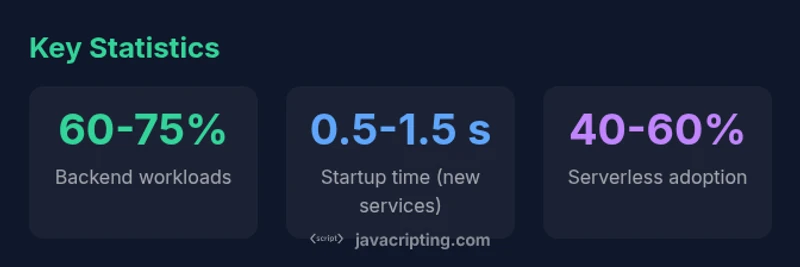
Public case studies and tech talks have highlighted several notable examples of JavaScript on the backend. Netflix has used Node.js to speed up startup times for some microservices, enabling teams to deploy faster and iterate quickly. LinkedIn migrated portions of its API surface to Node.js to improve responsiveness and developer velocity. PayPal adopted Node.js in production to unify frontend and backend code and simplify maintenance. Uber employs JavaScript-based services to support its demand-forecasting and real-time rider updates, leveraging asynchronous I/O to handle massive traffic. eBay and Walmart have both experimented with or deployed Node.js in production microservices and real-time features. Trello, with its emphasis on rapid UI feedback, has leveraged JavaScript on the server to keep development cycles short. These patterns show a common thread: teams look for speed, maintainability, and a shared language across frontend and backend to reduce friction.
Beyond the big names, many startups and mid-market teams rely on Node.js or Deno for API backends, data processing workers, and real-time services. The shared JavaScript toolchain—testing, linting, CI/CD, and security tooling—also reduces the time to ship and simplifies onboarding for new engineers. While each company has its own constraints, the overarching trend is clear: JavaScript is a viable and increasingly common server-side option when teams value speed, consistency, and extensibility.
Architecture patterns: Node.js, Deno, and serverless
The backend JavaScript ecosystem supports a spectrum of architectural choices. Node.js remains the workhorse for traditional microservices and API backends, thanks to its成熟 ecosystem, robust libraries, and efficient non-blocking I/O. Deno, a newer runtime, emphasizes security and modern tooling, offering developers a fresh approach to dependency management and module loading. For many teams, a hybrid model works best: Node.js for core APIs and services, Deno for isolated utilities, and serverless functions for event-driven workloads. Serverless patterns—using functions as a service—allow teams to scale rapidly on demand while maintaining low operational overhead. API gateways, event buses, and message queues help tie disparate services together.
Choosing between these patterns depends on traffic shape, latency requirements, and team expertise. For teams starting new projects, serverless JavaScript can deliver fast time-to-value, while a Node.js-based microservice can offer more control for long-running processes and complex business rules. Observability remains essential across all architectures; distributed tracing and centralized logging are non-negotiable for reliable operation at scale.
Performance and scalability myths about backend JavaScript
A common concern is whether JavaScript can scale to high-traffic workloads. The reality is nuanced. JavaScript runtimes excel at handling many concurrent I/O-bound operations due to the event loop, asynchronous APIs, and lightweight thread model. CPU-bound tasks, however, can become bottlenecks, especially in single-threaded runtimes. The recommended approach is to partition work: keep I/O-bound API endpoints fast with non-blocking code, and offload CPU-heavy computations to worker threads, native modules, or separate services written in performant languages. Horizontal scaling via container orchestration or serverless functions complements this approach, letting teams respond to demand without over-provisioning.
Caching strategies, careful data modeling, and efficient data access layers also play a critical role. In production, most teams observe that well-structured JavaScript backends with proper caching and load distribution can meet or exceed performance targets. The key myth to debunk is that JavaScript cannot scale; the reality is that architecture choices and task partitioning determine success more than the runtime itself.
Security considerations for backend JavaScript
Backend security in JavaScript ecosystems centers on dependencies, supply-chain risk, and runtime configuration. NPM ecosystems expose vast third-party code, making supply-chain hygiene essential. Teams should run regular npm audit checks, pin versions with lockfiles, and minimize the surface area of installed packages. Implement least-privilege service accounts, enforce secrets management, and segment services to limit blast radius in case of compromise. Keeping Node.js or Deno runtimes updated reduces exposure to known exploits. Additionally, apply standard security controls: input validation, rate limiting, and robust authentication/authorization. Finally, monitor for dependency vulnerabilities and automated alerts from security tooling to catch newly disclosed issues promptly.
How to evaluate whether JavaScript is right for your backend
Begin with an honest assessment of workload characteristics. If your services are I/O-bound, require fast iteration cycles, and benefit from shared language between front-end and back-end teams, JavaScript is worth serious consideration. For CPU-intensive workloads, plan for hybrid architectures that route heavy computation to dedicated services. Evaluate team skills, existing codebases, and compatibility with your cloud provider's offerings. Run a small pilot project that mirrors real-world traffic and measure startup times, latency, and error rates. Finally, ensure you have a feeding schedule for dependencies and security: automated tests, automated builds, and continuous delivery pipelines that can handle frequent updates.
Migration paths and best practices to adopt Node.js
If migrating from another backend language, map data models, authentication schemes, and data access layers before rewriting services. A pragmatic approach is to begin with a few microservices, expose them through a shared API gateway, and gradually remove monoliths as confidence grows. Invest in observability from day one: structured logging, metrics, tracing, and a centralized dashboard. Use containerization or serverless wherever appropriate, and consider code-sharing strategies for common utilities such as validation, serialization, and error handling. Regularly revisit architectural decisions as the system evolves, and keep the migration plan aligned with business goals.
Testing, observability, and maintenance for backend JS
Robust testing and observability are non-negotiable for production-grade JavaScript backends. Unit tests and integration tests should cover API behavior, data validation, and error paths. End-to-end tests help validate user journeys in production-like environments. Observability requires distributed tracing, logs with structured payloads, and metrics that align with service-level objectives. Establish alerting rules for error budgets, latency thresholds, and failure rates. Finally, invest in maintainable code: modular services, clear interfaces, and documentation so new engineers can onboard quickly and contribute to long-term reliability.
Representative backend patterns for JavaScript runtimes
| Use Case | Backend Runtime | Deployment Model | Notes |
|---|---|---|---|
| General API servers | Node.js / Deno | Containerized (Kubernetes) | Common for microservices |
| Serverless functions | Node.js / Deno | Cloud Functions | Event-driven workloads |
| Real-time apps | Node.js | Containers | WebSocket heavy workloads |
| Batch processing | Worker threads / Node.js | Containerized | Alternative to Python/Java for some pipelines |
Questions & Answers
Is JavaScript backend worth it for my project?
If your workload is predominantly I/O-bound and you value shared language across teams, JavaScript on the backend is a strong fit. For CPU-heavy tasks, plan for offloading or alternative runtimes.
For apps with lots of data access and API routes, JS backend is worth considering; CPU-heavy tasks may need extra care.
How scalable is Node.js for high-traffic apps?
Node.js scales well with horizontal scaling, load balancing, microservices, and asynchronous I/O. CPU-bound work should be offloaded to workers or separate services to maintain responsiveness.
Node.js scales by running many instances; offload heavy work for best results.
What runtimes exist besides Node.js?
Deno is a modern alternative with built-in tooling and improved security, while Node.js remains the most deployed runtime for production services.
Deno is an option, but Node.js remains the most common in production.
Should serverless be favored over containers for JavaScript?
Serverless excels for event-driven workloads and lower ops overhead, while containers offer more control for long-running services. Many teams adopt a hybrid approach.
Serverless is great for events; containers suit steady-state services.
Are there security concerns unique to backend JavaScript?
Dependency management and supply-chain risks are top concerns; use npm audit, lockfiles, least-privilege access, and regular updates.
Watch for dependency risks—keep packages updated and audited.
How do I start migrating an existing backend to JavaScript?
Start with a small pilot service, map data models and auth, set up CI/CD, then incrementally replace or wrap legacy components.
Begin small, establish pipelines, migrate in stages.
“JavaScript has matured into a robust backend language when paired with solid architecture, good security practices, and disciplined devops.”
What to Remember
- Lead with Node.js or serverless for fast time-to-value
- Separate CPU-bound work from I/O-bound APIs
- Adopt strong dependency hygiene and security tooling
- Invest in observability from day one
- Evaluate hybrid architectures to fit workload needs