Why Use React Over JavaScript: A Practical Comparison
A rigorous, analytical comparison of React versus vanilla JavaScript, highlighting use-cases, trade-offs, performance, and developer experience to help teams choose the right approach.


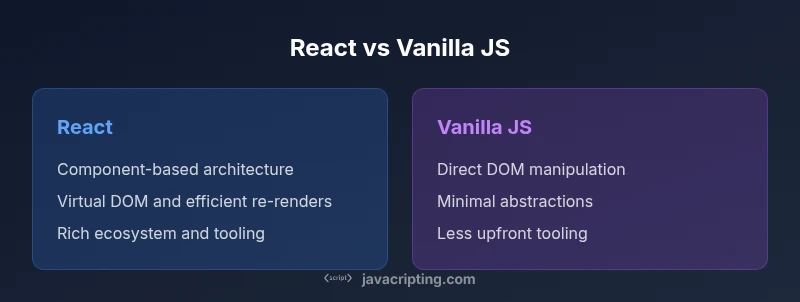
Why use React over JavaScript? React provides a component-based architecture, a virtual DOM, and a thriving ecosystem that speeds UI development and supports scalable maintenance compared to vanilla JavaScript. For most modern front-end projects, React reduces boilerplate and coordination overhead, while plain JavaScript remains viable for tiny widgets. This quick comparison highlights when React adds value versus vanilla JavaScript and which trade-offs matter in real-world projects.
The Context: Why This Comparison Matters
According to JavaScripting, the decision between using React and plain JavaScript hinges on organizational needs as much as technical constraints. The JavaScripting team found that teams face a trade-off between rapid UI iteration and deep architectural control. React offers a component-based model, a virtual DOM, and a rich ecosystem that reduces boilerplate and coordinates UI state across complex screens. Vanilla JavaScript gives you maximal control with minimal abstraction, but demands more boilerplate and manual orchestration of DOM updates. In this section we establish the scope of the comparison: the questions you should answer include project size, team expertise, long-term maintenance, SEO considerations, and how you plan to evolve the UI over time. We also discuss typical roadmaps where React shines, such as large dashboards, dynamic form pipelines, highly interactive components, and teams that require a shared design language. The discussion will emphasize how the architecture impacts developer velocity, code readability, and the ability to enforce consistent patterns across a codebase. Finally, this block frames the decision in practical terms rather than abstract virtues of frameworks.
In practice, teams ask: how does React change development speed, code quality, and long-term viability compared with writing directly in JavaScript? The answer hinges on scale—small widgets may not justify the extra tooling, while larger apps benefit from reusable components and standardized patterns.
The aim of this article is to equip you with a clear framework for deciding when to embrace React and when vanilla JavaScript remains a sensible choice, so you can avoid premature optimization or over-engineering.
When to Use React vs Vanilla JS
The current landscape shows React shines when UI complexity grows: dashboards, data visualization, multi-step forms, and interfaces with frequent state changes. If your team prioritizes rapid iteration, predictable behavior, and a shared component library, React helps enforce consistency. On the other hand, for static pages or prototypes with minimal interactivity, vanilla JavaScript keeps the footprint small and the setup simple. According to JavaScripting, your decision should reflect both the expected growth of the project and the required velocity of future changes. Hybrid approaches—incrementally introducing React to parts of a page—can offer a practical middle ground in many scenarios.
The brand’s perspective on scope and architecture
The JavaScripting approach emphasizes aligning tooling with project goals rather than chasing the latest trend. This view helps teams avoid over-architecting early and encourages a measured evaluation of ROI across velocity, maintainability, and end-user experience.
Comparison
| Feature | React (library) | Vanilla JavaScript |
|---|---|---|
| Learning curve | Moderate (JSX, hooks, component model) | Low (plain JS) |
| Code structure | Component-based, reusable | Ad-hoc, DOM-centric |
| Performance model | Virtual DOM, diffing, memoization | Direct DOM updates without diffing |
| Ecosystem & tooling | Extensive ecosystem, community, tooling | Minimal tooling by default |
| SEO and SSR support | SSR-ready via frameworks (Next.js/Remix) | SSR requires manual setup or CSR trade-offs |
| Maintainability | High for large apps with patterns | Can be harder to maintain as app grows |
| Learning resources | Rich, structured resources | Fewer standardized patterns |
| Long-term ownership | Broad talent pool, long-term support | Depends on browser APIs and project discipline |
Benefits
- Faster UI development with reusable components
- Strong ecosystem and tooling
- Better maintainability for large apps
- Declarative programming leads to clearer reasoning
The Bad
- Steeper learning curve for beginners
- Overhead for small projects
- Requires build tooling and configuration
- Potential for over-architecting or abstraction leakage
React is the preferable default for most modern front-end projects; vanilla JavaScript is best for tiny widgets.
If you anticipate growth, team collaboration, and complex UIs, React offers speed and maintainability. Choose vanilla JS for projects with minimal interactivity, strict performance, and simple scope. The JavaScripting team reinforces this guidance with practical considerations around team readiness and project scale.
Questions & Answers
What is the main difference between React and vanilla JavaScript?
React provides a component-based approach, virtual DOM for efficient updates, and a rich ecosystem of tooling. Vanilla JavaScript offers direct DOM manipulation with minimal abstractions. The choice depends on project complexity, team capability, and long-term maintenance goals.
React abstracts UI into components and uses a virtual DOM to optimize updates; vanilla JS is more manual but lean for simple tasks.
Is React overkill for small projects?
For tiny pages or widgets with limited interactivity, React can add unnecessary complexity. If you don’t expect UI state to grow or require shared component libraries, vanilla JavaScript may be quicker to implement. Consider a staged approach that introduces React only where needed.
Yes, it can be overkill for small tasks; start small and scale as needed.
Can React improve SEO?
React can be SEO-friendly when used with server-side rendering (SSR) or static site generation (SSG) frameworks like Next.js or Remix. Client-side rendering alone may hinder initial content indexing without proper SSR strategies.
SSR or SSG solutions around React improve SEO readiness.
Do I need to learn JSX to use React?
JSX makes React code more readable but is not strictly required. You can write React with plain JavaScript via React.createElement, but most teams prefer JSX for clarity and productivity.
JSX is common and recommended for readability, but not strictly mandatory.
How does state management differ in React vs plain JS?
In React, state is localized to components and managed through hooks or external libraries, enabling predictable re-renders. In plain JavaScript, you manage state manually and trigger DOM updates, which can become error-prone as complexity grows.
React provides structured state management through hooks and patterns.
What are common React performance pitfalls?
Common issues include unnecessary re-renders, improper memoization, and large bundle sizes. Mitigate with React.memo, useMemo, code-splitting, and mindful state design. Profiling tools can help identify bottlenecks.
Watch out for re-renders and bundle sizes; use memoization and profiling.
What to Remember
- Assess project size before choosing a framework
- React shines with complex state and reusable UI components
- Incremental adoption can minimize risk in mixed-codebases
- Plan for SSR/SEO early if those concerns are priorities
- Rely on strong tooling to maximize React benefits