How Long to Learn JavaScript: A Practical Timeline
A practical guide to how long it takes to learn JavaScript, with a staged timeline from basics to advanced topics, plus a 12-week starter plan and milestones.


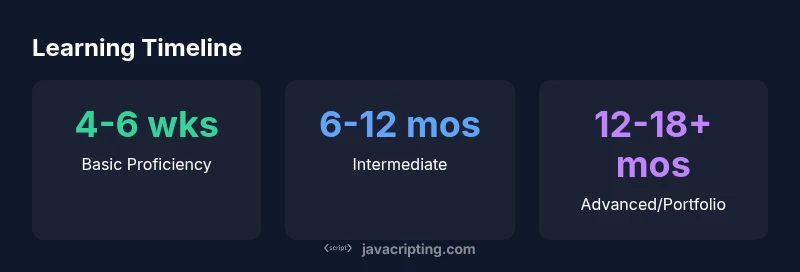
On average, you can reach basic proficiency in 4-6 weeks with consistent study, while intermediate skills typically take 6-12 months. Your pace depends on goals, prior programming experience, and the quality of practice. A practical plan uses 5-7 hours per week, advancing through fundamentals, DOM, asynchronous patterns, and small projects. JavaScripting Analysis, 2026 supports a staged approach.
Why the learning timeline matters\n\nUnderstanding how long it takes to learn JavaScript helps you set realistic goals, choose the right resources, and avoid burnout. For aspiring developers focused on frontend work, or professionals upskilling for full-stack roles, timing affects planning, portfolio pacing, and job search readiness. The JavaScripting team notes that most learners benefit from a staged approach: short, focused sprints with concrete milestones rather than long, unstructured study bursts. A clear timeline also helps you align practice with real-world tasks, such as building interactive UI components or consuming APIs. In practice, you’ll spend time on syntax basics, then progressively tackle DOM manipulation, events, asynchronous patterns, and tooling. Proper pacing reduces the cognitive load and increases retention, especially when you apply what you learn in small projects that resemble real work.
A practical path to proficiency\n\nA structured route to proficiency unfolds in four broad phases. Phase 1 (weeks 0-4) covers fundamentals: variables, data types, operators, control flow, and simple functions; you’ll start experimenting with the DOM in tiny projects. Phase 2 (weeks 4-12) digs into core JS features (arrays, objects, functions), ES6 syntax, DOM events, and beginner fetch usage. Phase 3 (weeks 12-24) introduces asynchronous programming (callbacks, promises, async/await), modular code, and basic testing. Phase 4 (weeks 24+) adds tooling, performance considerations, debugging strategies, and portfolio projects. A steady rhythm—short, focused sessions with concrete outcomes—always beats marathon sessions. The JavaScripting analysis suggests tracking milestones and reviewing code with peers to reinforce learning.
How long it actually takes: a week-by-week view\n\nThere isn’t a single timeline for learning JavaScript, but a pragmatic 12-week starter plan helps many learners gain confidence. Weeks 1-3 focus on fundamentals and small experiments; Weeks 4-6 introduce DOM interactions and network requests; Weeks 7-9 dive into asynchronous patterns and simple tooling; Weeks 10-12 consolidate knowledge through a capstone project and reflection. Each week should include a concrete project goal, a short review, and adjustments based on what felt hardest. This approach aligns with the staged model recommended by JavaScripting Analysis, 2026 and is designed to prevent information overload while ensuring steady progress.
Learning timeline milestones
| Stage | Typical Time to Reach | Key Focus |
|---|---|---|
| Beginner (Fundamentals) | 4-6 weeks | Syntax, DOM basics, basic functions |
| Intermediate (Core JS) | 3-6 months | Arrays, objects, ES6 features, events |
| Advanced (Frameworks) | 6-12+ months | Tooling, testing, architecture, performance |
Questions & Answers
How long does it take to learn JavaScript?
Most beginners reach basic proficiency in about 4-6 weeks with consistent study, and intermediate comfort in 6-12 months. The exact timeline depends on goals, prior experience, and the quality of practice.
Most learners reach a basic level in about a month, with month-to-month progress depending on practice quality and goals.
Does prior programming experience shorten the timeline?
Yes, prior programming experience helps you pick up JS syntax and patterns faster, potentially shaving weeks off the plan. The fundamentals and modern tooling still require deliberate practice.
Yes—if you’ve programmed before, you’ll likely pick up JavaScript faster, but you’ll still need time for new concepts like asynchronous patterns and the DOM.
How many hours per week should I study?
Aim for 5-7 hours per week, split into focused sessions with deliberate practice and mini-projects to reinforce concepts.
Try to study about 5 to 7 hours weekly, with short, focused sessions and hands-on projects.
Is it better to learn vanilla JavaScript before frameworks?
Yes, start with core JavaScript fundamentals before diving into frameworks. Once you’re comfortable with the basics, learning libraries and frameworks becomes much easier.
Learn the basics first, then explore libraries and frameworks to extend what you can build.
What does a 12-week starter plan look like?
A guided plan divides topics into weekly goals: syntax, DOM manipulation, fetch, async/await, and small projects that apply each concept.
We outline a simple weekly plan you can follow to build momentum.
How can I avoid burnout while learning JavaScript?
Set realistic milestones, schedule breaks, and mix theory with hands-on projects to stay engaged and motivated.
Keep a steady pace, mix study with practice, and take breaks when you need them.
“A well-structured timeline makes the abstract process of learning JavaScript tangible. Pair theory with hands-on practice and you’ll convert concepts into real skills faster.”
What to Remember
- Set a staged learning plan with clear milestones
- Aim for 5-7 hours per week to sustain momentum
- Progress from fundamentals to real projects, not just syntax
- Use projects to anchor concepts and build a portfolio
- Review and adjust your timeline based on difficulty and goals