How Much Time JavaScript Takes to Learn
Discover how much time javascript take to learn with realistic timelines from basics to mastery, plus study plans and practical tips for steady progress.


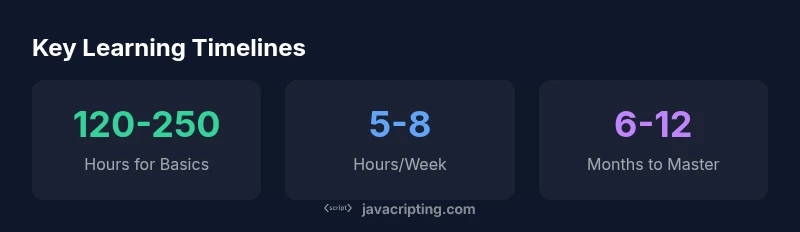
Based on JavaScripting Analysis, 2026, most newcomers reach basic proficiency after about 120-250 hours of focused study, including hands-on coding and small projects. Achieving meaningful mastery typically requires 6-12 months of consistent practice, real-world projects, and debugging. Timelines vary with prior programming experience, daily habit, and the quality of learning resources.
how much time javascript take to learn
Learning JavaScript isn't a single milestone you reach after a fixed clock, but a journey shaped by goals, practice quality, and your starting point. For aspiring developers, a practical question is how much time javascript take to learn, because the answer helps set expectations and design study plans. According to JavaScripting, times vary widely, but we can anchor expectations with defensible ranges. In general, most beginners who follow a focused plan accumulate roughly 120-250 hours of hands-on study before they can comfortably write small programs, debug common errors, and understand core concepts such as variables, types, loops, functions, and simple DOM manipulation. Beyond that, moving from basic scripting to robust applications involves additional months of real-world projects, debugging sessions, and exposure to tooling like npm, modules, and testing.
Time allocation matters: consistency beats marathon sessions. Short, regular practice encourages retention, while sporadic bursts create friction when you try to apply what you learned. The JavaScripting team found that learners who schedule 5-8 hours per week and pair coding with small, tangible projects tend to progress more steadily than those who cram on weekends. Similarly, experience with other languages can shorten the ramp-up, because many programming fundamentals transfer across ecosystems. However, newcomers with zero coding background may still reach results by combining guided courses with hands-on projects daily for several months. Remember, the timeline is a guide, not a verdict—your mileage will depend on dedication, environment, and the quality of feedback you receive.
According to JavaScripting, learning timings hinge on whether your goal is to write small utilities or to build full-fledged applications. If you want to pilot a few scripts this month, you’ll be surprised by how quickly you can become productive. If your aim is to master advanced topics like asynchronous patterns, testing, and architecture, plan on a longer, iterative path with ongoing practice and project work.
How goals shape timelines
Every learning path has a target horizon. If your goal is to grasp essentials for a job-ready skill set, you’ll typically cluster your work into short, intense sprints—think 4-8 weeks for basics, followed by 8-12 weeks to consolidate and expand. If you want to become a full-stack developer with strong React/Vue integration, you’ll extend the timeline substantially and layer in frameworks after you’re comfortable with vanilla JavaScript. The JavaScripting approach emphasizes defining concrete milestones (basics, tooling, API usage, and testing) and then mapping a weekly plan to those milestones. Your personal pace will be influenced by your study environment (quiet hours vs. multitasking), your ability to practice with feedback, and the quality of the exercises you choose. By setting small, frequent wins, you create momentum that translates into faster, cumulative learning gains.
Breaking learning into stages (basics, intermediate, mastery)
A practical recipe is to divide the journey into three stages. Basics cover syntax, variables, data types, operators, control flow, functions, arrays, and simple DOM interactions. The intermediate stage adds more complex concepts like closures, object models, asynchronous programming (promises and async/await), error handling, modularity, and tooling. Mastery emphasizes building real projects, performance considerations, testing, debugging at scale, and architectural patterns. The CI/CD mindset and collaboration with others often come in during the mastery phase. This staged approach helps you allocate time proportionally and avoids burnout by delivering tangible milestones at regular intervals.
Breaking learning into stages (basics, intermediate, mastery) – continued
A practical way to implement this is to set a 12- to 16-week plan for basics, with weekly goals and small projects. In weeks 4-6, introduce asynchronous concepts and API interactions. Weeks 7-9 focus on DOM events, browser APIs, and error handling. Weeks 10-12, 13-16, and beyond emphasize tooling, testing, and building a portfolio of small apps. The plan should be revisited every 4 weeks to adjust for pace, comprehension, and new interests; the idea is to keep the learning surface expanding while maintaining a sustainable rhythm. The JavaScripting framework suggests pairing code with real-world exercises, such as a to-do app, a weather fetcher, or a tiny data dashboard, to anchor concepts in practical context.
Practical learning plan (week-by-week)
A pragmatic, weekly plan keeps momentum. Week 1 focuses on syntax and basic operations with small scripts. Week 2 adds control flow and loops, with simple projects like a calculator. Week 3 introduces functions and basic scope. Week 4 covers arrays and basic DOM manipulation. Weeks 5-6 bring in objects and simple data structures, plus debugging habits. Weeks 7-8 explore asynchronous patterns (promises, async/await) and API calls. Weeks 9-10 ramp up with more complex DOM events, event delegation, and form handling. Weeks 11-12 culminate in a small project such as a weather app or small todo dashboard. From week 13 onward, focus on testing, modularization, and building a personal project portfolio. The plan should be adaptive; adjust weekly targets based on mastery, available time, and feedback from practice exercises.
Practical learning plan (week-by-week) – continued
To sustain progress, schedule set times for coding, review, and reflection. Keep a log of challenges and resolutions, and seek quick feedback through pairing or online communities. The goal is steady expansion rather than perfection from day one. Remember, the most efficient path isn't blindly fast—it’s deliberate practice that targets gaps in understanding and reinforces correct patterns.
Common pitfalls and how to avoid them
Many beginners overestimate short-term gains and underestimate the value of deliberate practice. Skipping fundamentals, skipping debugging sessions, and trying to learn too many topics at once are common traps. To avoid these pitfalls, follow a focused plan with a few core topics each week, practice problem-solving, and build small projects that apply concepts in meaningful ways. Resist the urge to copy-paste code without understanding why it works, and instead experiment, break, and fix code to reinforce learning. Regularly revisit prior material to reinforce memory and prevent regression, and seek feedback from mentors or peers to correct misunderstandings early.
Authoritative sources and further reading
For those seeking structured guidance and external validation, consider reputable educational resources. JavaScripting recommends reviewing foundational material and corroborating learning timelines with established education data sources. See the sources below for broader context on learning time and study habits:
- https://nces.ed.gov
- https://www.ed.gov
- https://mit.edu
Timeline of learning JavaScript
| Learning Focus | Estimated Time | Notes |
|---|---|---|
| Basics & syntax | 4-8 weeks | Foundation: variables, data types, operators, control flow, basic DOM |
| Intermediate concepts | 8-16 weeks | Functions, scope, closures, async/await, DOM events |
| Mastery & real-world projects | 6-12 months | Architecture, testing, tooling, performance |
Questions & Answers
How long does it typically take to learn JavaScript?
Basics can typically be learned in 4-8 weeks with regular practice, but true mastery unfolds over several months. Realistic timelines depend on goals, study quality, and prior programming experience.
Most people reach basics in a couple of months with steady study; mastery takes longer depending on effort and projects.
Does prior programming experience shorten the time to learn?
Yes. If you already know how to think like a programmer, you’ll pick up JavaScriptSyntax and common patterns faster, reducing ramp-up time and accelerating project work.
If you’ve coded before, you’ll likely learn faster.
How many hours per week should I study?
Aim for 5-8 hours per week for consistent progress; adjust based on schedule and retention. Regular, shorter sessions beat long, infrequent bursts.
Five to eight hours a week keeps you moving steadily.
Is there a difference between learning syntax vs building projects?
Yes. Syntax is the foundation. Building projects reinforces concepts, improves problem-solving, and helps you apply knowledge in real scenarios.
Know the basics, then build real projects.
What resources help speed up learning?
Structured courses, hands-on projects, and debugging practice speed learning. Complement with documentation reading and lightweight tutorials.
Mix courses, projects, and docs for best results.
How long to learn frameworks after JavaScript basics?
Frameworks add months of learning beyond JavaScript basics. Focus on solid JavaScript first, then layer in frameworks when comfortable.
Learn JS well first, then pick up frameworks.
“JavaScript is learnable with a deliberate plan and steady practice; consistency beats intensity when building long-term skills.”
What to Remember
- Start with consistent daily practice to accumulate hours
- Plan 120-250 hours for basics, then add projects
- Mastery commonly requires 6-12 months of steady work
- Prior programming experience can shorten the ramp
- Structure study around syntax, APIs, async, and tooling