How to Learn JavaScript for Beginners: A Practical Guide
A practical, step-by-step guide to learning JavaScript for beginners, with hands-on exercises, debugging tips, and beginner-friendly projects to build confidence.


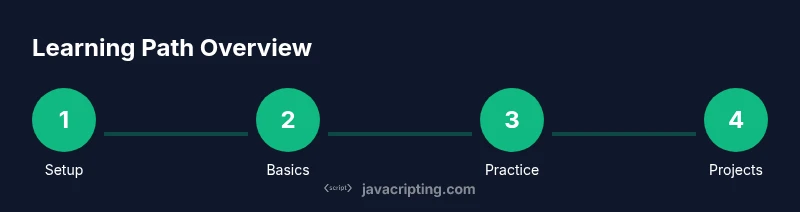
Goal: learn how to start JavaScript for beginners by setting up a simple development environment, writing your first script, and understanding core concepts. You’ll cover variables, data types, operators, basic functions, and how to run code in a browser console. The steps are practical, with runnable examples and troubleshooting tips to help you gain confidence quickly—no prior programming experience required.
What JavaScript is and why it matters for beginners
JavaScript is the scripting language that powers interactivity on the web. For beginners, it’s the bridge between static HTML pages and dynamic experiences. According to JavaScripting, learning JavaScript for beginners today sets you up for opportunities across front-end, back-end, and mobile app development. You’ll discover how JavaScript runs in the browser and on servers with Node.js, and how it interacts with HTML and CSS to make websites feel alive. Start by understanding the big picture: JavaScript adds behavior to pages, from form validation to animations, and it enables you to build useful tools directly in the browser. With patience and practice, you’ll move from writing simple statements to composing small programs that solve real tasks. This initial understanding prepares you for practical projects that reinforce theory with real results.
Setting up your beginner-friendly environment
Before you write a line of code, set up a lightweight, comfortable workspace. You will need a modern web browser (Chrome or Firefox), a text editor (VS Code recommended), and access to the browser's developer tools console. Node.js is optional for now but useful later for server-side practice. If you’re on Windows or macOS, installing Node.js ensures you can run JavaScript outside the browser and use npm to manage packages. Keep your environment simple: a single project folder, a couple of starter files, and a plan to save and test frequently. This approach reduces cognitive load and helps you focus on the language itself rather than setup hassles. JavaScripting notes that consistent, short practice sessions beat long, sporadic sessions for mastering basics.
Your first script: Hello world and a tiny interaction
A classic starting point is printing a message to the console and showing a tiny interaction on the page. Create an index.html file and a script.js file, then link them. In script.js, write console.log('Hello, JavaScript!'); and experiment with a simple DOM update, such as document.getElementById('output').textContent = 'Welcome to JS basics'; Observe how your code runs when you refresh the page. This hands-on exercise builds confidence and demonstrates the immediate feedback loop that makes programming rewarding. Repeat with variations to see how changes propagate in real time.
Core syntax you must know: variables, data types, and operators
JavaScript uses variables to store data: let name = 'Ada'; const age = 30; var x = 5; Today, let and const are preferred for most cases. Data types include numbers, strings, booleans, null, undefined, and objects. Operators such as +, -, *, /, and % perform arithmetic, while comparisons (==, ===, !=, !==, >, <) and logical operators (&&, ||, !) help you make decisions. Strings support concatenation with + and template literals with backticks. As a beginner, practice by creating small expressions, logging results, and gradually combining them into meaningful statements.
Control flow: if statements, switch, and loops
Control flow decides which code runs. Start with if statements to react to conditions: if (score >= 60) { console.log('pass'); } else { console.log('fail'); } Switch statements offer multi-way branching, beneficial when you have several distinct cases. Loops—for, while, and do-while—help you repeat tasks efficiently. A simple loop might print numbers 1 through 5. Practice is essential: write small programs to decide what to display for different inputs and to ensure your code handles edge cases gracefully.
Functions: reusable logic and scope
Functions group instructions into reusable blocks. Define a function: function greet(name) { return Hello, ${name}!; } Or use an arrow function for concise syntax: const greet = (name) => Hello, ${name}!; Functions create modular, testable code. Practice by building a tiny calculator function, a converter between units, or a formatter for user input. Understand how parameters, return values, and scope affect behavior. As you advance, you’ll see how closures and higher-order functions unlock more powerful patterns.
Working with data: arrays and objects
Arrays store ordered lists: const nums = [1,2,3]; Objects store key-value pairs: const user = {name:'Ada', age:30}. Learn common methods like push, pop, map, filter, and forEach for arrays. Objects enable nested data structures and simple data modeling. Try a mini exercise: transform an array of numbers, or create an object to represent a shopping cart. Practice helps you see how data shapes influence logic.
The browser environment: DOM and events
In the browser, JavaScript interacts with the Document Object Model (DOM). Use document.getElementById('hello').textContent = 'Hi'; to update page content. Event handling connects code to user actions: button clicks, key presses, and form submissions. Example: document.querySelector('button').addEventListener('click', () => alert('Clicked!')); Understanding the DOM makes your scripts tangible and visible, turning concepts into real experiences for users.
Debugging and common beginner mistakes
Expect errors and learn to read stack traces. Start with console.log statements to verify values, and use breakpoints in dev tools to pause execution. Common mistakes include typos, off-by-one errors in loops, and forgetting to declare variables in strict mode. Develop a habit of incremental testing, clear naming, and commenting. Remember that debugging is a skill as important as writing code.
Putting it all together: a tiny project and next steps
Now you’re ready to combine what you’ve learned into a small project. Build a simple interactive to-do list: an input for new tasks, a button to add tasks, and a display area that shows items. Practice by expanding features, refactoring into functions, and gradually introducing modules if you’re curious about structure. Finally, explore more resources from MDN and ECMA standards for deeper understanding, and keep a steady practice routine.
Tools & Materials
- Computer with internet access(Stable connection recommended)
- Modern web browser (Chrome or Firefox)(Latest version for best debugging tools)
- Code editor (e.g., Visual Studio Code)(Extensions are optional; start simple)
- Browser console access (DevTools)(F12 or right-click > Inspect to open)
- Optional: Node.js(For server-side practice later)
- Notebook or digital notes(Record examples and ideas)
Steps
Estimated time: 3-4 hours
- 1
Set up your workspace
Create a dedicated project folder, install a code editor, and open your browser’s developer tools. This step establishes a stable environment for writing and testing code. Keep a simple structure: index.html, script.js, and a single output element for demonstrations.
Tip: Organize files with clear names and use a consistent folder structure to reduce confusion later. - 2
Create your first files
Add an index.html and a linked script.js. Include a basic HTML scaffold and a script tag or external JS reference. This gives you a place to run and see JavaScript output in the context of a webpage.
Tip: Use descriptive file names and comment the purpose of each file at the top. - 3
Write a simple console log
In script.js, write console.log('Hello, JavaScript!'); Save and refresh the browser to see the message in the console. This confirms the environment is wired correctly and you can start experimenting immediately.
Tip: Check the console panel for any syntax errors and fix them before moving on. - 4
Experiment with DOM updates
Add a DOM interaction, such as document.getElementById('output').textContent = 'JS basics'; This shows how code can modify the page content in real time. Inspect the element in the DOM to verify changes.
Tip: Start with a single, simple DOM change before layering more logic. - 5
Learn variables and data types
Declare let and const variables, assign strings, numbers, and booleans, and log them. Practice basic operations like concatenation and template literals to build dynamic strings.
Tip: Prefer const for values that don’t change; use let for variables that will be reassigned. - 6
Write and use a small function
Create a function that takes input and returns a result, then call it and log the outcome. This reinforces modular thinking and reusability.
Tip: Aim for functions with a single responsibility and clear names. - 7
Work with arrays
Create an array of numbers, traverse it with a loop, and use map or filter to transform data. Observe how array methods affect the original data.
Tip: Experiment with chaining methods for concise, readable code. - 8
Introduce objects
Model a simple person with an object, access properties, and modify them. This builds familiarity with key-value data and nested structures.
Tip: Use meaningful property names to improve readability. - 9
Explore the DOM and events
Select elements, update content, and attach a click event to respond to user actions. This makes your pages interactive and tangible.
Tip: Test event handlers with quick console feedback before expanding behavior. - 10
Build a tiny project
Combine what you’ve learned in a small project (e.g., a to-do list). Refactor into functions, add small features, and debug any issues that arise.
Tip: Document decisions and note what you’d improve next time.
Questions & Answers
Do I need to learn HTML before JavaScript?
It's helpful to know HTML because JavaScript interacts with the DOM, but you can learn basics in isolation. Start with plain scripts and gradually link them to HTML as you experiment with page updates.
Knowing HTML helps you see how JavaScript changes a web page, but you can start with pure JS concepts first.
Can I practice JavaScript without a browser?
Yes, you can practice with Node.js to run JavaScript outside the browser. This is useful for algorithms and utilities. However, you’ll miss DOM interactions that browsers provide.
You can run JS with Node, but you won’t see the live webpage interactions yet.
What are the best resources for beginners?
Start with structured tutorials, official docs like MDN, and small practice projects. Avoid overwhelming yourself with too many options at once. Pick a path and stick with it for consistency.
Choose a few reliable sources and build small projects to apply what you learn.
How long does it take to learn the basics?
It varies, but with consistent practice you can grasp core concepts in a few weeks. Set a regular study schedule and build progressively more challenging exercises.
Give yourself a few weeks of steady practice and you’ll see steady progress.
Should I use vanilla JS or frameworks later?
Begin with vanilla JavaScript to understand fundamentals. After you’re comfortable, explore frameworks to tackle larger apps and learn tooling.
Learn the core first, then pick a framework when you’re ready for bigger projects.
What is the browser console and how to use it?
Open DevTools (F12) and use the Console tab to run snippets, test expressions, and inspect errors. It’s your quick playground for experiments and debugging.
DevTools console is your quick playground for trying code and spotting issues.
Watch Video
What to Remember
- Set up a stable workflow and stick to it
- Master variables, data types, and basic syntax
- Practice control flow, functions, and data structures
- Experiment in the browser and inspect output in console
- Progress from small scripts to tiny projects