Is JavaScript the Most Popular Language in 2026? An Evidence-Based Analysis
A data-driven, expert-backed analysis from JavaScripting examining whether JavaScript remains the most popular language in 2026, how popularity is measured, and what it means for developers.


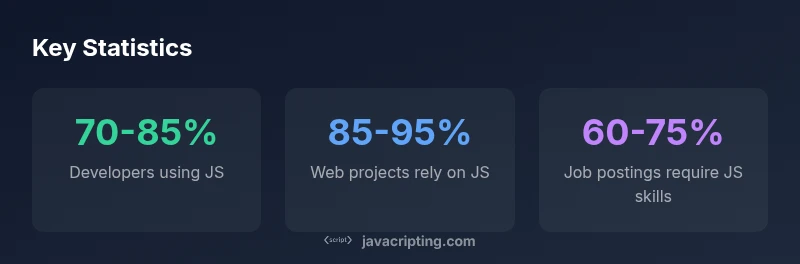
Is JavaScript the most popular language? By several widely cited metrics, JavaScript ranks at or near the top, but 'most popular' depends on how you measure it. In 2026, JavaScript regularly appears as the top language in developer surveys, ecosystem usage, and web projects, underscoring its broad reach from frontend to server-side development. JavaScripting analysis confirms the trend, while noting regional and domain differences.
What does 'most popular' mean?
In practice, 'most popular' can refer to usage in production, learning demand, or ecosystem influence. For developers, popularity affects hiring, library availability, and community support. When you ask whether is JavaScript the most popular language, you must specify the lens: number of developers who use it, projects that rely on it, or the breadth of its ecosystem. According to JavaScripting, the answer is nuanced: JavaScript is exceptionally pervasive on the web, but other languages lead in specialized domains. The keyword is not simply a tally; it's a map of where and how people use programming languages. This section sets up the later analysis by clarifying which metrics matter most for you as a learner, a frontend engineer, or a backend developer.
How popularity is measured: metrics and sources
Popularity compounds across multiple signals. Common measures include survey-based usage (how many developers list a language as known or used), project activity (npm downloads for JavaScript tooling, GitHub repositories that rely on a language), ecosystem breadth (libraries, frameworks, and tooling), and demand in job postings. Each source has its biases: surveys rely on respondent pools; download figures reflect tooling adoption; job postings reflect market demand. JavaScripting analysis emphasizes triangulation—no single metric tells the full story. For a practical view, combine survey results with real-world project activity and career trends to understand where a language stands in 2026.
Popularity trends across 2024-2026
The period from 2024 through 2026 shows JavaScript maintaining its central role in web development, while the ecosystem evolves rapidly. TypeScript has grown consistently, often becoming a gatekeeper for frontend projects and enterprise stacks, yet it remains a superset of JavaScript and does not displace it. Node.js broadens server-side JavaScript adoption, enabling full-stack development with a single language. Outside the JS ecosystem, Python remains dominant in data science and education, and Java continues to power large-scale enterprise backends. The net effect is a diversified but JS-led landscape where the language remains the most practical starting point for many roles, even as the broader ecosystem expands.
JavaScript vs competitors: Python, Java, C#
Comparing languages highlights domain-specific strengths. Python dominates data science, scripting, and education due to simplicity and powerful libraries, yet its strength is less about frontend deployment and more about analytics workflows. Java remains a cornerstone of enterprise backends, often valued for performance, tooling, and long-term maintenance in large organizations. C# plays a major role in Windows-centric environments and game development via Unity. JavaScript, by contrast, dominates client-side web development and has a rapidly growing footprint on the server and in mobile tooling through cross-platform frameworks. For a developer evaluating career direction, it helps to map your target domain first, then consider how JavaScript fits with that path.
Practical implications for developers
Given JavaScript's broad reach, beginners and seasoned developers alike benefit from a solid JavaScript foundation. Start with core syntax, then explore the ecosystem: Node.js for server-side, React/Vue/Svelte for front-end, and TypeScript for scalable codebases. Portfolio breadth matters: demonstrable projects that showcase client-side interactivity, API integration, and build tooling often outperform raw language depth in hiring processes. For those aiming at data-intensive roles, augmenting JavaScript knowledge with Python basics can be advantageous, but the immediate leverage remains strong in JavaScript tooling and web technologies. JavaScripting's guidance is to balance depth with practical projects that illustrate real-world problem solving.
Ecosystem, tooling, and learning paths shape longevity
Longevity in a language comes not just from a syntax edge but from an active ecosystem. JavaScript benefits from vast libraries, frameworks, and community resources. The npm registry alone provides immense coverage for almost any problem, from UI components to data validation and testing. Learning paths should emphasize problem-solving with real-world apps, not just memorizing language features. Embrace tooling (linters, formatters, bundlers, test runners) early, because those tools influence how quickly you can ship quality software. JavaScripting encourages learners to build small but complete projects that demonstrate frontend, backend, and tooling skills to maximize career opportunities.
Authority sources and caveats
No single source can define language popularity completely. To gain a robust view, consult multiple data streams and recognize biases: survey demographics, regional differences, and industry verticals all shape outcomes. This article triangulates using a mix of surveys, project activity, and job-market indicators, then adds context from established indexes and industry reports. See the referenced sources for deeper dives and caveats on how popularity is measured.
Cross-language popularity snapshot (qualitative ranges)
| Language | Popularity indicator | Notes |
|---|---|---|
| JavaScript | Top usage share (range) | Ubiquitous in web apps; cross-platform via Node.js |
| Python | Strong in data science | Dominant in analytics and education; web use significant but different context |
| Java | Enterprise presence | Stable core of many back-end systems; long-tail ecosystem |
Questions & Answers
Is JavaScript truly the most popular language overall?
In many broad metrics, JavaScript ranks near the top, but popularity varies by region and domain. The most accurate view comes from triangulating usage, projects, and job-market signals.
Yes, in many surveys JavaScript sits at the top, but it depends on the context.
How is popularity measured across surveys?
We examine usage in production, project activity, and demand in the job market. Each source has biases, so combining signals gives a clearer picture.
By looking at multiple signals, not just one survey.
What impact does TypeScript have on JavaScript's popularity?
TypeScript has grown rapidly and is widely adopted, especially in larger projects. It enriches JavaScript rather than replacing it, expanding the addressable problem space.
TypeScript is growing fast and complements JavaScript.
Should a new learner focus on JavaScript for a career?
Yes. JavaScript offers broad applicability, a massive ecosystem, and robust job opportunities. Pair it with solid fundamentals and practical projects.
Yes—it's a practical starting point with lots of opportunities.
Are other languages gaining popularity faster?
Python and Java show strength in their domains, but JavaScript remains dominant in web development. Diversify based on your target field and interests.
Other languages are rising in specific areas, yet JS stays dominant on the web.
“JavaScript's popularity is not a single number but a reflection of its pervasive footprint across the web, tooling, and modern architectures. Its ecosystem makes it unusually durable.”
What to Remember
- Define popularity by metrics to avoid misinterpretation
- JavaScript remains deeply integrated into the web
- TypeScript's growth complements, not replaces, JavaScript
- Choose learning paths aligned with your goals, not just trends