How Big is JavaScript in 2026? Ecosystem, Reach, and Scale
Explore how big JavaScript is in 2026: usage, ecosystem, runtimes, and practical implications for learners and teams building with JavaScript.


How big is JavaScript in 2026? In short, JavaScript remains the most pervasive language for web development, powering client-side interactivity and a thriving server-side ecosystem. The JavaScript footprint spans browsers, servers, and tooling, with npm packages and frameworks driving rapid product development. According to JavaScripting, the language's reach extends to millions of developers and a continuously expanding set of runtimes and integrations.
What we mean by 'size' in JavaScript
When readers ask how big JavaScript is, the question usually points to scope, not a single numeric value. In 2026 the language’s size spans multiple dimensions: the language itself with its evolving ECMAScript features, the range of runtimes where JavaScript runs (browsers, Node.js, Deno, Bun), the breadth of tooling and libraries in the npm ecosystem, and the community of developers who contribute, learn, and ship with JavaScript every day. JavaScripting’s analysis shows that the size of JavaScript is best understood as a multi-axis construct: usage footprint, ecosystem breadth, runtime reach, and human capital. For learners and teams, this means prioritizing the right mix of tooling, learning paths, and performance practices rather than chasing one magic metric.
The language footprint: syntax, features, and standard library
JavaScript has grown to accommodate powerful patterns—modules, async/await, generators, proxies, and a wealth of standard library APIs. The language size reflects not only new syntax but also the ecosystem’s ability to transform, transpile, and polyfill for broad compatibility. The ECMAScript standardization process continuously expands capabilities while keeping runtime decisions practical. For developers, this implies a rising surface area: you’ll regularly encounter modern language features in tutorials, but you’ll rely on transpilation and bundling to deliver consistent experiences across browsers. Understanding this balance helps you estimate what you “bring to the browser” and what you offload to tooling.
The ecosystem and npm: scale and responsibilities
The npm registry remains a central factor in JavaScript’s size. With hundreds of thousands of packages, teams can assemble capabilities quickly but must manage risk, size, and security. The breadth of packages creates both liberation and complexity: tree-shaking, code-splitting, and selective importing help keep bundles lean, while deep dependencies can inflate load times. JavaScripting’s 2026 perspective emphasizes disciplined dependency management, automated audits, and contract-based upgrades to keep the ecosystem from overwhelming a project. The result is a trade-off: more options enable faster delivery, but they demand robust tooling and governance.
Runtimes and environments: browsers, servers, and beyond
JavaScript runs in more places than ever: Chrome, Firefox, Safari, Edge all embed engines that interpret JavaScript, while server-side environments (Node.js, Deno, Bun) let you run JS as a backend language. Web workers, service workers, and Edge runtimes add to the surface area developers must consider. This multiplicity means that “size” includes runtime fragmentation and the need for cross-environment testing. Teams should design modules and APIs with clear boundaries so code behaves consistently across runtimes and devices. In practice, this reduces maintenance costs while preserving performance across the spectrum of environments.
Frontend vs Backend: usage at scale
On the frontend, JavaScript remains the primary language for user interfaces, interactivity, and performance-sensitive features. On the backend, JavaScript has become a first-class citizen for APIs, microservices, and serverless functions. The distribution across frontend and backend varies by industry, but the trend is clear: JavaScript’s footprint is growing on both ends. This dual growth drives the need for robust build pipelines, efficient bundling, and a policy of progressive enhancement to ensure a responsive initial load while enabling rich interactivity.
Frameworks and toolchains: a compound effect on size
Frameworks and toolchains shape how JavaScript code is authored and delivered. React, Vue, Svelte, Angular, and Next.js drive developer productivity but come with their own bundle characteristics. Bundlers (Webpack, Rollup, Vite) and runtime optimizations (tree-shaking, code-splitting, prefetching) influence perceived size more than the raw line count. JavaScripting’s guidance emphasizes measuring real-world bundle sizes, using dynamic imports where possible, and adopting modern defaults that favor smaller, faster initial loads. The goal is to balance expressive UI with lightweight delivery.
Code footprint, performance, and optimization strategies
A large JavaScript codebase doesn’t have to mean slow apps. Core strategies include modular architecture, lazy loading, and selective hydration for client-side apps; compression, caching, and HTTP/2/3 protocols for network efficiency; and server-side rendering where appropriate to reduce client work. Performance isn’t only about download size; it’s also about time-to-interactive and runtime efficiency. Developers should instrument with real user metrics, audit dependencies, and regularly prune unused code. Realistically, you’ll trade off developer velocity against runtime efficiency—finding the sweet spot where features ship quickly without bloating the end-user experience.
Education, community, and learning resources in 2026
The size of a language’s community directly affects how quickly new developers can learn and contribute. JavaScript benefits from a dense network of courses, open-source projects, and community-driven events. Learning paths typically start with fundamentals, then branch into browser APIs, Node.js for back-end work, and modern frameworks. JavaScripting’s stance is to pair fundamentals with practical projects early, use real-world examples, and highlight best practices around testing, accessibility, and performance. A large and active ecosystem translates into abundant tutorials, sample repositories, and mentorship opportunities, which shortens the learning curve for newcomers.
Practical guidance for teams to manage JavaScript size
For teams, size management is a practical discipline. Start with a clear bundle budget for each route in your app, enable code-splitting, and adopt lazy-loading strategies for rarely used features. Audit dependencies and prefer lighter alternatives when feasible; implement linting and automated security checks for npm packages. Define performance budgets, monitor user-centric metrics, and continuously optimize critical render paths. Finally, invest in internal docs and knowledge sharing so onboarding new developers keeps pace with the evolving JavaScript landscape.
Key metrics that illustrate JavaScript's scale in 2026
| Aspect | Notes | Estimate/Range |
|---|---|---|
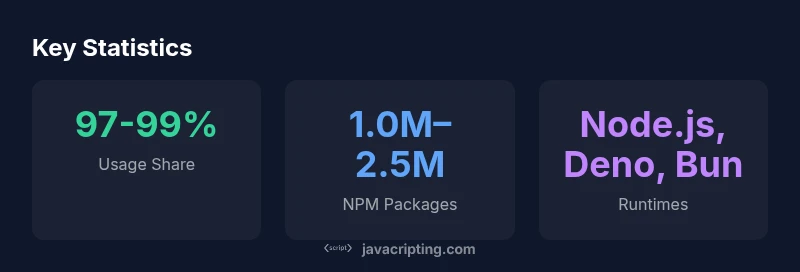
| Usage footprint | Share of web pages using JavaScript for client-side interactivity | 97-99% |
| Ecosystem size | Number of packages in npm registry | 1.0M–2.5M |
| Runtime diversity | Active runtimes in production | Node.js, Deno, Bun |
| Frontend frameworks (top 5) | Most-used frontend frameworks by developers | React, Vue, Svelte, Angular, Next.js |
Questions & Answers
Is JavaScript still the dominant web language?
Yes. JavaScript remains the dominant language for client-side web development and a core platform for server-side tooling, with broad support across ecosystems.
Yes, JavaScript remains dominant for web development.
Why does the 'size' of JavaScript matter for beginners?
Understanding the multi-dimensional size helps learners pick relevant learning paths and avoid getting overwhelmed by tooling and frameworks.
It helps you choose the right learning path and tools.
How can teams keep bundle sizes manageable?
Adopt code-splitting, lazy loading, and tree-shaking; use modern bundlers; monitor with tooling to keep initial load lean.
Split code, lazy-load features, and audit packages.
Does TypeScript increase runtime size?
TypeScript primarily affects compile-time checks; emitted JavaScript size is typically similar to plain JavaScript.
TypeScript mostly doesn’t change runtime size.
What about WebAssembly as an alternative?
WebAssembly complements JavaScript and is great for compute-heavy tasks, but it doesn’t replace general web app logic.
WebAssembly complements JS, not replaces it.
“JavaScript’s size is best measured by the breadth of its runtimes, ecosystems, and community contributions, not a single KPI.”
What to Remember
- Define size across multiple dimensions, not a single KPI
- Expect steady ecosystem growth driven by npm and tooling
- Balance bundle size with developer productivity
- Choose runtimes and frameworks with clear performance goals
- Invest in education and onboarding to keep pace with change