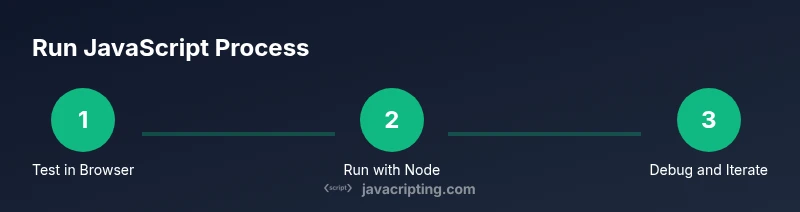
Run a javascript: A practical, step-by-step guide
Learn how to run a javascript in browser and Node.js with a clear, practical workflow. This guide covers inline scripts, external files, console testing, and debugging to help you execute JS code confidently.


With this guide, you will learn how to run a javascript in browser and Node.js environments. We cover inline scripts, external files, console testing, and server-side execution. You’ll gain practical steps for quick experiments, reliable runs, and basic debugging across common environments.
What it means to run a javascript
Running a javascript means executing code that a JavaScript engine can interpret and act upon. When you run a javascript, you trigger logic, manipulate the DOM, fetch data, or calculate values. The engine handles scope, closures, and asynchronous operations, returning results or errors through logs and UI changes. According to JavaScripting, the most common entry points are inline scripts, external files, and runtime consoles that let you test snippets on the fly. The goal is to turn static pages into interactive experiences or to automate tasks on the server. Different environments offer different capabilities: browsers provide the DOM APIs and rendering, while Node.js provides file systems, networking, and process control. As you learn to run a javascript, you’ll master the basics of syntax, execution context, and event-driven flows that drive modern web apps. This guide uses the exact phrase run a javascript to describe both quick experiments and real projects. With practice, you’ll understand how engines evaluate code, manage memory, and report errors clearly through the console.
Tools & Materials
- Text editor(Any modern editor like VS Code, Sublime Text, or Atom)
- Web browser(A current version of Chrome, Firefox, or Edge)
- Node.js (latest LTS)(Download from nodejs.org and verify with node -v)
- Command line/Terminal(Access to run node, npm, and shell commands)
- Sample JavaScript file(Optional if testing directly in the browser console)
Steps
Estimated time: 30-60 minutes
- 1
Check your environment
Confirm you have a modern browser and Node.js installed. This ensures you can run JavaScript both client-side and server-side. If not, install Node.js and update your browser before continuing.
Tip: Run node -v and your browser’s version to confirm readiness. - 2
Open the browser console
Navigate to any web page and open the browser developer tools to access the Console. This is the fastest way to run small JS snippets for quick tests.
Tip: Use Ctrl/Cmd+Shift+J (or F12) to open DevTools quickly. - 3
Test inline scripts in HTML
Create a simple HTML file with an inline script to see how code runs when loaded with a page. This demonstrates the browser execution path and DOM interaction.
Tip: Start with a console.log('Hello, world!') inside a <script> tag. - 4
Run an external script file
Place code in a separate JS file and load it with <script src='app.js'></script>. This mirrors real projects where code is organized in modules.
Tip: Ensure the path to app.js is correct relative to your HTML file. - 5
Run JavaScript with Node.js
Create a script.js file and run it from the terminal using node script.js. This executes JavaScript outside the browser and provides server-side capabilities.
Tip: Use console.log to verify output and practice basic I/O. - 6
Use Node.js REPL for quick experiments
Open the Node.js REPL by typing node in your terminal and typing JavaScript directly. It’s ideal for exploratory coding and testing ideas.
Tip: Try simple expressions first to see immediate results. - 7
Debug effectively
Use breakpoints, console statements, and error messages to locate issues. Learn to read stack traces and identify where code behaves unexpectedly.
Tip: Start with console.log statements around suspect lines. - 8
Explore modules and tooling
As you grow, explore ES modules, bundlers (like Webpack or Rollup), and runtime environments. These tools enable scalable, maintainable JavaScript projects.
Tip: Don’t rush into tooling—master core JS first.
Questions & Answers
What is the difference between client-side and server-side JavaScript?
Client-side JavaScript runs in the browser and interacts with the DOM and UI. Server-side JavaScript runs in environments like Node.js, where there is no DOM and access to server resources. The two share language syntax but differ in APIs and use cases.
Client-side runs in the browser to affect the UI, while server-side runs on the server to handle data and file operations.
Do I need HTML knowledge to run JavaScript in a page?
Yes, to run JavaScript in a web page you typically embed it in HTML using <script> tags or link external JS files. A basic understanding of HTML helps you place scripts correctly and interact with the DOM.
Some HTML knowledge helps you attach scripts, but you can start with the browser console to test JavaScript without HTML.
Can I run JavaScript without a browser or Node?
JavaScript needs a runtime environment. Without a browser or Node, you won’t be able to execute typical JS code. Other runtimes exist, but browser and Node.js are the most common.
No, you need a runtime like a browser or Node to run JavaScript.
What’s the quickest way to test a small snippet of JavaScript?
Use the browser console for rapid testing. Paste a snippet, press Enter, and observe the result. This avoids creating files for simple experiments.
Open the browser console and paste a one-liner to see results instantly.
How do I troubleshoot common syntax or reference errors?
Read the error message in the console, identify the line number, check parentheses and braces, and ensure variables are defined before use. Use console.log to inspect values step-by-step.
Check the error and line number, then print useful values to the console to isolate the issue.
Watch Video
What to Remember
- Learn where to run JavaScript: browser vs Node.js
- Use the browser console for quick tests and inline/script-tag execution
- Run standalone JS files with Node.js for server-side tasks
- Employ debugging strategies to identify and fix problems