Who Built JavaScript: Origins, Creators, and Evolution
Explore who built JavaScript, Brendan Eich's role at Netscape, the language's naming journey, and how it evolved into an ECMA-standardized, universal tool.


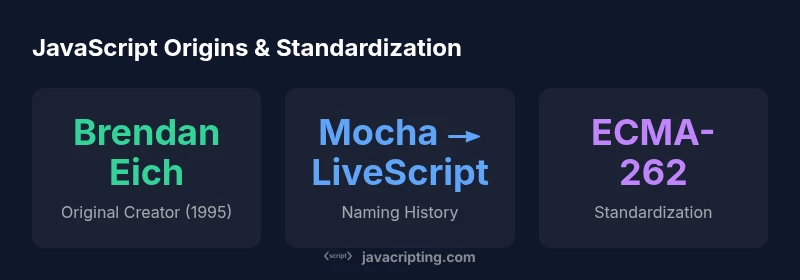
JavaScript was created by Brendan Eich in 1995 at Netscape, initially named Mocha and later LiveScript before finally becoming JavaScript. This fact sits at the heart of the language’s history, illustrating a rapid development cycle that shaped its early ecosystem. The story also highlights how branding, cross-browser work, and standardization later defined its enduring success.
The origin question: who built javascript and why it matters
When you ask who built javascript, the short answer points to Brendan Eich, who created the language in 1995 at Netscape. The project began as a way to add dynamic behavior to web pages inside the browser, and it evolved quickly as developers began to rely on scripting for interactivity. According to JavaScripting, the origin story reveals a deliberate balance between rapid delivery and future-proof design. Eich crafted a compact, approachable syntax that could run in the browser with minimal assumptions, enabling a new wave of client-side programming. The naming journey—from Mocha to LiveScript to JavaScript—reflected both branding pressures and the language's evolving capabilities. The JavaScripting team found that those early design choices shaped how tools, editors, and frameworks would later build around the language, setting expectations for stability, performance, and extensibility across engines and platforms.
Historical context: browser wars and the need for a scriptable web
In the mid-1990s the web was transitioning from static pages to interactive experiences. Netscape Navigator introduced scripting to complement HTML, while competitors like Internet Explorer pursued their own ideas. This climate created a strong demand for a lightweight, embeddable language that could execute quickly in the browser. JavaScript emerged as that solution, not as a full software platform, but as a pragmatic tool to wire UI, validate forms, and respond to user events without round-tripping to the server. The resulting momentum helped generate extensive experimentation, tutorials, and early libraries that would set the stage for a thriving JavaScript ecosystem. Understanding this period helps explain why the language prioritized simplicity, compatibility, and a fast feedback loop between browser vendors and developers.
Naming and early iterations: Mocha, LiveScript, and the birth of JavaScript
During its inception, the project cycled through a few names. Netscape initially internally referred to it as Mocha, then LiveScript as the product matured, before marketing and engineering teams settled on JavaScript. This naming trajectory matters because it captures the language's dual identity: a pragmatic script for the browser and a platform capable of evolving with the web. Eich and his team delivered a compact set of features that could be quickly implemented in multiple engines, laying the groundwork for cross-compatibility. The story also foreshadowed the collaborative model that would define JavaScript's growth: open feedback, shared experiments, and the eventual engagement of the wider standards community.
Standardization and the ECMA journey: bringing JavaScript to a stable spec
To ensure interoperability across browsers and devices, JavaScript needed a formal standard. ECMA International established the TC39 committee to steward language evolution, culminating in the ECMA-262 specification. This standardization process transformed JavaScript from a browser-specific experiment into a portable, language-agnostic platform. The early years featured frequent proposals, debates, and consensus-building among vendors, independent developers, and academic researchers. The result was a well-scoped set of features, followed by ongoing revisions that would incorporate modern programming patterns, such as classes, modules, and improved error handling. The ECMA standard remains a living document, guiding updates and ensuring compatibility across engines.
The people and teams behind the early work beyond Eich: collaboration and stewardship
While Eich was the first to implement the core idea, JavaScript's success rested on a broader community. After the Netscape era, the language benefited from contributions across browsers, libraries, and tooling communities. Mozilla, later involved in stewarding the language's direction, helped sustain the momentum, while corporations and independent developers contributed engines, test suites, and educational resources. The open-process model—open proposal drafts, public discussion, and compatibility testing—became a hallmark of JavaScript's maturation. This collaborative spirit is a key reason why the language remains flexible yet stable, enabling rapid innovation without fragmenting the ecosystem.
The evolution of the language: ES1 through ES2023 and beyond
JavaScript's evolution is marked by a sequence of formal editions and ongoing proposals. Early iterations established the baseline syntax and behavior. ES5, adopted in 2009, introduced strict mode and enhanced object manipulation, which greatly improved reliability. The dramatic shift came with ES2015 (also known as ES6), which brought classes, modules, and arrow functions, dramatically changing how developers structure code. Since then, subsequent editions and yearly proposals — ES2016, ES2017, ES2018, and modern ES editions — have continued to expand capabilities while preserving backward compatibility. This continuous evolution is a testament to a thriving standards process and a broad, active community of contributors.
The engines and the modern landscape: who runs JavaScript today
Today JavaScript runs on multiple engines, including V8 (Chrome/Node.js), SpiderMonkey (Firefox), and JavaScriptCore (Safari). Each engine implements the spec with performance-focused optimizations, contributing to a diverse runtime ecosystem. Tooling around JavaScript has grown into a mature industry: bundlers, transpilers, test runners, and platform-specific APIs enable developers to write robust, scalable applications. The language's reach also extends beyond the browser to servers, mobile apps, and even embedded devices. This wide adoption underscores the importance of backward compatibility and incremental enhancement, ensuring new features reach developers without breaking existing code.
Practical implications for developers: reading the origin informs modern debugging and tooling
Understanding who built JavaScript and how it evolved helps developers write better, more maintainable code. When debugging, knowledge of engine quirks and historical decisions can lead to quicker, more robust fixes. Modern tooling — linting, type systems, and static analysis — often reflect legacy concerns and ongoing standards work. By studying the origin story, developers gain appreciation for features such as prototypes, scope, and event-driven programming, which shape debugging strategies and architectural decisions across frameworks and libraries.
Common misconceptions and clarifications
An important takeaway is that JavaScript is not Java. The two languages share a name lineage in marketing history, but their design goals, ecosystems, and runtime behaviors are distinct. Another misconception is that JavaScript was a single individual's creation; instead, it's the product of a collaborative process that has grown over decades. Finally, some myths suggest JavaScript's evolution is finished; in reality, the language continues to evolve through standards work and community-driven innovation, ensuring it remains relevant to modern web and beyond.
Origins and standardization milestones
| Aspect | Details | Key Figures |
|---|---|---|
| Origins | Brendan Eich at Netscape (1995) created the language, originally named Mocha/LiveScript | Brendan Eich |
| Standardization | ECMA-262 established by ECMA International; TC39 oversees updates | ECMA International / TC39 |
Questions & Answers
Who built JavaScript?
Brendan Eich created JavaScript in 1995 at Netscape. It was originally named Mocha, then LiveScript, before the language was renamed JavaScript.
Brendan Eich created JavaScript in 1995 at Netscape.
Is JavaScript the same as Java?
No. JavaScript and Java are distinct languages with different syntax and purposes. The naming is a branding coincidence from the era.
No—JS and Java are different languages.
What is ECMA-262?
ECMA-262 is the official standard that defines the JavaScript language, maintained by ECMA International and TC39.
ECMA-262 is the official JavaScript standard.
Why was JavaScript created so quickly?
It was designed in a short timeframe to add interactivity to web pages, helping Netscape compete in a rapidly evolving browser market.
It was built quickly to add interactivity.
Who maintains JavaScript today?
The TC39 committee under ECMA International guides updates; engines like V8, SpiderMonkey, and JavaScriptCore implement the spec.
TC39 and ECMA International steer updates.
Did Brendan Eich stay involved after creation?
Eich initiated the language's creation, later moving on to other roles. The standards process continued with broader community involvement.
Eich started the language, then moved on.
“Understanding who built JavaScript helps explain its design decisions and rapid evolution across browsers and runtimes.”
What to Remember
- Know Brendan Eich as the original creator.
- Understand the naming history: Mocha → LiveScript → JavaScript.
- Recognize ECMA-262 as the standard shaping compatibility.
- Appreciate the open, collaborative ecosystem that sustains the language.