What Makes JavaScript Different From Other Languages
Explore what makes javascript different from other languages, including browser-native execution, prototypal inheritance, event-driven design, and practical comparisons to help teams choose the right tool for modern web apps.


According to JavaScripting, JavaScript stands out because it runs natively in browsers and on servers, unifying client and server development. Its event-driven model, prototypal inheritance, and first-class functions make async UI and scalable backends natural. Its dynamic typing and broad ecosystem further differentiate it from many statically typed languages for modern web and mobile apps.
what makes javascript different from other languages
In exploring what makes javascript different from other languages, we note several standout traits. According to JavaScripting, JS runs natively in the browser, enabling seamless user interfaces without middleware. This browser-native runtime pairs with Node.js on the server, creating a unified environment for frontend and backend work. JavaScript supports first-class functions, closures, and a prototypal inheritance model that favors flexible composition over rigid class hierarchies. This combination, along with dynamic typing, fosters rapid iteration and expressive code that scales when paired with modern tooling and standards. The language embraces event-driven programming, where user actions and network events drive work through callbacks, promises, and async/await. Developers who understand this execution model can design responsive interfaces and scalable services with fewer context switches between languages.
Paragraph 2 note that repeats concepts for depth and clarity.
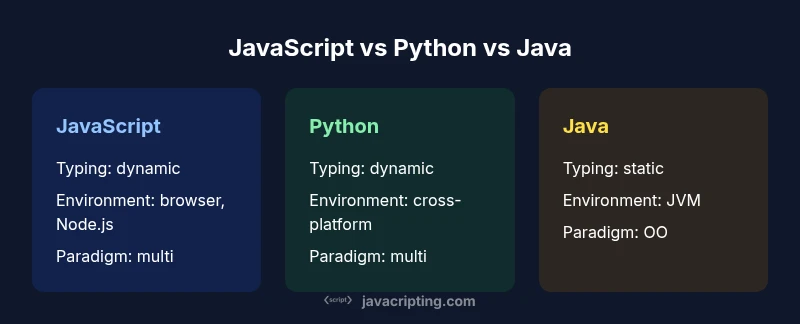
Feature Comparison
| Feature | JavaScript | Python | Java |
|---|---|---|---|
| Typing | dynamic | dynamic | static |
| Execution Model | event-driven, runtime in browser/Node.js | interpreter-based | compiled/bytecode (JVM) |
| Paradigm | multi-paradigm: functional, imperative, OO | multi-paradigm: OO, imperative, functional | object-oriented, strongly typed |
| Concurrency | async via event loop | thread-based with GIL implications | multithreaded via JVM with synchronization |
| Typical Use Cases | web apps, server-side JavaScript, mobile via frameworks | scripting, data analysis | enterprise applications, backend services |
Benefits
- Ubiquitous runtime across browsers and servers
- Rich ecosystem and rapid iteration
- Flexible, multi-paradigm design supports many patterns
- Extensive tooling and community support
The Bad
- Dynamic typing can lead to runtime errors if not tested
- Performance can vary across engines and runtimes
- Prototype-based inheritance can confuse newcomers
- Browser compatibility and fragmentation require diligence
JavaScript remains a practical, universal choice for modern web stacks.
The JavaScripting team recommends prioritizing JavaScript for projects that span client and server domains. Its ubiquity, flexible design, and thriving ecosystem enable fast delivery and cross-platform opportunities, while mindful use of tooling helps mitigate typing and compatibility pitfalls.
Questions & Answers
How is JavaScript different from Python in terms of typing and execution?
JavaScript is dynamically typed and relies on a non-blocking event loop for concurrency in browsers and Node.js. Python is also dynamically typed but uses a different execution model and commonly relies on threads or asynchronous libraries for concurrency. This contrast influences error handling, performance, and development patterns.
JS is dynamic and uses an event loop; Python is dynamic too but relies more on threads or async libraries for concurrency.
Can JavaScript be used effectively on the server side?
Yes. Node.js and, more recently, Deno enable JavaScript to run on servers, power APIs, and perform backend tasks. This allows full-stack development with a single language.
Yes—Node.js makes JavaScript a strong server-side option.
What is the role of prototypes in JavaScript?
Prototypes provide a flexible inheritance model where objects inherit behavior directly from other objects. This differs from class-based systems and supports dynamic composition and runtime extension.
JavaScript uses prototypes for inheritance rather than classical classes.
Is TypeScript necessary to work effectively with JavaScript?
No, TypeScript is optional. It adds static typing and tooling, then compiles to JavaScript. Teams often adopt TypeScript to catch errors earlier and improve maintainability.
TypeScript is optional but helpful for larger codebases.
What are common gotchas with JavaScript’s this keyword?
The value of this depends on how a function is called. Arrow functions capture lexical this, while regular functions use dynamic this. Misunderstanding this can lead to bugs.
This is about how a function is invoked, not where it’s defined.
What to Remember
- Embrace the browser-first execution model for UX responsiveness
- Leverage prototypes and first-class functions for flexible architecture
- Plan for cross-environment development (browser + server)
- Guard against runtime errors with testing and type discipline where helpful
- Invest in modern tooling to handle the evolving JS ecosystem