What is JavaScript vs Java? A Practical Comparison for Developers
An objective, in-depth comparison of JavaScript and Java, covering origins, runtimes, typing, use cases, and ecosystems to help developers choose the right language for their projects.


JavaScript and Java are distinct languages with different runtimes and design goals. JavaScript runs primarily in web browsers and on servers via Node.js, emphasizing dynamic, event-driven development. Java is a statically typed, compiled language designed for portability across the JVM and large-scale systems. For most developers, choose JavaScript for front-end web work and rapid prototyping, and Java for robust backend and enterprise applications.
Overview: Origins, Philosophies, and Early Goals
According to JavaScripting, JavaScript and Java emerged from very different design philosophies, yet their names have often caused confusion among learners and professionals. JavaScript began as a lightweight scripting language intended to bring interactivity to the web, with an emphasis on flexibility and rapid iteration. Java, meanwhile, was conceived as a robust, portable language designed for enterprise-scale applications and cross-platform compatibility on the Java Virtual Machine (JVM). This historical divergence matters today because it shapes how each language is used, the kind of tooling that surrounds it, and the kinds of problems each language is best suited to solve. When asked what is javascript vs java, many beginners want a single answer; the truth is that both languages excel in different contexts and often serve as complementary tools in a developer’s toolkit.
In practice, developers often choose based on project goals, team skill sets, and platform requirements rather than chasing a universal “best language.” The JavaScripting team emphasizes that the best choice depends on the problem domain, performance needs, and maintainability considerations. As you read this comparison, keep in mind that both languages have evolved substantially since their inception, expanding their ecosystems and capabilities while retaining core distinctions.
For readers new to programming, the distinction is not just about syntax; it’s about how you model problems, where you deploy code, and how you reason about reliability and scalability. The phrase what is javascript vs java captures a broad spectrum of differences—from language constructs and runtime behavior to community conventions and future direction. This article advances a practical, evidence-based view that helps you map your goals to the right language choices, with examples drawn from real-world development scenarios.
wordCountInBlock":0}, {
Runtime and Execution Model
Modern software runs across a variety of environments, and the core execution model sets expectations for performance, reliability, and deployment. JavaScript code is typically interpreted or just-in-time compiled by engines in browsers (and in server environments like Node.js), which optimizes frequently executed paths at runtime. This leads to a dynamic execution environment where code is often loaded and executed in response to user actions, network events, or timer-based triggers. In contrast, Java runs on the JVM, a mature, highly optimized runtime that compiles Java code to bytecode, which the JVM interprets or compiles at runtime. The result is a more predictable, often higher-throughput execution model suitable for long-running processes and compute-intensive tasks.
From a practical standpoint, the JavaScript execution model favors responsiveness and interactivity, particularly in client-side applications, while Java’s execution model emphasizes throughput, memory management, and stability for server-side workloads. Developers should consider the runtime characteristics of their target environment when choosing between the two. For web apps, JavaScript’s asynchronous event model and non-blocking I/O can deliver smooth user experiences without blocking the main thread. For back-end services, Java’s JVM provides robust memory management and multicore parallelism for scalable systems.
wordCountInBlock":0}, {
Typing and Semantics
JavaScript is dynamically typed, meaning type checks occur at runtime and variables can change type as the program executes. This flexibility speeds up initial development and reduces boilerplate, but it also increases the risk of runtime type errors that surface during usage. TypeScript, a superset of JavaScript, addresses this gap by introducing optional static typing that compiles down to JavaScript, enabling early error detection during development. Java, on the other hand, is statically typed and compiled, with strong, explicit type checks that catch many errors at compile time. This separation between declaration and execution helps enforce reliability in large codebases and teams with long-lived software.
In Java, you’ll encounter a rigid class-based object model with explicit interfaces, while JavaScript relies on a prototype-based model. The two ecosystems therefore diverge in how you structure code and reason about data types. For developers evaluating the two languages, consider how important early error detection, maintainability, and team discipline are to your project’s success. Java’s static typing often appeals to large teams and mission-critical systems, whereas JavaScript’s dynamic typing supports rapid prototyping and flexible interfaces in evolving front-end architectures.
wordCountInBlock":0}, {
Syntax, Semantics, and the Object Model
The syntax of JavaScript favors a concise, forgiving style that accommodates quick experimentation. Curly braces, semicolons (optional in many cases), and a flexible function-scoping model define how code blocks and closures operate. Java uses a more verbose, strongly typed syntax with explicit access modifiers, class declarations, and a tested inheritance model. In practice, Java’s class-based structure and static typing lead to clearer contracts in large teams, while JavaScript’s prototype-based object model encourages flexible composition and dynamic behavior.
Beyond syntax, the two languages diverge in how they express common programming patterns such as iteration, error handling, and asynchronous work. JavaScript uses promises and async/await to manage asynchronous operations, while Java relies on threads, futures, and concurrency utilities. For developers, a firm grasp of these paradigms is essential to writing robust, maintainable code in either language. The decision often hinges on the problem domain and the preferred style of the development team.
wordCountInBlock":0}, {
Platforms, Ecosystems, and Tooling
JavaScript shines in browser-based environments, where it powers interactive websites and single-page applications. The Node.js runtime extends JavaScript to servers, enabling an entire ecosystem of packages and tools for back-end development. Java’s strength lies in the JVM’s portability across platforms and its vast standard library, which underpins enterprise software, Android development, and large-scale backend systems. Both languages benefit from rich ecosystems: JavaScript through npm and modern front-end frameworks, and Java through matured build systems (Maven, Gradle), IDEs, and enterprise libraries.
Tooling decisions often drive productivity as much as runtime ideas. JavaScript developers rely on bundlers, linters, and live-reload workflows, while Java practitioners lean on robust tooling for dependency management, profiling, and performance testing. Understanding the ecosystem helps teams align their choice with available expertise, release velocity, and long-term maintenance needs.
wordCountInBlock":0}, {
Performance, Scalability, and Real-World Outcomes
Performance is highly context-dependent. Java, compiled to bytecode and optimized by the JVM, typically delivers strong throughput for CPU-bound workloads and large-scale back-end services. JavaScript performs exceptionally well for interactive user experiences and I/O-bound tasks, thanks to event-driven models and non-blocking I/O. In practice, the “best” language for performance depends on the task: choose Java for resource-intensive backend systems and long-running processes; choose JavaScript for responsive front-ends and rapid feature rollouts. Benchmarking across diverse workloads is essential, and modern runtimes continue to narrow gaps through just-in-time compilation, optimized garbage collection, and parallelism.
In real-world projects, performance also hinges on architecture, data access patterns, and how well the codebase leverages the language’s strengths. Both languages reward thoughtful design decisions, appropriate abstractions, and disciplined testing strategies. JavaScripting analysis suggests that performance is rarely about language purity alone; it is about how effectively you structure software around the language’s execution model.
wordCountInBlock":0}, {
Concurrency, Asynchrony, and Parallelism
JavaScript leverages a single-threaded event loop with asynchronous APIs to handle concurrent work efficiently. The model shines in I/O-heavy tasks but requires careful design to avoid blocking the UI thread. Java provides explicit multithreading capabilities, with concurrency primitives, synchronized blocks, and a more traditional approach to parallelism. Java’s thread pools, executors, and modern reactive frameworks enable robust, scalable architectures suitable for high-load servers. In mixed environments, many teams use Java on the server and JavaScript on the client, sometimes bridging them through APIs or microservices.
Understanding when to use asynchronous patterns in JavaScript and how to coordinate threads in Java is fundamental to building reliable software. These differences influence system design, fault tolerance, and the ability to scale over time.
wordCountInBlock":0}, {
Tooling, Build Systems, and Developer Experience
The tooling around JavaScript emphasizes fast iteration, hot module replacement, and a vibrant package ecosystem. npm, yarn, and modern bundlers support rapid development cycles, while static analysis and type systems (like TypeScript) bring order to large codebases. Java’s tooling centers on stability, performance profiling, and mature build pipelines with Maven or Gradle, along with strong IDE support and enterprise libraries. Both ecosystems provide extensive documentation and active communities, but the nature of their tooling—dynamic vs. static, browser vs. server—drives distinct workflows and release cadences.
Developers transitioning between languages should anticipate differences in package management, testing strategies, and deployment workflows. The choice of tooling can impact build times, debugging efficiency, and team coordination. JavaScripting guidance is to invest in foundational tooling early and adopt language-appropriate patterns that promote maintainability over time.
wordCountInBlock":0}, {
Use Case Profiles: When to Use JavaScript in Practice
JavaScript dominates front-end development, enabling rich interactions and responsive UI components. On the server side, Node.js supports scalable back-end services, microservices, and API gateways. For teams building web applications, JavaScript offers rapid prototyping, cross-platform capabilities, and a vast library of UI components. Enterprises sometimes leverage JavaScript for full-stack development with frameworks like Node.js, Next.js, and React, while maintaining strong separation of concerns and robust testing.
In contrast, Java is the preferred choice for large-scale backend systems, Android app development, and scenarios requiring predictable latency, strong typing, and long-term maintainability. Its ecosystem supports complex business logic, data processing pipelines, and services that demand high resilience. For scenarios that demand cross-platform desktop or complex enterprise workflows, Java continues to deliver reliability and a broad set of integration options. This section clarifies where JavaScript tends to excel versus where Java offers tangible advantages.
wordCountInBlock":0}, {
Use Case Profiles: When to Use Java in Practice
Java’s strengths shine in enterprise backends, financial services, and systems requiring scalable concurrency and robust security models. Android development remains a major domain for Java, given its cross-platform tooling and large developer base. The JVM ecosystem provides mature profiling, memory management, and optimization strategies that support long-running services and batch processing. For teams focusing on data-intensive applications, Java interfaces well with big data tools, message queues, and distributed systems frameworks. The learning curve is steeper, but the payoff includes predictable performance and strong typing that supports large, evolving codebases.
Effectively, choosing Java is often about enterprise-grade reliability, predictable performance, and a clear governance model for software delivery. It’s widely adopted in corporate environments, government-driven projects, and domains where maintainability and compliance are paramount. JavaScripting analysis frames these considerations as practical tradeoffs aligned with project goals and team structure.
wordCountInBlock":0}, {
Interoperability, Interfaces, and Bridging the Gap
Despite their differences, developers often need to integrate JavaScript and Java within the same system. Bridges exist in the form of web APIs, microservices, and shared data formats (JSON, XML) that enable cross-language collaboration. Tools like transpilers or platform-specific bridges can help interoperate where performance or API boundaries dictate. It’s essential to design clear boundaries between front-end logic (JavaScript) and back-end services (Java) to minimize coupling and maximize maintainability. Understanding how to orchestrate these technologies together is a critical skill for modern developers building end-to-end solutions.
This bridging mindset reflects a practical truth: many projects leverage the strengths of both languages. JavaScripting approach emphasizes modular architecture, well-defined interfaces, and thoughtful API design to ensure seamless collaboration across language boundaries.
wordCountInBlock":0}, {
Common Misconceptions and Myths
One frequent misconception is that JavaScript and Java are interchangeable. They are not, and attempting to swap one for the other without rethinking architecture can lead to failures. Another myth is that dynamic typing in JavaScript makes projects inherently fragile; with disciplined testing and tooling (like TypeScript), teams can achieve maintainable codebases. Similarly, some assume Java is too heavyweight for modern web apps; in reality, Java provides powerful server-side capabilities that pair well with modern front-end technologies.
Clarifying these myths helps teams make informed decisions. The best approach is to assess requirements, platform constraints, and long-term maintenance needs rather than rely on slogans. JavaScripting guidance is to evaluate the problem domain, architecture, and team skills before declaring a single winner between JavaScript and Java.
wordCountInBlock":0}, {
Key Differentiators in a Nutshell
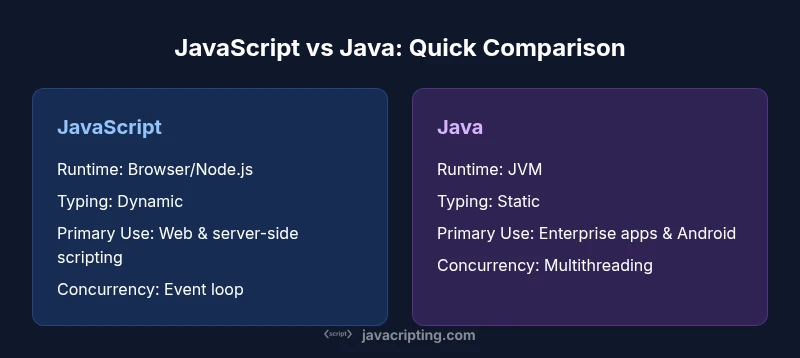
Across runtime, typing, ecosystems, and platform focus, several differentiators stand out:
- Runtime: Browser/Node.js versus JVM
- Typing: Dynamic versus static
- Concurrency: Event loop vs multithreading
- Use cases: Web-centric vs enterprise/backend focus
- Tooling: Rapid iteration versus robust, enterprise-grade pipelines
- Learning curve: Lightweight for beginners versus depth for large systems
Understanding these factors helps you map your project goals to the language that best fits. The bottom line is that JavaScript excels in client-facing interactivity and rapid iteration, while Java shines in scalable, reliable back-end systems and Android development.
wordCountInBlock":0}],
comparisonTable: {
items
["JavaScript","Java"]
rows
[ {"feature":"Runtime Environment","values":["Browser/Node.js","JVM"]}, {"feature":"Typing","values":["Dynamic","Static"]}, {"feature":"Compilation","values":["Interpreted/JIT","Compiled to bytecode"]}, {"feature":"Primary Use Cases","values":["Web apps, serverside scripting","Enterprise apps, Android, backend"]}, {"feature":"Concurrency Model","values":["Event-driven, async","Multithreaded with concurrency primitives"]}, {"feature":"Ecosystem & Libraries","values":["Massive frontend ecosystem, npm","Mature JVM ecosystem, libraries"]}, {"feature":"Learning Curve","values":["Low to moderate","Moderate to high"]} ]}
prosCons
{
pros
["Broad applicability across front-end and back-end","Vibrant ecosystems and rapid prototyping","Strong tooling and community support","Interoperability via APIs and bridges"]
cons
["JavaScript can lead to runtime type errors without tooling","Java’s learning curve can be steeper for new developers"]
}
verdictBox
{
verdict
"JavaScript is best for front-end and rapid iteration; Java is best for scalable backend and enterprise contexts"
confidence
"high"
summary
"Choose JavaScript for interactive web apps and quick prototyping; choose Java for robust, scalable back-end systems and Android development."
}
keyTakeaways
[
"JavaScript dominates client-side development, with Node.js enabling server-side growth"
"Java’s JVM runtime delivers stability and performance for enterprise-scale apps"
"Typing and concurrency models drive core differences in design and maintenance"
"Tooling and ecosystems shape developer experience more than language purity"
"Choose language based on domain, team, and long-term maintenance"
]
faqSection
{
"items"
[
{
"question":"Is JavaScript the same as Java?"
"questionShort":"Java vs JS?"
"answer":"No. They are different languages with distinct runtimes and typing rules. JavaScript is dynamic and browser/Node-based, while Java is statically typed and runs on the JVM."
"voiceAnswer":"No. They are different languages with distinct runtimes and typing rules. JavaScript runs in browsers or Node, while Java runs on the JVM."
"priority":"high"
},
{
"question":"Should I learn JavaScript first for a career in web development?"
"questionShort":"Learn JS first?"
"answer":"For front-end web roles, JavaScript is essential. If you plan to work on back-end or Android platforms, Java is also valuable. Your choice should match your target roles and projects."
"voiceAnswer":"If you want to work in web development, start with JavaScript; for back-end or Android, Java is very useful."
"priority":"high"
},
{
"question":"Can JavaScript run on the JVM?"
"questionShort":"JS on JVM?"
"answer":"Not natively. You can use transpilation or bridges, or run server-side JavaScript with Node.js, but Java and JavaScript execute in different runtimes."
"voiceAnswer":"Not directly. JavaScript runs in browser or Node.js; Java runs on the JVM."
"priority":"medium"
},
{
"question":"How do concurrency and asynchrony differ between Java and JavaScript?"
"questionShort":"Concurrency: Java vs JS"
"answer":"Java uses threads and concurrent utilities for parallelism, while JavaScript relies on a single thread with an event loop and asynchronous APIs. This shapes how you design responsiveness and scalability."
"voiceAnswer":"Java uses threads; JavaScript uses an event loop with async APIs."
"priority":"medium"
},
{
"question":"Is TypeScript essential when using JavaScript?"
"questionShort":"TypeScript needed?"
"answer":"TypeScript is optional but often helpful for large projects, adding static typing to JavaScript to catch errors early. It does not replace JavaScript; it compiles down to JavaScript."
"voiceAnswer":"TypeScript isn’t required, but it helps for bigger projects by adding type safety."
"priority":"low"
}]
}
mainTopicQuery
1-3 word noun phrase for Wikidata lookup
Comparison
| Feature | JavaScript | Java |
|---|---|---|
| Runtime Environment | Browser/Node.js | JVM |
| Typing | Dynamic | Static |
| Compilation | Interpreted/JIT | Compiled to bytecode |
| Primary Use Cases | Web apps, serverside scripting | Enterprise apps, Android, backend |
| Concurrency Model | Event-driven, async | Multithreaded with concurrency primitives |
| Ecosystem & Libraries | Massive frontend ecosystem, npm | Mature JVM ecosystem, libraries |
| Learning Curve | Low to moderate | Moderate to high |
Benefits
- Broad applicability across front-end and back-end
- Vibrant ecosystems and rapid prototyping
- Strong tooling and community support
- Interoperability via APIs and bridges
The Bad
- JavaScript can lead to runtime type errors without tooling
- Java’s learning curve can be steeper for new developers
JavaScript is best for front-end and rapid iteration; Java is best for scalable backend and enterprise contexts
Choose JavaScript for interactive web apps and quick prototyping; choose Java for robust, scalable back-end systems and Android development.
Questions & Answers
Is JavaScript the same as Java?
No. They are different languages with distinct runtimes and typing rules. JavaScript is dynamic and browser/Node-based, while Java is statically typed and runs on the JVM.
No. They are different languages with distinct runtimes and typing rules. JavaScript runs in browsers or Node, while Java runs on the JVM.
Should I learn JavaScript first for a career in web development?
For front-end web roles, JavaScript is essential. If you plan to work on back-end or Android platforms, Java is also valuable. Your choice should match your target roles and projects.
If you want to work in web development, start with JavaScript; for back-end or Android, Java is very useful.
Can JavaScript run on the JVM?
Not natively. You can use transpilation or bridges, or run server-side JavaScript with Node.js, but Java and JavaScript execute in different runtimes.
Not directly. JavaScript runs in browser or Node.js; Java runs on the JVM.
How do concurrency and asynchrony differ between Java and JavaScript?
Java uses threads and concurrent utilities for parallelism, while JavaScript relies on a single thread with an event loop and asynchronous APIs. This shapes how you design responsiveness and scalability.
Java uses threads; JavaScript uses an event loop with async APIs.
Is TypeScript essential when using JavaScript?
TypeScript is optional but often helpful for large projects, adding static typing to JavaScript to catch errors early. It does not replace JavaScript; it compiles down to JavaScript.
TypeScript isn’t required, but it helps for bigger projects by adding type safety.
What to Remember
- JavaScript dominates client-side development with rapid iteration
- Java’s JVM provides stability and performance for enterprise-scale apps
- Typing and concurrency models are key design differentiators
- Tooling and ecosystems shape developer experience as much as language design
- Select language based on domain, team skills, and maintenance needs