Why Use JavaScript Over Other Languages: An Objective Comparison
A rigorous, analytical comparison of JavaScript versus other languages, examining ecosystem, performance, learning curve, and cross-platform viability for frontend, backend, and beyond.


Why use javascript over other programming languages? This guide analyzes the core reasons, focusing on ecosystem breadth, runtime flexibility, and rapid UI iteration. JavaScript powers browsers and servers with Node.js, enabling unified tooling and faster shipping. While languages like Python or Java excel in specific domains, JavaScript's ubiquity and rich libraries make it a pragmatic choice for modern web apps. This TL;DR recommends starting with JavaScript for most web projects, then evaluating niche needs before choosing alternatives.
Why JavaScript shines in modern development
According to JavaScripting, JavaScript has become the default language for the web not by accident but through a combination of ubiquity, evolving standards, and a thriving ecosystem. The language’s evolution—from simple scripting in browsers to a full-stack runtime with Node.js—has created a durable flywheel: more libraries, more tooling, and more community knowledge. For new developers, this translates into easier onboarding, ample learning resources, and a lower risk of vendor lock-in when starting projects. For professionals, it means faster prototyping, easier maintenance, and a broad pool of talent. In short, JavaScript’s trajectory is built on practical usefulness and continuous improvement, which is why many teams begin here when evaluating language choices.
The keyword behind this analysis is why use javascript over other programming languages: because it aligns with modern development needs—rapid iteration, cross-platform deployment, and a large supporting ecosystem. When you consider the breadth of frameworks, the continued refinement of the language itself, and the ability to run the same code in the browser and server, JavaScript often emerges as the most pragmatic default for many projects. The JavaScripting team emphasizes that suitability is context-dependent, but the standard path for most teams starts with JavaScript and then evolves from there.
Ecosystem breadth and library richness
One of JavaScript’s most compelling advantages is its ecosystem. The npm registry hosts millions of packages spanning every conceivable use case—from UI components to server utilities, testing frameworks, and deployment tools. This breadth reduces development time by enabling reuse rather than reinventing the wheel. The ecosystem also drives continuous integration and delivery workflows through well-established tooling, such as bundlers, linters, and test runners. For teams, this translates into faster onboarding, more predictable environments, and consistent coding standards. While some languages boast strong domains (e.g., scientific computing for Python), JavaScript’s universality makes it a safer first choice for cross-functional teams and rapidly changing product requirements.
Runtime versatility: browsers, Node.js, and beyond
JavaScript runs wherever the user interacts with your product: inside web browsers, on servers via Node.js, and in hybrid/mobile environments through frameworks like React Native or Electron. This versatility enables a single language across the stack, reducing cognitive load and avoiding context-switching costs. Developers can write isomorphic or universal code that shares business logic between client and server, which improves maintainability. Conversely, languages primarily tied to a single runtime may require separate tooling and translation layers. For many teams, this cross-environment compatibility is a decisive factor in adopting JavaScript as the primary language.
Frontend UX: non-blocking patterns and frameworks
Non-blocking I/O and asynchronous programming are central to JavaScript’s performance characteristics, especially in UI workloads. The event-driven model lets the browser remain responsive even when network calls or heavy computations occur in the background. Modern frameworks further optimize rendering, component reusability, and state management, enabling faster user interactions and smoother scrolling. While other languages offer strong perf in compute-heavy tasks, JS excels in interactive experiences, real-time collaboration, and data-driven UI. The combination of asynchronous patterns, a vast ecosystem of UI components, and extensive browser APIs makes JavaScript especially well-suited for frontend development.
Typing and error handling trade-offs
JavaScript is dynamically typed, which lowers the entry barrier but can introduce runtime errors that are harder to catch at compile time. This trade-off favors flexibility and speed of iteration in early-stage projects or rapid prototyping. To mitigate risks, teams increasingly adopt TypeScript, a typed superset of JavaScript that preserves existing code while adding static types. This hybrid approach lets teams gain stronger guarantees without abandoning the JavaScript ecosystem. If a project prioritizes early error detection and maintainability in large codebases, embracing TypeScript alongside JavaScript can offer a practical balance.
Learning curve and onboarding for learners
For beginners, JavaScript presents a gentle entry point: syntax is approachable, and you can see immediate results in the browser console or a simple web page. The ecosystem, documentation, and community support make it easier to start building small projects quickly. As learners advance, the breadth of tooling, patterns, and frameworks can become overwhelming. Structured curricula, practice projects, and staged exposure to advanced topics like asynchronous programming, closures, and module systems help maintain progress. The learning curve is steepest when adding in type systems, performance tuning, and architecture decisions, but the payoff is a scalable, versatile skill set.
Tooling, testing, and quality assurance
Robust tooling is a cornerstone of JavaScript productivity. Modern toolchains cover transpilation (for browser compatibility), bundling, code analysis, and automated testing. Test-driven development is widely adopted, with frameworks that support unit, integration, and end-to-end testing. Quality assurance in JavaScript projects benefits from clear modular boundaries, comprehensive test suites, and consistent linting rules. While every language has its tooling, JavaScript’s maturity across editors, IDEs, and cloud-based CI pipelines makes it easier to implement reliable workflows, especially for teams delivering rapid UI changes and frequent feature updates.
Security considerations and best practices
Web security is integral to any JavaScript project, particularly given the exposure of frontend code to end users. Common risks include XSS, CSRF, and insecure dependencies. Best practices emphasize input validation, content security policies, dependency auditing, and keeping libraries up to date. Using secure defaults, avoiding eval-like patterns, and scoping variables can reduce risk. On the server side, Node.js security requires careful handling of permissions, secure headers, and regular package updates. The JavaScript ecosystem supports a strong security culture, but teams must stay vigilant to maintain safe applications.
Performance characteristics: when JS shines and when it doesn’t
JavaScript performance is highly context-dependent. For I/O-bound workloads, non-blocking asynchronous code and event-driven architectures deliver excellent responsiveness. In CPU-bound tasks, JavaScript may lag behind compiled languages, particularly for heavy numerical computations. Teams often mitigate this with Web Workers or offloading compute-heavy tasks to WASM modules. The takeaway: design systems with the strengths of JavaScript in mind, using architecture choices that exploit asynchronous patterns and offload heavy work when necessary.
Cross-platform viability: mobile, desktop, and beyond
Cross-platform development has flourished for JavaScript with frameworks that bridge web technologies to native apps and desktop environments. This enables a broad reach without rewriting logic for each platform. Conversely, platform-specific optimizations and native APIs may require careful integration. The ability to share code across platforms is a compelling reason to choose JavaScript, especially in teams targeting multiple devices and form factors. Always assess whether a cross-platform strategy aligns with your product goals and performance requirements.
Interoperability with other languages and stacks
JavaScript often coexists with other languages in polyglot stacks, where microservices or performance-intensive parts are implemented in languages like Go, Rust, or C++. Interoperability approaches—APIs, message formats, and WASM modules—allow teams to leverage strengths from multiple ecosystems. This flexibility reduces the pressure to force-fit a single language for all components. As a result, JavaScript remains a reliable baseline while specialized components may be implemented in other languages to optimize critical paths.
Comparison
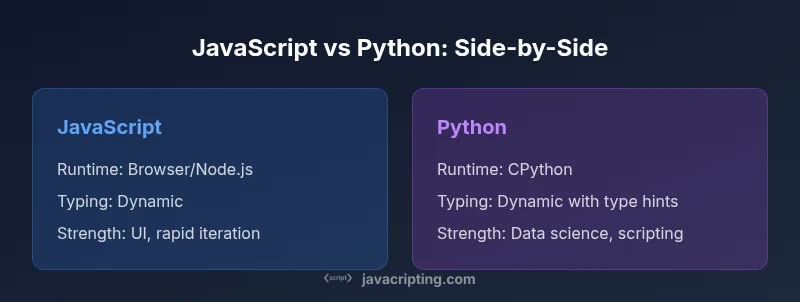
| Feature | JavaScript | Python |
|---|---|---|
| Execution Environment | Browser/Node.js | Interpreter in CPython/virtual environment |
| Typing | Dynamic typing | Dynamic typing with optional static typing via type hints |
| Ecosystem | Extensive frontend/backend tooling | Robust data science and scripting libraries |
| Performance (CPU-bound) | Strong for I/O-bound apps | Slower for CPU-heavy workloads |
| Learning Curve | Low entry point for UI | Steeper for scientific computing and ML |
| Typical Use Cases | Web apps, SPA, serverless | Data analysis, scripting, ML prototyping |
Benefits
- Extensive ecosystem and community support
- Unified language across frontend and backend
- Rich tooling and rapid prototyping workflows
- Strong browser integration and UI capabilities
- Broad talent pool and ongoing language evolution
The Bad
- Dynamic typing can lead to runtime errors if not managed
- CPU-bound tasks may underperform compared to compiled languages
- Security considerations with browser exposure require careful practices
- Fragmentation across browser environments can cause inconsistencies
JavaScript is usually the best default for web-focused projects, but evaluate performance needs and team expertise before adopting it as a sole solution.
JavaScript offers unmatched ubiquity, tooling, and cross-platform potential that most teams can leverage. For compute-heavy or highly specialized tasks, supplementing with other languages or WASM may be prudent. Overall, the ecosystem and versatility justify JavaScript as a primary choice in many modern stacks.
Questions & Answers
Is JavaScript suitable for back-end development?
Yes. Node.js enables JavaScript back-end development, offering non-blocking I/O, a vast package ecosystem, and shared tooling with the frontend. For services with high concurrency or real-time features, JavaScript can be very effective.
Yes. You can use Node.js for servers, and it pairs well with frontend code. It supports real-time apps and a large ecosystem.
Can JavaScript be used for mobile apps?
JavaScript powers mobile apps through frameworks like React Native and hybrid approaches. While not always as native-performant as platform-specific languages, these tools enable rapid development and code reuse.
Yes. Through React Native or similar frameworks, you can build mobile apps using JavaScript.
What is TypeScript and how does it relate to JavaScript?
TypeScript is a typed superset of JavaScript that adds static types. It compiles to plain JavaScript, offering stronger compile-time checks while preserving ecosystem compatibility.
TypeScript adds types to JavaScript and compiles to JS, helping catch errors early.
Is JavaScript faster than compiled languages like C++ or Go?
Generally not for CPU-bound tasks. JavaScript is optimized for responsiveness in UI and I/O, but compiled languages can outperform it on computation-heavy workloads. Use JS where interactivity matters and offload heavy work when needed.
In raw speed, compiled languages win. For UI and web tasks, JavaScript is very fast enough when designed well.
What about security best practices in JavaScript projects?
Prioritize input validation, dependency auditing, secure headers, and content security policies. Regularly update libraries and review code for risky patterns like eval. Security is a shared responsibility across frontend and backend.
Keep dependencies up to date and validate inputs to reduce security risks.
Should beginners start with JavaScript?
Yes. JavaScript provides immediate feedback in the browser, a gentle learning curve, and a large support community. As skills grow, learners can adopt TypeScript and advanced patterns to scale projects.
Yes, start with JavaScript for quick wins and then add TypeScript when you’re ready.
What to Remember
- Start with JavaScript for web projects to leverage ecosystem and ubiquity
- Use TypeScript to balance flexibility with safer code when needed
- Leverage Node.js for backend parity with frontend codebase
- Exploit asynchronous patterns and WASM for CPU-intensive tasks
- Incorporate strong testing and security practices from day one