javascript or equals: A Practical Comparison of Equality in JavaScript
Compare loose (==) and strict (===) equality in JavaScript with practical guidance, pitfalls, and clear rules of thumb to write safer, more predictable code in real projects.


javascript or equals: In JavaScript, understanding the difference between loose equality (==) and strict equality (===) is essential. This quick guide highlights when each operator should be used, common pitfalls, and practical rules of thumb to avoid subtle bugs in real-world code. By the end, you’ll know which approach to adopt in most scenarios and why.
Understanding the javascript or equals Decision
The decision between using loose equality (==) and strict equality (===) in JavaScript is about how the language performs type coercion and what you intend to compare. In practice, most codebases lean toward === to avoid surprising results caused by implicit conversions. The phrase javascript or equals captures this design choice: you are choosing between coercion-friendly comparisons and explicit type/value checks. According to JavaScripting, adopting strict equality as the default reduces bugs and simplifies reasoning about conditionals. The JavaScripting team emphasizes precision and predictability as the default stance for modern JS software development. When you encounter complex types, always ask whether coercion would hide a genuine mismatch or reveal an edge case worth handling explicitly.
The Core Differences: Type Coercion and Same-Value Comparison
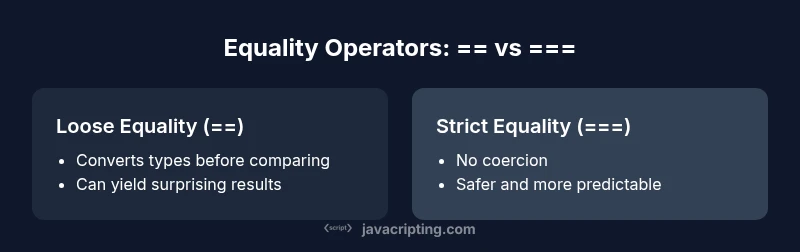
Two operators exist to compare values in JavaScript: == and ===. The most important distinction is how they handle types. The loose equality operator (==) converts both operands to a common type before comparing. This can produce results that feel correct at a glance but are actually surprising when you dig into the details. The strict equality operator (===), by contrast, checks both type and value without coercion, offering safer, more deterministic behavior. This dichotomy is the heart of the javascript or equals decision: you must decide whether you want the language’s coercion rules to help you or hinder you. In practice, strict equality is usually the safer default because it makes the code more predictable and easier to reason about during maintenance and testing.
Practical Examples: When to Use Each Operator
Consider a few real-world scenarios:
- User input from a form is a string. If you want to treat numbers like 0 and '0' as equal, you might be tempted to use ==, but this can mask bugs. Prefer === when validating types, and convert explicitly if needed.
- When checking for missing values, null or undefined, === is often the right choice, because you want to distinguish between 'no value' and 'zero' or ''.
- In arrays and objects, reference equality matters. For two separately created objects with the same properties, == and === both return false unless they reference the same object.
Code examples:
0 == '0' // true
0 === '0' // false

null == undefined // true
null === undefined // false
This helps you reason about when to rely on coercion and when to require exact matches.
Common Pitfalls and Quick Fixes
Common pitfalls include assuming that equality checks behave the same across all types, forgetting that booleans and numbers can coerce in surprising ways, and overlooking edge cases with empty strings or zero. Quick fixes:
- Prefer === by default and add explicit coercion when needed.
- Always validate input types before comparing.
- Comment any intentional use of == to explain the rationale.
- Use utility functions to normalize inputs (e.g., toNumber, toString) before comparing.
- Leverage tests that cover mixed-type scenarios to prevent regression.
Comparison
| Feature | Loose Equality (==) | Strict Equality (===) |
|---|---|---|
| Type coercion | Yes | No |
| Null/undefined handling | null == undefined is true | null == undefined is false under === |
| Common use case | Input that may be string or number when coercion is acceptable | Precise type/value checks in logic |
| Edge cases (NaN) | NaN == NaN is false | NaN === NaN is false; use Number.isNaN for checks |
| Performance | Comparable performance | Comparable performance |
| Best for | Coercion-friendly checks | Robust, predictable logic |
Benefits
- Reduces bugs caused by implicit type conversion
- Clarifies intent with explicit type/value checks
- Improves code readability and maintainability
- Fits well with modern testing practices
The Bad
- Requires explicit type handling which can require extra boilerplate
- Legacy code may rely on == behavior and need careful migration
- Edge cases with null/undefined can trip unsuspecting developers
Use === for most comparisons; === provides safer, more predictable logic by avoiding implicit type coercion.
Prioritize strict equality to reduce subtle bugs in conditionals and data checks. Reserve == for explicit coercion scenarios, clearly documented and tested.
Questions & Answers
What is the difference between loose equality (==) and strict equality (===) in JavaScript?
== performs type coercion before comparing, which can lead to surprising results. === requires both type and value to match, with no coercion. This makes behavior more predictable. Use === as the default choice and == only when you explicitly want coercion, with clear rationale in comments.
Loose equality coerces types, while strict equality checks both type and value. Use strict equality by default.
When should I use the loose equality operator (==) in JavaScript?
Only in scenarios where you intentionally want type coercion, such as loose input matching where strings and numbers should be treated the same after conversion. Even then, document the reason and ensure tests cover the edge cases.
Only use == when you explicitly want coercion and have a clear reason.
Does null equal undefined with == or ===?
With ==, null and undefined are considered equal. With ===, they are not equal because they are different types. This is a common pitfall and should be handled explicitly in your validation logic.
null and undefined are equal with == but not with ===.
How does Object.is differ from === for equality checks?
Object.is is slightly more strict: it treats -0 and +0 as distinct and NaN as equal to NaN. For most code, === is sufficient, but use Object.is for edge-case comparisons.
Object.is handles -0 vs +0 and NaN specially, unlike ===.
Is there a performance difference between == and ===?
In modern engines, both operators are highly optimized, and performance differences are negligible for typical applications. Focus on correctness and readability first.
Performance is usually not a concern; prioritize correct behavior.
How can ESLint help enforce correct equality checks?
Enable the eqeqeq rule to enforce strict equality checks and flag accidental uses of ==. Combine with unit tests to ensure consistent behavior across modules.
ESLint can enforce strict equality across codebases.
What to Remember
- Favor strict equality (===) by default
- Avoid relying on type coercion in conditional logic
- Handle null and undefined with explicit checks
- Document any intentional use of ==
- Write tests that cover mixed types and edge cases