Can You Use C++ Instead of JavaScript? A Practical Comparison
Explore whether C++ can replace JavaScript in modern apps, the role of WebAssembly, and trade-offs in performance, tooling, and maintainability for frontend and backend tasks.


Can you use C++ instead of JavaScript? In practice, you can run C++ code in the browser by compiling to WebAssembly and loading it alongside JS, but for everyday UI work JavaScript remains the default. This quick comparison shows the scenarios where C++ adds value and where JS keeps the development cycle fast.
Can you use c++ instead of javascript? An analytical framing
Can you use c++ instead of javascript? In practice, the answer hinges on context. According to JavaScripting, the best framing is to separate compute-intensive workloads from UI scripting. The JavaScripting team found that WebAssembly can bridge C++ performance with browser reach, but it does not replace JavaScript for DOM manipulation and rapid UI events. So, the central question can you use c++ instead of javascript should be answered by mapping use cases to deployment realities. This section establishes a decision framework and introduces the primary trade-offs you will see across sections of this article. If your goal is to maximize raw compute efficiency in a browser, C++ via WebAssembly is a powerful tool. If your goal is rapid UI development and broad browser APIs, JavaScript remains the baseline.
Key takeaway: the possibility exists, but the practical decision depends on where the bottlenecks are and who maintains the codebase.
The Core Trade-offs: reach, performance, and development velocity
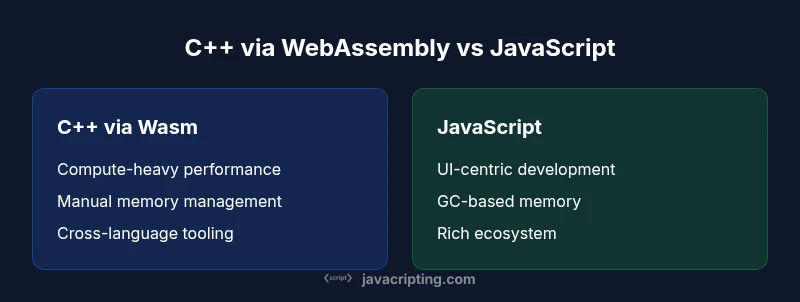
A central dimension when evaluating can you use c++ instead of javascript is reach versus control. C++ gives you fine-grained memory management, predictable latency, and near-native performance for compute-heavy tasks. JavaScript, by contrast, provides universal access to DOM APIs, a massive ecosystem, and rapid iteration cycles. In most teams, this translates to a hybrid architecture: critical algorithms in C++ compiled to WebAssembly, while the UI and orchestration remain in JavaScript. The JavaScripting analysis shows that this split can unlock performance gains without sacrificing developer velocity, but it also introduces cross-language tooling and larger build pipelines. When evaluating the question can you use c++ instead of javascript, assess your current bottlenecks, the critical paths in your app, and whether your team can manage multi-language debugging.
Key elements to compare: deployment footprint, tooling maturity, and maintenance costs. JavaScript wins on ecosystem and turn-around time; C++ wins on raw performance and deterministic behavior in compute-heavy modules.
WebAssembly: what it changes for language choices
WebAssembly (Wasm) is the bridge that makes can you use c++ instead of javascript a practical option for browser-based apps. Wasm provides near-native performance for compute-bound tasks and enables C++ code to run in the same security sandbox as JS. However, Wasm interacts with the browser through JavaScript glue code and lacks direct access to the DOM, which means you still need JavaScript to handle UI rendering, event handling, and browser APIs. This reality shapes any architecture decision: you build core logic in C++, expose a clean API to JavaScript, and orchestrate the UI with JS. The JavaScripting perspective emphasizes careful module boundaries and clear interfaces to minimize debugging complexity. For server-side contexts, Wasm can run in some runtimes, but the browser is the most common playground for this approach.
Keyword usage reminder: when considering can you use c++ instead of javascript, WebAssembly is often the enabling technology that unlocks cross-language integration while preserving browser portability.
Tooling, compilation, and build pipelines
Shifting from JavaScript to C++ introduces new toolchains, which change your development cadence. C++ projects rely on compilers, linkers, and sometimes platform-specific toolsets, whereas JavaScript projects lean on transpilers, package managers, and hot-reload servers. The hybrid approach commonly uses Emscripten or a similar tool to compile C++ into WebAssembly, then bundles it with JavaScript glue. This increases initial setup complexity and build times, but can pay off in optimized binaries and better memory control. The JavaScripting guidance highlights the importance of reproducible builds, strict CI for multi-language stacks, and clear performance benchmarks to justify long compilation cycles. Expect longer iteration loops during feature development, but potentially shorter hot-path execution in the browser thanks to Wasm’s efficiency.
Practical tip: automate the cross-language debugging workflow by using source maps for JS glue and native debugging for C++ code paths. This helps when you explore can you use c++ instead of javascript under real-world workloads.
Memory management, safety, and security
C++ offers explicit memory management, which provides control and potential performance advantages but requires discipline to avoid leaks and undefined behavior. In contrast, JavaScript relies on a garbage-collected heap with automatic memory management, reducing certain classes of bugs at the expense of non-deterministic pauses. When can you use c++ instead of javascript, the safety argument often hinges on the scope of the module: compute kernels with fixed lifetimes and predictable workloads benefit from RAII and smart pointers, while UI logic, event handling, and asynchronous control flow benefit from GC-friendly JavaScript patterns. WebAssembly itself runs in a sandboxed environment, but you must still consider the glue layer and data marshalling costs. The JavaScripting team notes that careful boundary design (what crosses the Wasm-JS boundary and how often) can prevent performance regressions and security vulnerabilities.
Takeaway: if you are aiming for tight memory and deterministic performance in compute tasks, C++ is attractive; for UI resilience and browser security models, JavaScript remains essential.
Real-world use cases by domain: web apps, games, scientific visualization
Different domains reveal distinct answers to can you use c++ instead of javascript. In web-heavy apps with complex UI, JavaScript often remains the primary language, while performance-intensive features like physics simulations, image processing, or machine-learning inference can be offloaded to C++ via WebAssembly. For game development, C++ has historically been the backbone of engines; Wasm can enable web-based ports with careful optimization, but the ecosystem and tooling are still maturing compared with established JS game libraries. Scientific visualization and data dashboards may also benefit from C++ for heavy computations, provided the development team can maintain the multi-language stack. In practice, a hybrid approach frequently yields the best balance between performance and developer productivity, but it requires disciplined design and robust testing across the language boundary.
Keyword density note: across domains, consider can you use c++ instead of javascript as a screening question that leads to a hybrid strategy rather than a pure rewrite.
Migration patterns and hybrid architectures
A practical migration path starts with profiling to identify hot paths; then extract those sections into C++ modules compiled to WebAssembly. The rest of the application—UI, routing, and API integration—remains in JavaScript. Over time, you may consolidate simpler logic into Wasm for binary compatibility, but expect ongoing maintenance work to keep the boundary interfaces clean. Documentation, strong typing in the glue layer, and clear module boundaries reduce cognitive load for developers who navigate can you use c++ instead of javascript in a live project. The end-state is a stable, hybrid stack that preserves browser interoperability while enabling high-performance kernels where they matter most.
Common pitfalls and anti-patterns
Be mindful of the common traps when evaluating can you use c++ instead of javascript. One frequent error is over-optimizing premature Wasm modules at the expense of overall app complexity. Another is underestimating the glue cost between JS and Wasm, which can become a bottleneck if data marshalling occurs on hot paths. A third risk is neglecting tooling for debugging across languages, leading to longer debug cycles and harder onboarding for new developers. Finally, never assume WebAssembly will magically solve all performance problems; profiling and iterative improvement remain essential. The best outcomes come from measured pilots, clear success criteria, and a willingness to revert scope if the hybrid approach doesn’t deliver the expected benefits.
Decision framework: when to choose C++ vs JavaScript
To decide when to adopt can you use c++ instead of javascript, start with a decision framework anchored on two axes: performance needs and development velocity. If your application’s bottleneck is computation-heavy and deterministically timed, and your team can sustain a cross-language workflow, C++ via WebAssembly is a compelling choice. If the app relies on rapid UI changes, browser APIs, and a large ecosystem of libraries, JavaScript remains superior for speed of iteration and community support. The framework also considers deployment complexity, security concerns, and long-term maintenance. The JavaScripting analysis supports a staged approach: prove value with a small Wasm module, measure the performance delta, and then decide whether to scale across the product. Always document the decision rationale for future audits and onboarding.
Comparison
| Feature | C++ via WebAssembly | JavaScript (ECMAScript) |
|---|---|---|
| Runtime environment | WebAssembly in-browser/WebView | Browser-native JS engine and APIs |
| Development speed | Longer compile cycles; requires glue code | Rapid iteration; vast tooling and fast hot reload |
| Performance | Near-native for compute-heavy tasks; depends on optimization | Excellent for UI logic with JIT-accelerated performance |
| Memory management | Manual/RAII with smart pointers | Automatic garbage collection |
| Ecosystem and libraries | C++ ecosystem; toolchains; Web APIs via glue | Massive JS ecosystem; DOM, async APIs, Node.js |
| Deployment model | Wasms, glue layers, binary size considerations | Single-file JS bundles; CDN delivery, tree-shaking |
| Best for | Compute-intensive modules, native-like performance | UI orchestration, web app logic, rapid development |
Benefits
- Enables near-native performance for compute-heavy modules
- Provides explicit memory management and deterministic behavior
- Can improve security by isolating critical logic in Wasm
- Allows reuse of existing C++ libraries in the browser
The Bad
- Longer setup and build pipelines; hybrid debugging complexity
- Glues between Wasm and JS add data marshalling costs
- Smaller ecosystem for browser-native Wasm modules; tooling matures slowly
- Increased maintenance due to multi-language codebase
Hybrid approach outperforms pure rewrites in most cases
When performance-critical code dominates, WebAssembly-backed C++ can win. For typical UI tasks, JavaScript remains the practical default. The best choice is often a measured hybrid with clear boundary definitions and robust tooling.
Questions & Answers
Can you run C++ directly in a web browser without WebAssembly?
No. Browsers execute JavaScript natively, and C++ code must be compiled to WebAssembly or be run on a server. WebAssembly provides the in-browser bridge but requires glue code for interaction with JS and the DOM.
No direct C++ execution in browsers; use WebAssembly with JavaScript glue.
When should I consider using C++ over JavaScript in web apps?
Consider C++ for compute-heavy modules, performance-critical kernels, or when you already have robust C++ libraries. For UI, routing, and rapid development, JavaScript typically wins on velocity and ecosystem.
Use C++ for performance-critical parts; JS for UI and rapid development.
What are the main risks of a multi-language WebAssembly project?
Risks include more complex debugging, larger build pipelines, data marshalling overhead, and steeper onboarding. A clear boundary between Wasm and JS and strong CI can mitigate these issues.
Be prepared for debugging and build complexity; set clear boundaries.
Is WebAssembly production-ready for all domains?
WebAssembly is production-ready for many domains, especially compute-heavy tasks, but it may lack complete browser API parity and mature tooling in some areas. Evaluate your specific use case and perform thorough benchmarking.
Wasm is ready for many uses, but test it for your case.
How do I start a migration from JS to C++ modules?
Begin with profiling to identify hot paths, create a small Wasm module, and measure performance. Establish a robust glue layer and incremental milestones to avoid disrupting the entire app.
Start small with a pilot module and measure results.
What to Remember
- Assess whether computation, not UI, is the bottleneck
- Prefer a phased, pilot-driven migration
- Plan for cross-language debugging and build tooling
- Leverage WebAssembly when you need near-native performance
- Maintain clear boundaries to reduce maintenance cost