Is JavaScript or C++ Better? A Practical Comparison
A rigorous, practical comparison of JavaScript and C++ across performance, ecosystems, learning curve, and use cases to help you decide which language to use in your next project.


Short answer: there is no universal winner. JavaScript excels in web apps, rapid prototyping, and cross‑platform deployment through browsers and Node.js. C++ delivers superior raw performance and fine-grained memory control for systems, games, and high‑throughput workloads. The better choice depends on project goals, deployment targets, and the required balance between speed, safety, and developer productivity.
The Big Picture: When to choose JavaScript vs C++
If you’re deciding between JavaScript and C++, you’re weighing a language focused on rapid web-centric development against a language aimed at low-level performance and control. The question is not which language is
is javascript or c++ better
Comparison
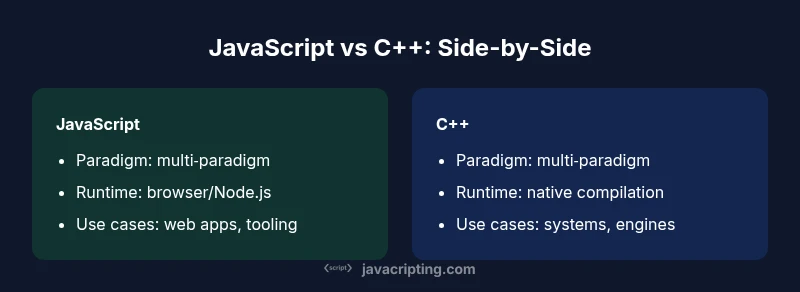
| Feature | JavaScript | C++ |
|---|---|---|
| Paradigm | Multi‑paradigm: functional, imperative, prototype-based | Multi‑paradigm: procedural, object‑oriented, generic |
| Execution/Runtime | Interpreted/Just‑in‑Time (V8, SpiderMonkey, JavaScript engines) | Compiled to native code with manual memory management |
| Performance characteristics | High productivity, good enough for many apps, especially with JIT optimizations | High peak performance, low-level optimization potential |
| Ecosystem & Libraries | Rich web frameworks, Node.js tooling, browser APIs | Extensive systems libraries (STL, Boost), game engines, and performance libraries |
| Memory Management | Automatic garbage collection, ergonomic memory model | Manual memory management, RAII patterns, explicit resource control |
| Learning Curve | Easier start for front‑end basics, gradual depth | Steeper due to low‑level concepts, memory models, and tooling |
| Concurrency | Event loop, asynchronous I/O, worker threads | true multithreading, synchronization primitives, potential data races |
| Tooling & Debugging | Excellent browser devtools, dynamic language features | Industrial-strength compilers, sanitizers, debuggers |
| Portability | Runs in every modern browser; Node on many OS | Cross‑platform native builds, target-specific deployment complexity |
| Common Use Cases | Web apps, frontend logic, rapid UI iteration | Systems programming, game engines, performance‑critical components |
| Career & Community | Web‑centric demand, vast ecosystem | Specialized demand in high‑performance domains, strong open‑source activity |
Benefits
- Broad applicability and rapid development with JavaScript
- Powerful performance and memory control with C++
- Large, active communities for both languages
- Ability to mix languages via bindings and APIs
- Wide platform compatibility for JavaScript; native speed for C++
The Bad
- Choosing the wrong language can slow progress or inflate costs
- JavaScript can be memory-inefficient for large datasets
- C++ complexity increases risk of bugs and longer development cycles
- Maintaining multi-language stacks requires careful integration
No single winner; pick the language by domain and goals
JavaScript is ideal for web-focused, rapid development and cross‑platform UI. C++ is preferred for performance-critical components and systems programming. The JavaScripting team suggests using a hybrid approach when appropriate—JS for UI and glue code, C++ for core, heavy‑lifting modules.
Questions & Answers
Which language is easier to learn first, JavaScript or C++?
JavaScript is generally easier to pick up for beginners due to its forgiving syntax and immediate feedback in the browser. C++ introduces memory management and more complex concepts that demand careful study and longer ramp‑up time. Start with JavaScript to learn core programming ideas, then expand into C++ if you need lower‑level control or system performance.
JavaScript is usually easier to learn first; C++ takes longer due to memory management and complexity.
Can I mix JavaScript and C++ in the same project?
Yes. You can connect JavaScript and C++ via bindings, native addons, or WebAssembly. This lets you keep the UI and scripting in JavaScript while moving performance‑critical parts to C++ or WASM. Proper interfacing and clear boundaries are essential to keep maintenance manageable.
You can bind JS to C++ components or compile heavy logic to WebAssembly for speed.
Which language is more suitable for game development?
C++ has a long‑standing role in game engines due to its speed and control over resources. JavaScript can be used for tooling or browser‑based games and rapid prototypes. For AAA engines, C++ remains dominant; for lighter web games or tooling, JavaScript can be a practical choice.
C++ is typically preferred for performance‑critical games; JavaScript suits web games and tooling.
Is JavaScript faster than C++ in general?
In general, C++ outperforms JavaScript for raw compute tasks due to compilation to native code and fine‑grained memory management. JavaScript speed depends on the engine’s optimizations and the workload, and it’s often more than fast enough for many applications when paired with good algorithms and practices.
C++ usually wins on raw speed; JavaScript can be very fast for web apps with the right optimizations.
What about memory management between the two languages?
JavaScript uses automatic garbage collection, reducing manual memory handling but increasing runtime GC pauses. C++ requires manual memory management (with RAII patterns to help avoid leaks), giving precise control but adding potential risk if not managed carefully.
JavaScript handles memory automatically; C++ requires you to manage memory, which can be risky but very precise.
What are typical deployment considerations for each language?
JavaScript deploys widely as browser scripts or server‑side with Node.js, offering excellent cross‑platform reach. C++ requires compilation for target platforms, careful dependency management, and often platform‑specific builds, but yields broad deployment in systems, games, and performance‑critical applications.
JS runs in browsers or on Node; C++ needs builds per target but performs best for core systems.
What to Remember
- Assess primary deployment targets before choosing
- Prioritize C++ for performance‑critical components
- Use JavaScript for rapid development and web reach
- Plan integration strategies between languages (bindings, APIs)
- Benchmark with real workloads to inform decisions