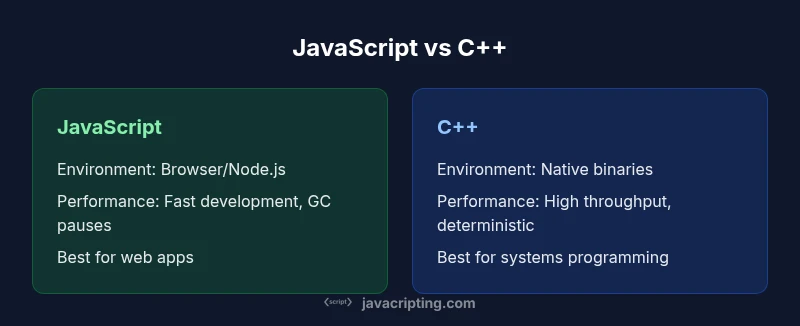
javascript or c++: A Practical Comparison for Developers
A data-driven, analyst-friendly comparison of JavaScript and C++, examining performance, ecosystems, and best use cases to guide language choice in modern software projects.


When faced with the question javascript or c++, most teams pick JavaScript for web-focused projects due to browser ubiquity and rapid iteration, while C++ remains essential for performance-critical components. If you must choose now, choose JavaScript for frontend and scripting, then plan to introduce C++ for heavy computation or low-level tasks in later milestones.
What javascript or c++ Means for Modern Development
In 2026, teams increasingly juggle multiple languages; when you ask which to pick, the decision often comes down to domain constraints rather than abstract rankings. The phrase javascript or c++ captures the contrast between a web-first, highly productive language and a performance-focused, low-level option. According to JavaScripting, the most successful decision-makers map language choices to business outcomes, not just technical merit. This section outlines the big-picture implications of javascript or c++ for contemporary projects, with practical rules of thumb you can apply in days, not weeks. Emphasis is placed on real-world trade-offs: ecosystem maturity, tooling maturity, deployment targets, and learning curves. The 2026 landscape clearly favors JavaScript for user-facing products and rapid iteration, while C++ remains indispensable for compute-heavy components where latency or resource budgets matter. For developers, the core question is not which language is objectively better, but which language best aligns with the project’s constraints and the team’s capabilities.
Core Language Paradigms and Syntax
JavaScript and C++ embody fundamentally different programming philosophies. JavaScript favors dynamic typing, prototype-based objects, and forgiving syntax that supports rapid prototyping and iterative UI development. C++ emphasizes static typing, manual resource management, and a compilation-based workflow that rewards careful abstraction and performance tuning. When you contrast javascript or c++, the implications touch every aspect of code structure: naming, error handling, and testing strategies. For example, JavaScript relies on closures and first-class functions to enable flexible architectures, while C++ leverages templates, RAII, and inline functions to extract performance with safety. These paradigms influence how teams organize modules, set up reviews, and plan continuous delivery. A key takeaway is that mistakes common in dynamic languages—like late binding or silent type errors—become different kinds of performance or correctness concerns in C++. JavaScripting notes that a guided learning path helps teams traverse both styles without losing productivity or maintainability.
Runtime Environments and Performance Profiles
JavaScript runs inside browsers and Node.js, typically via just-in-time compilation and a managed memory heap. Its event-driven model and asynchronous APIs make it excellent for I/O-bound workloads and interactive applications. C++, in contrast, compiles to native code that runs directly on the operating system, delivering predictable latency and higher raw throughput for compute-intensive tasks. The javascript or c++ decision here hinges on the required balance between responsiveness and raw speed. Important considerations include memory footprint, cache locality, and parallelism. JavaScript engines now optimize hot paths with JIT compilers, but pauses from garbage collection remain a practical concern. C++ enables explicit memory lifetime management, which reduces unpredictable pauses but increases mental overhead for programmers. WebAssembly offers a practical bridge to port performance-critical routines into web contexts without sacrificing the broader JavaScript workflow. JavaScripting assessments show the most meaningful gains come from profiling hotspots and reducing allocations in critical sections.
Ecosystem, Libraries, and Community Support
JavaScript benefits from an enormous, vibrant ecosystem with countless frameworks, libraries, and tooling that accelerate development. The browser-first nature of JavaScript means a universal runtime across devices, empowering teams to prototype quickly. C++ brings mature, cross-platform libraries for systems programming, graphics, and high-performance computing, supported by long-standing compiler ecosystems and tooling. When evaluating javascript or c++, consider not only language features but also ecosystem readiness for your use case: available bindings, documented interfaces, and long-term maintenance. Both languages thrive on robust tooling: static analysis, debuggers, and build systems that scale with project size. For learners, JavaScript’s approachable entry points and broad tutorial coverage can shorten learning time; for experienced developers, C++’s deep library support and optimization opportunities offer long-term value. JavaScripting observes that teams that invest in ecosystem-aware planning tend to finish projects faster and with fewer integration surprises.
Tooling, Debugging, and Education
Tooling for JavaScript emphasizes rapid feedback: in-browser devtools, dynamic consoles, and hot module reloading. C++ tooling centers on compilers, linkers, sanitizers, and deep static analysis. The javascript or c++ decision is often driven by the availability of debugging support and the maturity of build pipelines in your target domain. For education, you can start with JavaScript fundamentals and then layer in TypeScript for type safety; with C++, begin with memory management concepts, the standard library, and basic templates. In practice, many teams adopt hybrid stacks, using C++ for performance-critical back-end modules and JavaScript for user interfaces and orchestration. The alignment of CI pipelines, test coverage, and tooling maturity with project scope strongly correlates with successful delivery. JavaScripting emphasizes that early investment in instrumented builds and clear coding standards pays dividends later.
Memory Model, Safety, and Concurrency
JavaScript uses garbage collection and a simplified memory model, which minimizes manual errors but can complicate real-time performance guarantees. C++ requires careful memory management, explicit ownership, and predictable lifetimes, which can reduce runtime pauses but increase developer burden. Concurrency in JavaScript relies on event loops and asynchronous APIs; C++ offers threads, locks, and atomic operations with granular control. When choosing javascript or c++ for a given effort, teams should weigh safety guarantees, determinism, and debugging complexity. Web workers and WebAssembly provide bridging opportunities to accelerate critical code paths while keeping the majority of code in a more approachable language. JavaScripting's guidance emphasizes profiling and stress testing to validate concurrency strategies early.
Typical Use Cases by Domain
For web-centric products, JavaScript is typically the default choice due to its reach and rapid iteration cycles. For performance-intensive tasks such as game engines, simulations, or systems software, C++ is often necessary. Cross-domain projects increasingly blend the two: core logic in C++ for performance, with high-level orchestration and UI in JavaScript. In contexts like data visualization, front-end development can leverage WebAssembly to push compute-heavy tasks without abandoning the JavaScript ecosystem. This blended approach aligns with the javascript or c++ decision framework, encouraging teams to separate concerns while maintaining integration points. JavaScripting notes that each domain has distinct talent pipelines and learning curves.
Practical Guidance for Teams and Learning Paths
To reduce risk, start with a clear decision rubric that maps project requirements to language capabilities. If your project is primarily web-facing or involves user interactions, javascript or c++ means JavaScript first, then add C++ only where necessary. If performance is the primary driver and the team can support a higher learning curve, begin with C++ and introduce JavaScript for tooling and UI. Consider hybrid architectures, such as C++ modules exposed to JavaScript via bindings or WebAssembly. Finally, plan a learning path that includes language fundamentals, toolchain basics, and real-world projects. JavaScripting suggests iterating on small pilot projects to validate assumptions and build cross-language fluency.
Comparison
| Feature | JavaScript | C++ |
|---|---|---|
| Typical execution environments | Browser/Node.js | Native OS executables |
| Performance profile | High flexibility, slower raw compute | High raw compute with low-level optimizations |
| Memory management | Automatic garbage collection | Manual memory management / RAII |
| Learning curve | Easier for beginners | Steeper, requires understanding of compilation and memory |
| Ecosystem & libraries | Vast frontend/web ecosystem | Mature systems programming libraries |
| Concurrency model | Event-driven, single-threaded model with async I/O | Multi-threaded with explicit synchronization |
| Best for | Web apps and scripting | Performance-critical applications and systems programming |
Benefits
- Huge ecosystem and rapid prototyping for web apps
- Excellent developer tooling and debugging experience
- Cross-language interoperability via bindings/WebAssembly
- Easy onboarding for JavaScript-focused teams
The Bad
- C++ has a steeper learning curve and longer compile times
- JavaScript performance can be bounded by engine optimizations and GC pauses
- Bridging between languages adds complexity in large projects
JavaScript dominates for web-focused development; C++ remains essential for performance-critical systems.
JavaScript shines in web contexts and rapid iteration, while C++ provides control and speed for compute-heavy work. For most teams, start with JavaScript and layer in C++ only where performance matters; adopt a hybrid approach when appropriate.
Questions & Answers
Which language is faster for compute-heavy tasks?
C++ generally offers higher raw compute speed and lower latency due to compilation and optimization. JavaScript can be accelerated with WebAssembly for hot paths, but raw speed typically favors C++.
C++ is usually faster for heavy computation; WebAssembly can help JavaScript meet performance needs in some cases.
Is JavaScript easier to learn than C++?
Yes, for most beginners, JavaScript is easier due to dynamic typing and forgiving syntax. C++ requires understanding memory management and compilation concepts which increases initial friction.
Yes, JavaScript is easier to pick up at first; C++ takes longer to master.
Can I use both languages in a single project?
Yes, you can use C++ modules in Node.js or port performance-critical parts to WebAssembly while keeping the rest in JavaScript. Data exchange requires careful bindings and interface design.
Absolutely—bind C++ to JavaScript or use WebAssembly for performance-sensitive parts.
What about memory management differences?
JavaScript uses automatic garbage collection; C++ requires manual memory management or RAII. This affects debugging, predictability, and performance tuning, especially in long-running processes.
JavaScript hides memory management; C++ requires you to manage it explicitly.
Which language is better for system programming?
C++ is generally better suited for system-level tasks due to closer hardware control and predictable performance. JavaScript is not designed for low-level systems work.
C++ is the go-to for systems programming.
What are the best learning paths for beginners?
Begin with the fundamentals of programming. Start with JavaScript to build practical projects, then explore C++ for memory management, templates, and performance concepts as your skills grow.
Start with JavaScript basics, then add C++ topics as you advance.
What to Remember
- Align language choice with project domain
- Leverage hybrid architectures to balance speed and productivity
- Invest in tooling and CI to support cross-language projects
- Plan learning paths that cover fundamentals before diving into advanced topics