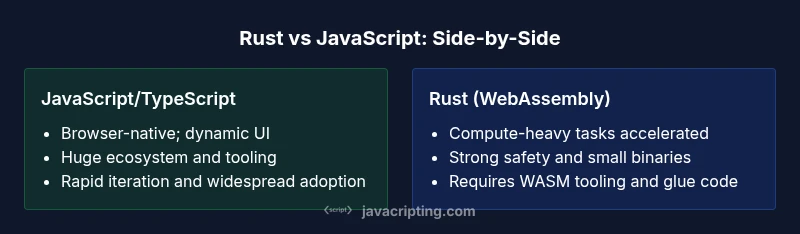
Rust vs JavaScript: Can You Use Rust Instead of JavaScript?
A practical, analytical comparison weighing Rust via WebAssembly against JavaScript/TypeScript for frontend and beyond, covering performance, tooling, deployment, and real-world project decisions.


Short answer: you generally don’t replace JavaScript with Rust for browser code. Rust is excellent for performance-heavy tasks when compiled to WebAssembly, but the browser runtime and ecosystem strongly favor JavaScript or TypeScript. This quick comparison outlines typical web and non-web use cases, deployment realities, and developer experience to help you judge whether Rust can meaningfully substitute JavaScript in your project.
Can you apply rust instead of javascript in frontend development?
In 2026, developers often ask whether you can replace JavaScript with Rust to build browser-based experiences. The short answer is nuanced: Rust can be powerful when compiled to WebAssembly (WASM) and used to accelerate specific tasks, but it is not a drop-in substitute for all browser code. The JavaScript runtime remains the standard for DOM manipulation, UI frameworks, and the vast ecosystem of npm packages. For aspiring developers, this means shifting the mental model from one language rules the browser to a hybrid strategy where Rust handles compute-heavy components and JavaScript/TypeScript coordinates UI and web APIs. The practical question is not simply language preference but architectural fit: where does Rust add value, and where does it complicate delivery? Can you use rust instead of javascript? The answer is: in carefully chosen parts of the app, yes; for the rest, you will likely want to keep JavaScript in the loop.
Core differences: runtime, ecosystem, and performance expectations
The core decision when comparing can you use rust instead of javascript centers on three axes: runtime reality, ecosystem maturity, and performance expectations. JavaScript runs directly in the browser without an extra layer. Rust code, when compiled to WebAssembly, executes in a sandboxed module that must be loaded and interfaced through a JS glue layer. This separation adds serialization costs, data transfer overhead, and asynchronous boundaries that can affect responsiveness if not carefully managed. In terms of ecosystems, JS/TS enjoys decades of libraries, toolchains, and tutorials for frontend tasks, while Rust's WASM ecosystem is growing but still catching up for browser driven tasks. Performance-wise, WASM often delivers strong compute performance, especially for number crunching, image processing, or physics simulations, but you must consider memory models, stack usage, and interaction with the DOM. The net takeaway is that Rust is complementary in many scenarios, not a wholesale replacement for the browser runtime. When you weigh can you use rust instead of javascript, you should map your workload to the right tool: compute-bound components in WASM, UI and events in JS, and data marshaling across boundaries with efficient schemas.
WebAssembly: what it solves and what it doesn’t
WebAssembly shines when you need predictable performance for heavy tasks while keeping the same API surface as your existing JS code. It solves the problem of language performance disparity by letting Rust run near native speeds in the browser. However, WASM does not grant direct DOM access; browsers still expose DOM APIs to JavaScript, so you must write JS glue code to bridge WASM modules to the UI. WASM also introduces binary sizes, loading times, and the need for compilation pipelines (cargo, wasm-pack, rollup/esbuild). Debugging across the boundary can be more complex, requiring source maps and specialized tooling. In short, WebAssembly is a powerful accelerator, not a full browser replacement for JS. It is most effective when integrated with careful interop and clear performance goals.
Real-world use cases by project type
For web apps that require advanced graphics, physics, or data processing, Rust via WASM can deliver meaningful gains. For example, a data analytics dashboard might run heavy matrix operations in WASM while leaving the UI in JavaScript. Games or simulations in the browser often leverage Rust for core logic and WASM for performance-critical loops, with the UI and event handling still managed by JS. If your project hinges on rapid UI iteration, a large npm ecosystem, or intricate DOM interactions, you will likely keep most of the UI in JavaScript and use Rust selectively for modules that prove bottlenecks. Non-web contexts, like server-side tooling or command-line utilities, favor Rust more heavily, but you’ll typically deploy different stacks for those scenarios.
Tooling, debugging, and developer experience
Getting started with Rust for web requires a shift in tooling: cargo for Rust crates, wasm-pack for bundling, and a glue layer to connect Rust and JS. Debugging spans two ecosystems, often involving source maps for WASM and browser devtools for JS. The interop layer demands careful data marshaling and ergonomic bindings, which can slow initial velocity. Developers should invest in clear interfaces and gradually increase WASM responsibility to avoid sprawling, cross-language complexity. For teams already comfortable with TypeScript and modern frontend pipelines, the incremental cost is real but manageable, especially if performance is a hard requirement.
Deployment models and maintenance implications
Deployment with Rust and WASM adds a layer of complexity to the normal web stack. You must consider binary sizes, caching strategies, and the impact of longer build times during CI. WASM modules can be cached effectively, but you may need to tune load performance with streaming compilation and lazy loading. Maintenance involves keeping Rust tooling up to date alongside the JavaScript toolchain, and ensuring that bindings remain stable as both sides evolve. Teams should establish a policy for when to recompile WASM and how to measure the incremental value against development overhead. In maintenance terms, Rust brings long-term stability for compute-focused components but increases the operational surface area during development and deployment.
Migration strategies if you’re considering Rust
If you are exploring Rust as a replacement or augmentation, start small with a single compute-intensive module that has a clear boundary with the UI. Create a clean interface between JS and WASM, simulate realistic workloads, and measure end-user impact before expanding. Establish a gradual migration plan with milestones that include performance benchmarks, build pipeline changes, and a clear deprecation path for old code. Invest in learning resources and code reviews that emphasize safe interop, data marshaling costs, and the practical limits of WASM in your target browsers. By moving incrementally, you minimize risk while validating the real benefits of Rust in your stack.
The bottom line: when Rust makes sense and when it doesn’t
In many front-end projects, Rust via WebAssembly makes sense when you have heavy computation that dominates page load and keep JavaScript for interaction and rendering. It is a powerful tool in the right place, not a universal replacement for JS. If your goals include reproducible performance with safe memory management and access to a growing WASM ecosystem, Rust can be a strategic addition. If you prioritize ultra-fast UI iteration, vast frontend library support, and straightforward deployment, JavaScript remains the practical default. Use Rust where it adds measurable value, and keep JavaScript where it excels.
Comparison
| Feature | JavaScript/TypeScript | Rust (via WebAssembly) |
|---|---|---|
| Runtime in browser | Directly executed by browser engine | Runs in a WASM module with JS glue |
| Performance characteristics | Balanced performance for UI and logic | Strong compute performance for WASM-backed tasks |
| Tooling & ecosystem | Mature frontend toolchains, npm ecosystem | Growing WASM tooling; browser-specific libraries still maturing |
| Code interoperability | Direct DOM access via Web APIs | Interfacing through JS glue and bindings |
| Deployment & build | Relatively straightforward build and deploy | More complex pipelines (cargo, wasm-bindgen, bundlers) |
| Learning curve | Lower initial hurdle for frontend devs | Steeper for Rust and WASM interop |
| Best for | UI-centric apps with rapid iteration | Compute-heavy modules plus UI glue |
Benefits
- Potential performance gains for compute-heavy modules
- Ability to reuse Rust libraries and knowledge
- Stronger memory safety in critical paths
- Modular architecture via WASM boundaries
The Bad
- Requires additional tooling and build steps
- Ecosystem for frontend tasks is smaller and evolving
- Debugging across JS-WASM boundaries can be tricky
- Longer feedback cycles due to compilation and packaging
Rust is a strategic add-on, not a wholesale replacement
For most projects, use Rust for performance-critical parts via WebAssembly while keeping JavaScript for UI. The two-language approach often yields the best balance of speed and developer productivity.
Questions & Answers
Can you replace JavaScript entirely with Rust in web apps?
No. Rust via WebAssembly can accelerate compute-heavy tasks, but the browser APIs and UI logic are still best handled by JavaScript or TypeScript. A hybrid approach is most practical.
No, not entirely. Rust helps with performance, but JavaScript remains essential for UI and DOM work.
Is Rust production-ready for front-end development?
Yes, for specific workloads and teams willing to manage interop. It is increasingly used in production for performance-critical modules, with careful design and testing.
Rust is production-ready for parts of the app, not as a full browser replacement.
What is WebAssembly's role in this comparison?
WASM provides a way to run Rust code at near-native speed in the browser, but it still needs JavaScript glue to interact with UI and DOM APIs.
WASM lets Rust run in the browser, but you still rely on JavaScript for UI glue.
How hard is it for a JavaScript developer to learn Rust?
Rust has a steeper learning curve, especially around ownership and lifetimes, but many JavaScript developers pick up the basics quickly with focused practice and real projects.
Rust takes some time to learn, but the fundamentals you know in JS help a lot.
What are common Rust-to-WebAssembly pitfalls?
Watch for large WASM binaries, interop overhead, and serialization costs. Debugging across boundaries can be tricky without good tooling and source maps.
Be mindful of binding costs and debugging across JS and WASM boundaries.
When should I keep JavaScript as the primary language?
If you prioritize rapid UI iteration, a vast frontend ecosystem, and simpler deployment, keep JavaScript as the default and add Rust only when needed for performance.
Stick with JS for the UI unless you really need WASM speedups.
What to Remember
- Use Rust selectively for compute-heavy modules
- Plan clear JS-WASM boundaries and interfaces
- Expect longer build times and added tooling
- Leverage WASM for performance gains where it matters