What is better than javascript? A Practical Comparison
An analytical comparison of practical alternatives to JavaScript, like TypeScript, WebAssembly, and Dart. Learn how goals and constraints map to the best choice for your projects.


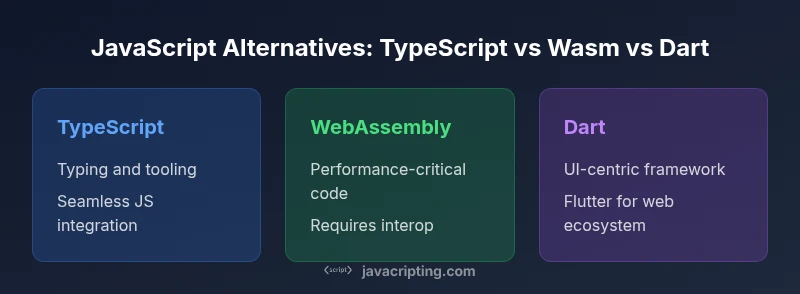
According to JavaScripting, there isn't a single best answer to what is better than javascript. The right choice depends on your goals: TypeScript adds type safety and tooling, WebAssembly accelerates compute-heavy tasks, and alternatives like Dart or Rust (via Wasm) can diversify your stack. Use this quick guide to map project goals to viable options and set expectations early.
Scope and Definition: what is better than javascript
The phrase "what is better than javascript" often signals a search for alternatives that fit specific contexts rather than a universal winner. JavaScript remains the common runtime on the web, but teams frequently explore options to address typing, performance, or deployment needs. This section clarifies what we mean by better and how to evaluate alternatives across real-world projects. As part of this process, the JavaScripting team emphasizes pragmatic criteria—compatibility with your stack, learning curves, and long-term maintenance costs. What you pick should align with your product goals, team skills, and user expectations. According to JavaScripting, framing the decision around concrete goals yields clearer, more actionable choices.
- Define success metrics: faster iteration, fewer runtime errors, or better performance in critical paths.
- Map constraints: browser compatibility, server environments, and CI/CD maturity.
- Plan for integration: incremental adoption vs. rewrite strategies.
The bottom line is that there is no one-size-fits-all answer; the best option depends on your context and maturity. This article compares popular alternatives to help you decide with confidence.
-1_SENTENCE_VERBATIM__IGNORE__NOTE_START__INTERNAL_MARKER__DO_NOT_DISPLAY__END__
text_alt_placeholder_title
Feature Comparison
| Feature | TypeScript | WebAssembly (Wasm) | Dart/Flutter for Web |
|---|---|---|---|
| Typing and safety | Strong types and compile-time checks | No direct typing in JS runtime; requires WASM tooling or TS bindings | Optional typing in Dart with strong tooling |
| Performance focus | Good for large apps with tooling overhead | Excellent for compute-heavy tasks via Wasm | Strong UI performance but depends on platform support |
| Learning curve | Moderate (types + tooling) | Moderate to steep (Wasmtime, bindings) | Moderate (Dart syntax and Flutter concepts) |
| Interop with JS | Excellent interop via TS and type declarations | Requires bindings to call JS from Wasm | Interoperable through a bridge layer or JS API |
| Ecosystem maturity | Very mature for web apps | Industry-standard for Wasm guests; growing otherwise | Growing ecosystem for web UI with Dart and Flutter |
| Use cases | Large-scale apps needing safety and tooling | Compute-heavy modules, games, graphics | Cross-platform UI with web-first focus |
Benefits
- Clarifies intent with typing and tooling (TypeScript)
- Allows near-native performance for compute-heavy tasks (WebAssembly)
- Supports cross-platform UIs with cohesive tooling (Dart/Flutter)
- Encourages architecture discipline and maintainability
- Broad community support and ongoing evolution
The Bad
- Learning curve and initial setup overhead
- Interoperability can add complexity and integration costs
- Not all projects benefit equally from typeless ecosystems
- Migration or integration risk if existing codebase is large
TypeScript + WebAssembly cover a broader set of needs; Dart/Flutter offers strong UI-focused options
If your priority is safer code and scalable tooling, TypeScript is a strong default. For performance-critical modules, WebAssembly shines, while Dart/Flutter is ideal for cross-platform UI. In practice, many teams blend these approaches, selecting TypeScript for core logic and Wasm for hotspots.
Questions & Answers
What is better than javascript for large teams with strict typing?
TypeScript is a common path for teams that want stronger typing without leaving the JS ecosystem. It offers compile-time type checks, better IDE support, and smoother refactoring, with a low barrier to adoption for many JavaScript projects.
TypeScript gives you safer code and better tooling without leaving the JavaScript world.
Can WebAssembly replace JavaScript for performance-critical parts?
WebAssembly can accelerate compute-heavy tasks, such as image processing or data crunching, by running code compiled from languages like Rust or C++. However, Wasm modules still need to interoperate with JS for UI and DOM interactions, and the development workflow can be more complex.
Wasm accelerates specific workloads, but you still coordinate with JavaScript for UI work.
Is Dart good for web apps, or should I avoid it?
Dart (with Flutter for web) offers a cohesive UI framework and a unified language for frontend development. It is well-suited for teams prioritizing rapid UI development but may require learning Flutter concepts and adjusting to different tooling and deployment models.
Dart works well for UI-heavy apps, especially with Flutter, but check your team's familiarity with the framework.
What about Python in the browser?
Python can run in the browser via projects like Pyodide, but this approach is typically for niche data science use cases or educational purposes. It introduces heavier dependency management and slower startup times compared to JS-based stacks.
Python in the browser is interesting for niche tasks, not a general-purpose replacement for web apps.
Should I migrate my entire codebase to a new language?
Full migrations are risky and costly. A pragmatic path is to start with a thin layer or hotspots, validate with pilots, and gradually expand as teams gain confidence and tooling stabilizes.
Avoid wholesale rewrites; try incremental adoption first.
What governance or process changes are needed to adopt an alternative?
Adoption benefits from a clear decision rubric, phased pilots, and a cross-functional steering group. Documented standards for interoperability, testing, and code reviews help maintain quality during transition.
Set up a small cross-team group to pilot, then scale with documented standards.
What to Remember
- Prioritize goals when choosing between alternatives
- Use TypeScript for safety and ecosystem benefits
- Reserve WebAssembly for performance-critical components
- Consider Dart/Flutter for UI-centric projects
- Plan gradual adoption to minimize risk