How Many JavaScript Frameworks Exist in 2026
Explore how many JavaScript frameworks exist in 2026, why counts vary by definition, and what factors influence framework ecosystems for developers evaluating options.


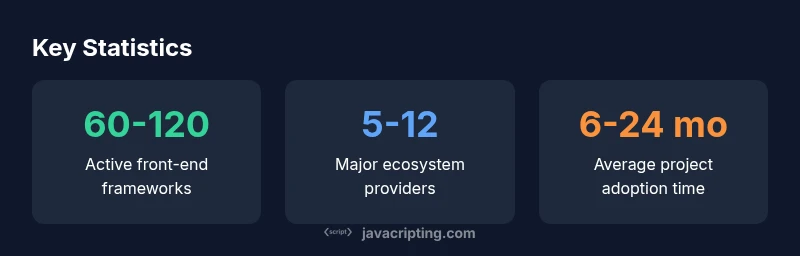
There is no official count of JavaScript frameworks. Estimates vary depending on whether you treat libraries, micro-libraries, and internal tools as frameworks. In 2026, practical landscape snapshots show roughly 60–120 active front-end frameworks and related libraries, with a core group of popular options dominating usage, tooling, and community support.
how many javascript frameworks are there
When people ask how many JavaScript frameworks exist, the answer depends on definitions. A framework is not a fixed category; it blends with libraries, toolkits, and even in-house scaffolds. Some teams treat a small library with opinionated patterns as a framework, while others reserve the term for larger, opinionated scaffolds that define architecture and lifecycle. Because counting rules vary, any published number should be considered a best-effort snapshot rather than a precise tally. For developers, the practical takeaway is to clarify what you count before you compare options. The same project might appear to have dozens of choices under one definition and a handful under another. This definitional ambiguity explains why sources disagree on counts and why JavaScripting Analysis, 2026, emphasizes transparency in methodology.
Understanding this nuance helps keep discussions productive. If you compare React-based projects to smaller, library-driven setups, you are comparing different counting frames. The question is not just how many frameworks exist, but which definition best fits your decision context.
Frameworks vs libraries: where the line lies
The boundary between a framework and a library is increasingly blurry. A library offers modular, focused functionality that you call from your code. A framework often imposes a structure, lifecycle, and conventions that drive how code is written and deployed. In practice, many modern toolsets blend both roles: you might start with a framework in the core architecture, then stress-test it with libraries for specific features. Developers should evaluate the degree of opinionation, the size of the ecosystem, and the ease of integration with existing systems. If a project requires strong conventions and a built-in routing or state-management pattern, you are likely looking at a framework; if you need plug-and-play capabilities with minimal constraints, a library-centric approach might be preferable.
a 2026 snapshot: core frameworks and rising stars
In 2026, a core group continues to shape the landscape, with React, Vue, Angular, and Svelte remaining influential in many teams. Newer entrants like Solid and Astro are gaining traction for specific use cases such as performance, SSR, and DX improvements. Beyond these leaders, there are numerous smaller projects, experiments, and internal toolchains that developers consider for narrow problems or pilot programs. The overall picture is dynamic but shows clear clustering around a few durable choices for large teams and a broader spread for experiments and niche requirements. The counts are sensitive to definitions, but the trend toward modularity and performance-first design remains consistent. JavaScripting Analysis, 2026, notes that ecosystem health depends as much on tooling maturity and community support as on core framework features.
how definitions shape the numbers (counts, active projects, forks)
Two frameworks can exist side by side in the same codebase depending on how teams count. If you count only officially released frameworks, you will see fewer entries. If you count forks, internal tools, and widely used libraries that influence architecture, the number grows significantly. Forks and alternative implementations can inflate the apparent count, while the depth of ecosystem—such as CLI tooling, plugins, and UI libraries—often lags behind core framework development. To make sense of the numbers, organizations should document their counting criteria: do you include micro-libraries, or only tools that define a project’s structure? JavaScripting Analysis, 2026 recommends that reports publish methodology alongside numbers to enable fair comparisons.
evaluation criteria for choosing a framework
Choosing a framework should begin with project goals and constraints. Evaluate stability (longevity, release cadence), ecosystem maturity (availability of plugins, tooling, and documentation), performance characteristics, and learning curve for the team. Consider long-term maintenance: how easy is it to hire developers, upgrade paths, and community support? Pilot projects are invaluable; run a small feature or page to compare framework DX, compile times, and runtime performance. In 2026, successful decisions often hinge on alignment with team strengths, not just popularity. The JavaScripting team suggests mapping requirements to ecosystem signals (types, tooling, testing, and deployment) before committing to a single option.
practical path: how to pilot a new framework
Start with a focused pilot: implement a representative feature using two candidate frameworks, tracking build times, bundle sizes, and hours to onboarding. Measure DX with common tasks like component design, state management, and data fetching. Document the learning curve, the quality of documentation, and the availability of experienced developers. A successful pilot should yield a data-backed recommendation rather than a popularity vote. If the pilot reveals strong trade-offs, consider hybrid approaches or gradually migrating parts of the app to preserve momentum while evaluating future-proof options.
ecosystem signals: market realities in 2026
Framework choices are influenced by ecosystem signals beyond core features. Strong typing support, robust testing tooling, server-side rendering capabilities, and a healthy plugin marketplace can dramatically affect productivity. Companies increasingly favor frameworks with transparent roadmaps, reliable security updates, and active maintenance teams. Community momentum—measured by stars, downloads, and conference presence—offers helpful context, but sustained success comes from a combination of practical performance, clear guidance, and a healthy plugin ecosystem. JavaScripting Analysis, 2026 emphasizes balancing ambition with maintainability when assessing future-proof options.
case studies: small apps with different frameworks
Case studies illustrate how two teams approached a similar feature set with different frameworks. One team prioritized rapid development and chose a mid-sized framework known for fast onboarding and strong DX, even though its ecosystem was smaller. The other team prioritized ecosystem maturity and long-term stability, leaning toward a more established option with extensive tooling. In both cases, the decision reflected trade-offs between speed, scalability, and maintainability rather than chasing the latest trend. These examples underscore the practical reality that there is no single perfect framework—and that success hinges on alignment with project goals and team skills.
How to interpret framework counts in 2026
| Aspect | Definition | Notes |
|---|---|---|
| Definition scope | Counts frameworks vs libraries | Based on counting rules |
| Active projects | 60-120 range | Includes libraries and tools |
| Ecosystem maturity | Varying levels of tooling | Depends on active maintainers |
Questions & Answers
How many JavaScript frameworks exist right now?
There is no official tally. 2026 estimates place the number in the broad range of 60–120 active front-end frameworks and libraries, depending on counting rules.
There isn't an official count; estimates range from sixty to about one hundred twenty depending on counting rules.
What counts as a framework vs library?
A framework provides an opinionated structure and lifecycle, while a library offers focused functionality to be used as needed. The line is fuzzy in modern tooling.
A framework gives you the structure; a library is a tool you plug in—though gaps blur in practice.
Which frameworks should a new project consider first in 2026?
React, Vue, Angular, and Svelte remain influential, with Solid and Astro rising for specific use cases. Evaluate based on team experience and long-term maintenance.
React and Vue are dominant; you might also consider Svelte or Solid for lighter workloads.
Does TypeScript adoption affect framework choices?
TypeScript adoption is high across modern frameworks, influencing onboarding and tooling. Most popular frameworks support TypeScript by default or with good typings.
TypeScript is widely supported; it shapes how teams pick and onboard frameworks.
How should I evaluate a framework for a new project?
Start with your requirements, assess ecosystem maturity, performance, and maintenance. Run small pilots to compare DX and community support.
Begin with needs, then pilot a couple of options to gauge fit.
“There is no one-size-fits-all answer when counting JavaScript frameworks; the best choice aligns with your project goals, team skills, and maintenance plans.”
What to Remember
- Define counting rules before judging options
- Expect a wide range (60–120) in 2026
- Core frameworks dominate large projects
- Evaluate ecosystem maturity and long-term maintenance
- Pilot small projects to compare DX and tooling