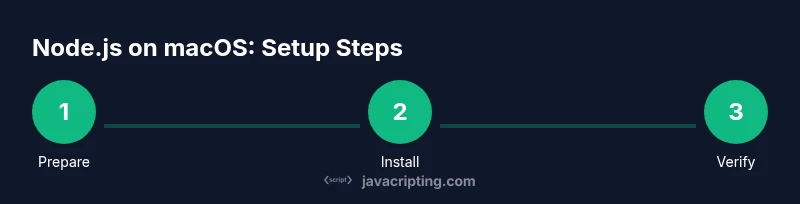
How to Install JavaScript on Mac: A Practical Guide
Learn how to install JavaScript on macOS by selecting Node.js or browser runtimes, using official installers or a version manager, and verifying your setup with simple tests. This educational guide is designed for aspiring developers and frontend professionals.


In this guide you’ll learn how to install JavaScript on macOS by choosing a runtime (Node.js is the most common), using official installers or a version manager, and verifying your setup. You’ll also explore browser vs server usage and how to stay up to date. According to JavaScripting, starting with the official installer is the safest path.
Why macOS is a popular choice for JavaScript development
macOS is favored by many JavaScript developers due to its Unix-based core, robust terminal tooling, and consistent performance across devices. For beginners and seasoned programmers alike, macOS provides a stable environment to run Node.js, build tooling, and test JavaScript code locally. As you learn how to install JavaScript on mac, you’ll see that the process is approachable and modular, letting you choose the path that fits your goals. According to JavaScripting, macOS users often prefer a setup that emphasizes stability, clear tooling, and easy upgrades, which is why Node.js and package managers are central to most workflows. In this guide, we’ll cover official installers, version managers like NVM, and practical tips to verify your setup. We’ll also contrast browser-based JS (which runs in Safari, Chrome, or Firefox) with server-side JavaScript (Node.js), so you can pick the right tool for your project.
Prerequisites and planning before you install
Before you dive into installing JavaScript on your Mac, take a moment to prepare. Ensure your macOS is up to date and that you have a reliable internet connection. You’ll want the Xcode command line tools, which provide essential compilers and utilities used by many Node.js installation methods. If you intend to manage multiple Node versions, set aside a plan for using a version manager like NVM. Having a clear goal (e.g., server-side development, local tooling, or learning to run JavaScript scripts) will guide which installation path you choose. JavaScripting research emphasizes starting with a simple baseline and expanding later, so begin with the official installer and then explore version managers as your needs grow.
Node.js vs other JavaScript runtimes on macOS
When people ask how to install JavaScript on Mac, they’re usually choosing between a runtime that executes server-side logic and a browser runtime for client-side code. The browser is built into macOS (Safari) and other browsers, so you don’t need a separate install to run JavaScript in the browser. For development and tooling, Node.js provides a runtime plus npm, a package manager that helps you install libraries and frameworks. You may also encounter newer runtimes like Deno, but for most projects on macOS, Node.js remains the standard. Understanding these options helps you pick the right tool for the task—whether you’re running scripts, building a local server, or wiring up a build system.
Installing Node.js on macOS: official installer method
The official Node.js installer for macOS provides a straightforward path to a working runtime. Visit the Node.js website, download the macOS installer (pkg), and follow the on-screen prompts. After installation, open Terminal and run node -v and npm -v to confirm the versions installed. If you run into permission prompts, you may need to adjust your PATH so macOS can locate the node binary. Keeping Node.js on the default path helps ensure compatibility with common tooling and tutorials. This method is ideal for beginners who want a quick, reliable setup without extra tools.
Installing Node.js with a version manager (NVM)
If you anticipate working with multiple Node versions across projects, a version manager like NVM is a smart choice. Install NVM from its official repository, then install a Node version (for example, a Long-Term Support release) and switch between versions as needed. NVM avoids global installs that can cause conflicts and makes it easy to align your local environment with project requirements. After installing, verify by running node -v and npm -v for the selected version. This approach is favored by developers who juggle several projects or want to test features against different Node releases.
Verifying installation and running your first script
With Node.js installed, you can verify your setup by running a tiny JavaScript file or using the REPL. Create test.js with a simple console.log('Hello, macOS JavaScript!'); and execute node test.js. You should see the message in your Terminal. You can also experiment directly in the Node REPL by typing node and entering JavaScript commands. As you gain confidence, start a new project with npm init -y and install a small package to see how dependencies are managed in a real-world workflow. This practical testing solidifies your understanding of how to install JavaScript on Mac and begin coding right away.
Troubleshooting common issues and next steps
If things don’t go as planned, check common culprits: PATH configuration, incomplete tool installs, and permission prompts. Revisit steps to confirm you used the correct installer for your macOS version, and verify that the Node binary is accessible from your terminal. If you prefer more control, switch to a version manager like NVM and manage your Node versions from one place. Finally, when you’re ready to expand, explore npm scripts, local development servers, and bundlers to streamline your JavaScript workflow on macOS.
Tools & Materials
- Mac computer (M1/M2/Intel)(Any modern Mac capable of running macOS; admin access recommended)
- Internet connection(Stable connection for downloads and updates)
- Xcode command line tools(Install with 'xcode-select --install' if prompted)
- Node.js installer or Node Version Manager (NVM)(Choose the official installer for simplicity or NVM for version control)
- Optional: Homebrew(Useful for alternative installation paths)
Steps
Estimated time: 45-90 minutes
- 1
Check prerequisites and prepare your Mac
Confirm your macOS version supports Node.js and that you have an active internet connection. Verify you can access the Terminal and create files. Understanding prerequisites reduces surprises during installation.
Tip: Run 'sw_vers' to confirm macOS version and 'whoami' to confirm you have admin rights. - 2
Install Xcode Command Line Tools
Install the essential compilers and utilities that many installation methods rely on. This step is quick and prevents later build failures.
Tip: If prompted, accept the installation and allow the process to complete before continuing. - 3
Choose your installation method
Decide between the official Node.js installer for a straightforward setup or a version manager (NVM) for multi-version flexibility. Your choice shapes how you manage updates and project requirements.
Tip: If you foresee multiple projects with different Node versions, start with NVM. - 4
Install Node.js using the official installer
Download the macOS installer package and run through the installer wizard. This creates the node and npm binaries in standard locations.
Tip: After installation, open Terminal and run 'node -v' and 'npm -v' to confirm success. - 5
Verify installation
Check that Node.js and npm are accessible from the terminal and note their versions. This confirms your environment is ready for development.
Tip: If commands aren’t found, review PATH configuration and try restarting your terminal. - 6
Optionally install NVM and manage versions
Install NVM, then install a Node version and switch between versions as needed. This avoids conflicts from global installs and makes testing across versions easier.
Tip: Use 'nvm ls' to list installed versions and 'nvm use <version>' to switch. - 7
Create a test project and run a script
Initialize a project with 'npm init -y', install a small package, and run a basic script to validate the setup end-to-end.
Tip: Start with a simple 'console.log' script to confirm the runtime behavior before adding dependencies.
Questions & Answers
Do I need Node.js to run JavaScript in the browser?
No. Modern browsers have built-in JavaScript engines, so you can run client-side code without installing Node.js. Node.js is primarily used for server-side development and tooling.
No, browsers run JavaScript natively. Node.js is for server-side work and tooling.
Which Node.js version should I install on Mac?
For most users, the Long-Term Support (LTS) version is recommended for stability and broad ecosystem compatibility.
Install the latest LTS version for reliability.
Is Deno a replacement for Node.js?
Deno is a separate runtime with different tooling and security defaults. For beginners and most projects, Node.js remains the standard.
Deno is not a drop-in replacement for Node.js; they’re separate runtimes.
Can I install multiple Node versions on Mac?
Yes. Use a version manager like NVM to install and switch between versions for different projects.
Yes, with NVM you can switch Node versions easily.
Do I need Xcode tools for installation?
Xcode command line tools are commonly required for building native modules and some installers. They are usually straightforward to install.
Yes, the command line tools are typically needed for builds.
How do I update Node.js on Mac?
If you used the official installer, download and reinstall the latest version. If you use NVM, install a newer version and switch to it.
Reinstall the latest version or use NVM to upgrade.
Watch Video
What to Remember
- Choose a Node.js method that matches your goals.
- Verify installation with node -v and npm -v.
- NVM is ideal for multi-version development.
- Browser JS and server-side JS rely on different runtimes.