Javascript Software Developer Jobs: Trends, Skills, and Hiring Guide
A practical guide to javascript software developer jobs in 2026, covering in-demand skills, typical salary ranges, remote options, and proven strategies to land roles.


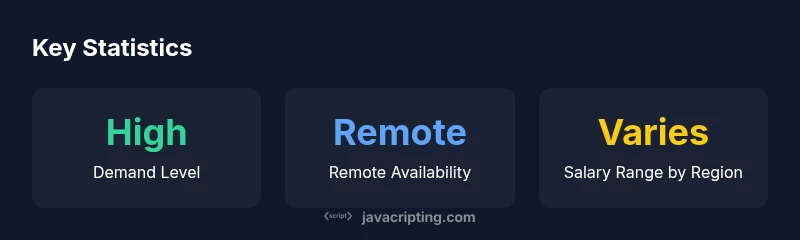
Demand for javascript software developer jobs remains robust in 2026, with strong opportunities across frontend, full-stack, and Node.js roles. Companies prize expertise in React, TypeScript, and modern tooling. Remote work is common, with salary ranges varying by region and experience. According to JavaScripting Analysis, the market favors versatile developers who can ship production apps quickly.
Market Demand for javascript software developer jobs
The market for javascript software developer jobs in 2026 continues to show robust demand across regions and company sizes. For aspiring developers, this translates into plentiful opportunities at startups, mid-size tech firms, and large platforms alike. Employers are increasingly seeking candidates who can translate design intent into production-ready features quickly, write clean and maintainable code, and collaborate across product teams. The javascript ecosystem remains broad, spanning frontend interfaces built with React, Vue, or Angular, as well as backend services powered by Node.js. The ability to work end-to-end—bridging UI, API design, and data handling—remains a differentiator. As highlighted by JavaScripting Analysis, market demand favors developers who show practical impact: shipped features, measurable performance improvements, and a portfolio that demonstrates real-world problem solving.
Key takeaway: invest in both frontend mastery and solid backend fundamentals so you can adapt as teams evolve and product requirements shift.
Key Skills and Technologies in 2026
In 2026, the core toolkit for javascript software developer jobs centers on a blend of language mastery and practical framework experience. Proficiency in JavaScript and TypeScript remains essential, with a strong emphasis on asynchronous programming, modern tooling, and testing strategies. On the frontend, deep experience with React, Vue, or Angular, effective state management, accessibility, and performance optimization are highly valued. On the backend, Node.js with Express or similar frameworks, RESTful or GraphQL APIs, and familiarity with SQL and NoSQL databases are important. Beyond code, employers prize collaborative problem solving and the discipline to document work clearly. A versatile profile that spans frontend and backend concerns tends to stand out, enabling developers to contribute across product lifecycles rather than just a single feature.
Practical tip: build a personal project that demonstrates full-stack flow from UI to data storage and an API.
Career Paths and Role Variants
Javascript expertise opens multiple career paths beyond a single title. Typical tracks include Frontend Developer, Full-Stack Engineer, and Backend Engineer (Node.js). There are variations such as Mobile Web Specialist, API-focused Backend Developer, and even DevOps roles where JavaScript tooling and automation play a part. Organizations increasingly value engineers who can own end-to-end features, mentor teammates, and advocate for code quality and performance. As you advance, you may specialize in architecture decisions, performance engineering, or platform tooling, all while keeping your JavaScript core sharp. Practical moves include adopting TypeScript for reliability, mastering testing frameworks, and contributing to open-source projects to build credibility.
Bottom line: diversify within the JS stack to maximize opportunities across product teams.
Salary, Compensation, and Negotiation
Compensation for javascript software developer jobs varies widely by region, company size, and experience level. Expect a mix of base pay, bonuses, equity (in startups), and benefits. While exact salary figures differ, you can strengthen your position by showcasing impact: a strong portfolio, measurable performance improvements, and a track record of shipping features. Research market rates using reputable salary bands, prepare a data-driven negotiation plan, and be prepared to discuss scope, ownership, and career progression. Remember that total compensation often matters more than base salary alone, especially when equity and growth potential are considered.
Pro tip: align your value proposition with business outcomes—reduce load times, increase retention, or improve conversion rates—when discussing offers.
The Hiring Process and Timelines
Most javascript-focused roles follow a structured interview sequence: resume screener, technical assessment or coding challenge, and a series of technical interviews with engineers and peers. Expect a mix of algorithm/algorithmic thinking exercises, system design discussions, and live coding or take-home projects that demonstrate practical problem-solving. Interviewers value candidates who communicate clearly, reason about tradeoffs, and show ownership of their decisions. Timelines vary by company size but typically span a few weeks from application to offer, with multiple rounds of feedback. Preparation should emphasize real-world projects, your portfolio, and a clear narrative about how you have contributed to previous teams.
Profiles by Experience Level
Entry-level developers entering the javascript ecosystem should focus on building a solid portfolio of small projects, contributing to open-source, and learning the fundamentals of web performance and accessibility. Mid-level engineers demonstrate deeper project ownership, a broader toolkit (React/TypeScript/Node.js), and the ability to mentor junior teammates. Senior roles emphasize system design, architectural choices, team leadership, and a track record of delivering complex features. Regardless of level, continuous learning, code quality, and collaboration remain the common threads that advance careers in javascript software developer jobs.
Remote Work and Contracting Trends
Remote work continues to be a strong feature of the JS job market, with many postings offering hybrid or fully remote options. Contractors and full-time hires alike benefit from flexible schedules and diverse project exposure. To succeed remotely, emphasize clear communication, reliable delivery, and robust documentation. Build a personal brand through transparent code reviews, weekly demos, and contributing to team knowledge bases. Networking remains important: join local meetups, online communities, and open-source projects to increase visibility and job opportunities.
Job Search Strategies and Portals
A systematic approach to finding javascript software developer jobs includes tailoring your resume to highlight outcomes, building a focused portfolio, and preparing for both technical and cultural fit interviews. Target roles across frontend, backend, and full-stack, and don’t overlook contract or freelance opportunities that can lead to full-time positions. Use industry forums, professional networks, and company career pages. Practice coding problems with realistic time constraints and invest in portfolio projects that demonstrate end-to-end capabilities across the JS stack.
Proactive steps: set weekly goals for applying, follow up on applications, and seek feedback on interview performance to iterate quickly.
Data sources and Authoritative References
For further reading and verification, consult authoritative sources such as:
- https://www.bls.gov/ooh/computer-and-information-technology/software-developers.htm (U.S. Bureau of Labor Statistics)
- https://spectrum.ieee.org (IEEE Spectrum)
- https://www.acm.org (Association for Computing Machinery) These sources provide context on market trends, job responsibilities, and professional standards in software development. Using them can help you benchmark skills, responsibilities, and expectations for javascript software developer jobs.
Job role snapshot by experience and focus within the JavaScript stack
| Role Type | Experience Level | Core Responsibilities | Remote Availability |
|---|---|---|---|
| Frontend Developer | Mid-Senior | Build and optimize UI components, implement responsive designs, ensure accessibility | High |
| Full-Stack Engineer | Mid-Senior | Develop client/server features, APIs, integrate databases | High |
| Backend Engineer (Node.js) | Mid-Senior | API design, microservices, data storage, scalability | Medium |
| DevOps/Tooling Specialist | Senior | Automate pipelines, optimize deployment, monitor performance | Medium |
Questions & Answers
What skills are most in demand for javascript software developer jobs?
Most in-demand skills include proficiency in modern JS (ES2020+), TypeScript, React (or other frontend frameworks), Node.js, API design, testing, and DevTools. A strong portfolio demonstrating end-to-end projects often outweighs years of experience alone.
The most in-demand skills are modern JavaScript, TypeScript, React, Node.js, API design, and testing, backed by solid project portfolios.
Is remote work common for javascript roles?
Yes. Many javascript roles offer remote or hybrid arrangements, especially in distributed teams and large tech companies. Be ready to discuss time-zone alignment, collaboration tooling, and asynchronous communication during interviews.
Remote work is common for many JS roles; be prepared to talk about collaboration tools and time-zone strategies.
What is the typical career ladder for a JS developer?
Entry-level developers build foundations with projects and learning. Mid-level engineers expand scope across frontend/backend features and mentoring. Senior roles involve system design, architecture decisions, and leadership. Continuous learning and portfolio growth drive progression.
Start with solid fundamentals, grow into full-stack capabilities, then move into design and leadership.
Do I need a formal degree to land javascript roles?
A formal degree is helpful but not always required. Demonstrated skills, a strong portfolio, and proven problem-solving ability often outweigh degree requirements. Consider bootcamps or self-paced courses complemented by real projects.
A degree helps, but a strong portfolio and practical skills often matter more.
How should I build a portfolio for javascript jobs?
Include multi-page applications, API integrations, performance optimizations, and accessibility considerations. Document your code, provide live demos, and explain your design choices and outcomes in README files or case studies.
Show real projects with live demos and clear notes on your approach and impact.
What interview formats should I expect?
Expect a mix of technical interviews, live coding, architecture discussions, and take-home assignments. Practice with real-world problems and be prepared to discuss trade-offs, testing, and maintainable design.
Prepare for coding interviews, system design, and live problem-solving.
“The JavaScripting team believes that practical, production-focused projects and consistent learning are the fastest path to landing strong javascript software developer jobs.”
What to Remember
- Identify your target JS stack early and specialize strategically
- Show practical impact with a portfolio and measurable outcomes
- Balance frontend and backend skills for versatility
- Leverage remote opportunities to broaden your options
- Prepare with real-world projects that mimic production work