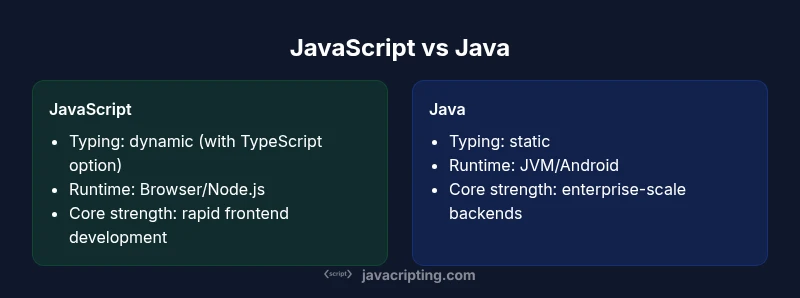
Is JavaScript Better or Java? A Practical Side-by-Side Comparison
Explore whether is javascript better or java in 2026. An analytical, objective comparison of use cases, performance, ecosystems, learning curves, and total cost to help you decide.


Is javascript better or java is not a universal truth—it depends on project goals, team capabilities, and deployment targets. JavaScript dominates frontend development and rapid prototyping, enabling fast iterations and responsive UIs. Java shines in established enterprise backends and performance-critical systems where strong typing and mature tooling matter. The best choice hinges on your specific context, not a blanket rule.
is javascript better or java: Framing the Comparison
According to JavaScripting, the question is less about a single winner and more about identifying the right tool for the job. The phrase is javascript better or java captures a fundamental tension: JavaScript thrives in fast feedback loops, browser-native experiences, and lightweight services, while Java offers predictability, strong typing, and scalable architectures. In 2026, most teams face multi-language realities, where both languages coexist in different layers of the same product. This article uses a structured, objective lens to analyze use cases, performance considerations, ecosystems, and long-term maintenance costs to help you decide which language to invest in for a given project.
Use Cases: Where JavaScript Shines and Where Java Shines
JavaScript excels in client-facing interfaces, rapid prototyping, and full-stack teams using Node.js for server code or APIs. It enables highly interactive UIs, component-driven architectures, and a vibrant ecosystem of frameworks and tooling. Java, by contrast, remains a workhorse for large, mission-critical systems: robust backends, batch processing, and enterprise-grade services that benefit from static typing, strong performance characteristics, and long-term maintenance practices. When evaluating which language to choose, map each candidate to the specific domain problem, data models, and deployment targets. Consider how fast you need to ship features, how important compile-time safety is, and how you plan to scale teams.
Performance and Efficiency: Real-World Implications
Performance in either language depends on the environment and the nature of the workload. Java benefits from a mature runtime with just-in-time compilation, aggressive in-VM optimizations, and predictable shutdown behavior for long-running services. JavaScript engines have also become remarkably fast, with V8 and other engines delivering strong performance for typical web workloads, yet startup times and memory usage can be more variable in browser contexts. The practical takeaway is to profile representative workloads, not rely on abstract benchmarks. Java often delivers steadier performance in CPU-bound tasks, while JavaScript shines in I/O-bound, event-driven scenarios when paired with asynchronous patterns.
Ecosystems and Tooling: Libraries, Frameworks, and IDEs
JavaScript’s npm ecosystem drives rapid development, modularization, and a vast array of frameworks for UI, server, and mobile development. Node.js, Deno, and modern JS tooling enable rapid iteration cycles, hot-reload development experiences, and scalable frontends. Java’s ecosystem emphasizes enterprise-grade frameworks (Spring, Jakarta EE), strong IDE support, and established build systems (Maven, Gradle). The choice often hinges on team familiarity and long-term maintenance needs: JS for speed-to-market and polyglot stacks; Java for stability, governance, and predictable evolution in large organizations.
Learning Curve and Team Dynamics
JavaScript offers a low barrier to entry for beginners in terms of setup, but its dynamic typing and diverse ecosystem can lead to subtle runtime errors if not carefully managed. TypeScript can mitigate these issues by introducing static typing while preserving JavaScript’s ecosystems. Java imposes a steadier learning path due to its explicit syntax, static types, and strong architectural patterns, which can ease onboarding for large teams but demand more boilerplate upfront. Teams often benefit from cross-training: frontend developers gain JVM exposure through API design, and backend engineers explore JavaScript to improve full-stack collaboration.
Cross-Platform Capabilities and Interoperability
Both languages have broad cross-platform footprints, yet in different dimensions. Java runs on the JVM, supports Android, desktop applications, and server environments, and benefits from robust performance tuning and secure containerization. JavaScript operates in browsers and servers via Node.js, with expanding cross-platform opportunities through WebAssembly, React Native, and Electron-like environments. Integration patterns—REST APIs, message queues, or WebAssembly modules—enable teams to combine Java and JavaScript in the same system, leveraging each language where it fits best rather than forcing a single-tech-stack policy.
Security Models, Reliability, and Maintenance Considerations
Security considerations diverge in practical terms. Java’s memory safety and mature governance model help with risk management at scale, while JavaScript’s rapid release cadence demands vigilant dependency management and security practices in frontend pipelines. Reliability in large systems benefits from strong typing, explicit contracts, and test suites. Maintenance costs often scale with system complexity: Java projects can incur longer build cycles but benefit from clearer abstractions; JavaScript projects can ship faster but require disciplined architecture and dependency hygiene. Plan a maintenance regime that matches your product’s risk tolerance and upkeep resources.
Cost Considerations and Total Cost of Ownership
Total cost of ownership includes development time, tooling, hosting, and ongoing maintenance. Java tends to have higher upfront investment due to boilerplate and longer setup, but it can offer lower incremental cost for very large systems thanks to robust tooling and long-term stability. JavaScript can reduce initial time-to-market and enable lean teams, yet dependencies and frequent updates can accumulate costs over time. Evaluate not only runtime costs but also team productivity, onboarding time, and the cost of future migrations or polyglot investments when computing TCO.
Practical Decision Framework: A 5-Step Checklist
- Define the problem domain and long-term goals. 2) List core requirements (typing, performance, deployment targets). 3) Assess team expertise and hiring availability. 4) Consider ecosystem maturity and tooling alignment. 5) Run a small pilot to compare a prototype in both languages, focusing on the most critical use case. This disciplined framework helps prevent biased conclusions and aligns technology choices with business goals.
Common Pitfalls and Myths Debunked
One common pitfall is treating language choice as a proxy for success without addressing architecture, data modeling, or teams. Another myth is that newer is always better; longevity and ecosystem stability matter for enterprise projects. A common error is assuming performance is solely about language speed; often, infrastructure, database access patterns, and concurrency models drive outcomes more than the language itself. By separating language capability from system design, teams can make smarter, architecture-first decisions.
Comparison
| Feature | JavaScript | Java |
|---|---|---|
| Typing discipline | dynamic (or TypeScript) | static |
| Runtime environment | Browser/Node.js | JVM/Android/desktop |
| Performance profile | Fast in typical UIs and I/O-heavy workloads; strong JIT in engines | Long-running, CPU-bound tasks with mature GC and optimizations |
| Concurrency model | Event-driven, async with promises/async/await | Multi-threaded with threads and synchronization |
| Learning curve | Flexible but can become chaotic without structure | Steady with explicit typing and conventions |
| Ecosystem and tooling | Massive npm ecosystem; rapid framework evolution | Mature Maven/Gradle toolchains; Spring ecosystem |
| Cross-platform reach | Web, server-side, mobile via frameworks | Cross-platform on JVM; Android, desktop options |
Benefits
- JavaScript enables rapid frontend development and prototyping
- Java provides strong typing and scalable backend capabilities
- Vibrant tooling and cross-language opportunities across stacks
- Wide talent pools and long-term ecosystem longevity
The Bad
- JavaScript’s dynamic typing can yield runtime errors if not managed
- Java’s boilerplate and longer setup can slow early development
- Ecosystem fragmentation and maintenance complexity in large JS projects
- Enterprise governance demands for Java may increase initial overhead
There is no universal winner; JavaScript excels in frontend agility and rapid iteration, while Java excels in enterprise-grade reliability and performance.
Choose JavaScript for quick UI development and flexible teams. Choose Java when you need strong typing, scalable backends, and long-term maintainability. If possible, design an architecture that leverages both where they fit best.
Questions & Answers
Which language is faster in typical workloads?
Java often delivers strong performance for CPU-intensive tasks due to its mature JVM optimizations. JavaScript performance is excellent for UI and I/O-bound workloads, aided by modern engines, but real-world results depend on workload and architecture. Profiling representative scenarios is essential.
Java usually shines in CPU-heavy tasks, while JavaScript excels in UI and I/O-bound work. Profile your actual workload to decide.
Can you mix JavaScript and Java in the same project?
Yes. Common patterns include microservices, REST APIs, or WebAssembly components that release language boundaries cleanly. Systems can leverage Java for backend services while JavaScript powers the frontend, enabling a flexible and scalable architecture.
Absolutely—use microservices, APIs, or WebAssembly to connect Java and JavaScript components.
Which language is easier to learn for beginners?
JavaScript offers a gentle entry point for web development, but its quirks require discipline. TypeScript helps. Java provides a clear, explicit path with strong typing, which can simplify learning for structured software development but introduces more boilerplate.
JavaScript is quick to start, but Java’s structure can help beginners through clarity—it depends on goals.
Is JavaScript still relevant in 2026?
Yes. JavaScript remains essential for frontend development and full-stack patterns. The ecosystem continues to evolve with new tooling and frameworks, and WebAssembly expands opportunities to run non-JS languages in the browser.
Yes—JavaScript remains central to web UI and modern tooling.
Which language should you choose for backend development?
If you need enterprise-grade reliability and performance, Java offers mature frameworks and governance. For lightweight, rapid APIs or microservices, JavaScript with Node.js can be highly effective, especially in a polyglot stack.
Java for enterprise-grade backends; JS for quick APIs and microservices when speed matters.
What about long-term maintenance and TCO?
Maintenance depends on architecture and team practices. Java’s static typing aids long-term correctness but may incur more upfront boilerplate. JavaScript can be cost-effective in early stages; ensure strong design, testing, and dependency management to control TCO.
Maintenance hinges on architecture and discipline; both languages can be cost-effective with good practices.
What to Remember
- Define domain first; select language to match needs
- Leverage both languages when appropriate to optimize velocity and reliability
- Evaluate typing, performance, and ecosystem for your context
- Pilot critical workflows in both languages before committing
- Invest in architecture and tooling to reduce future risk