What to Do with JavaScript: Practical Uses and Patterns
Explore practical JavaScript uses across frontend, backend, and tooling. Learn patterns, tooling, and debugging tips to turn ideas into reliable code for real projects and career growth.


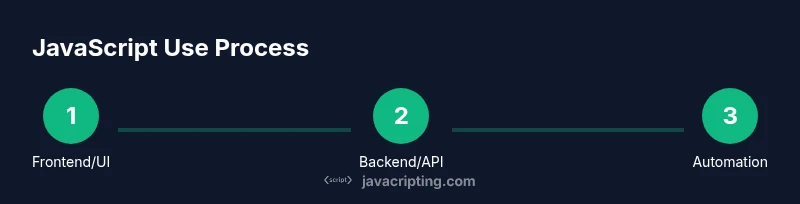
If you’re wondering what to do with javascript, this guide covers core patterns to help you get started. With this guide you’ll learn what to do with JavaScript: build interactive UIs, call APIs, automate tasks, and create lightweight backends. You’ll see practical patterns, tooling tips, and common pitfalls so you can apply JavaScript confidently from client-side features to server scripts. This quick overview sets expectations and points to deeper sections.
Why JavaScript remains versatile
JavaScript is more than the browser language you learned in a beginner course. Its versatility comes from a combination of an event-driven model, first-class functions, and the ability to run in diverse environments—from browsers to servers to standalone scripts. According to JavaScripting, the language’s ecosystems and tooling make it feasible to handle user interfaces, data fetching, and automation in a single, cohesive workflow. As you explore what to do with javascript, you’ll see that the same language can power a dynamic frontend, a lightweight API, and batch utilities. This flexibility translates into shorter learning curves for full-stack work and faster prototyping for experimental ideas. The key is to understand where JavaScript excels and where you should lean on complementary tools or patterns for maintainability and performance.
As you progress, you’ll learn to map real-world tasks to idiomatic JS solutions, whether you’re building a responsive UI, processing data on the server, or automating repetitive development tasks. The growth comes from practicing end-to-end scenarios and reflecting on how to compose small, reusable pieces into larger systems. The JavaScripting team emphasizes that a solid mental model—knowing when to leverage the DOM, the event loop, promises, and modules—will make complex projects feel approachable rather than overwhelming.
wordCountOnlyForBlock1Check
Tools & Materials
- Computer with a modern browser and code editor(Chrome or Edge recommended; VS Code or WebStorm as editor)
- Node.js installed (LTS version)(Needed for local testing, tooling, and build tasks)
- Basic project scaffolding (package.json, npm/yarn)(Helps organize dependencies and scripts)
- Internet access to consult docs(Useful for real-time reference and examples)
- Optional UI framework knowledge(If you plan to use React/Vue/Svelte, brief familiarity helps)
Steps
Estimated time: 2-3 hours
- 1
Define a concrete objective
Identify a real-world task you want to automate or UI feature you want to build. Write a one-sentence goal and list the outcomes you expect. This clarity saves time later and helps you measure success.
Tip: Start with a simple task, like fetching data from an API and rendering it to the page. - 2
Set up the development environment
Install Node.js, set up a project folder, and create a package.json. Open your editor and initialize a basic HTML/JS scaffold you can run locally.
Tip: Use npx to scaffold quick-start templates and avoid repetitive setup. - 3
Choose the primary domain
Decide whether you’ll work on frontend UI, backend services, or automation scripts. This focus determines your architecture and tooling choices.
Tip: If unsure, pick a simple frontend task first to learn event handling and DOM manipulation. - 4
Write initial code
Create a minimal, working script that accomplishes your objective. Include comments to document intent and edge cases you plan to handle.
Tip: Keep functions small and focused; aim for single-responsibility pieces. - 5
Add interactivity or data flow
If frontend, wire up events (clicks, inputs) and update the UI. If backend, implement a simple endpoint and data exchange.
Tip: Use event delegation to handle dynamic content efficiently. - 6
Integrate an API or data source
Fetch data with fetch or a small library, then parse and render it. Handle loading states and errors gracefully.
Tip: Always check for response.ok and provide user feedback on failures. - 7
Add error handling and tests
Introduce try/catch where appropriate and write minimal tests for critical paths. Validate inputs and outputs.
Tip: Use lightweight testing libraries and clear failure messages. - 8
Optimize and refactor
Refactor repetitive code into reusable utilities, review performance hotspots, and check for unnecessary re-renders.
Tip: Profile key paths with browser devtools and baseline performance metrics. - 9
Publish and reflect
Bundle and deploy if needed, document the approach, and note lessons learned for future projects.
Tip: Add version control and maintain a changelog for transparency.
Questions & Answers
What is the most practical use of JavaScript today?
JavaScript shines in building interactive frontends, fetching and displaying data, and scripting automations. It also powers lightweight backends and tooling workflows with Node.js. Start with UI interactivity and API integration to see immediate results.
The most practical use today is building interactive frontends and data-driven features, with growth into APIs and tooling.
Should I learn TypeScript after JavaScript?
TypeScript is optional but beneficial for larger projects. It adds type safety and helps catch errors early. Many teams adopt it gradually, adding types to critical modules first.
TypeScript is optional but helpful for larger codebases; you can start with plain JavaScript and add types later.
What are good beginner projects?
Good starter projects include a to-do list, weather fetcher, or simple blog client. These tasks teach DOM manipulation, HTTP requests, and state management in small, observable steps.
Try building a to-do app or a weather fetcher to practice DOM updates and API calls.
How long does it take to become proficient?
Proficiency comes with consistent practice over months. Focus on building projects, reading errors, and gradually expanding to more complex features.
It takes several months of steady practice; keep building projects and learning from mistakes.
Are there essential resources I should follow?
Start with official docs and reputable tutorials. The MDN Web Docs are a strong foundation, followed by hands-on courses and community examples.
MDN is a great starting point, paired with hands-on projects.
Is JavaScript safe for production apps?
Yes, with careful design, testing, and security practices. Validate inputs, sanitize outputs, and keep dependencies up to date.
JavaScript can be production-ready when you implement good testing and security practices.
Watch Video
What to Remember
- Identify practical JS use cases and map them to tasks
- Master core concepts: DOM, events, promises, and modules
- Embrace small, reusable patterns for bigger systems
- Incorporate tooling early for reliability
- Practice with real projects to accelerate mastery