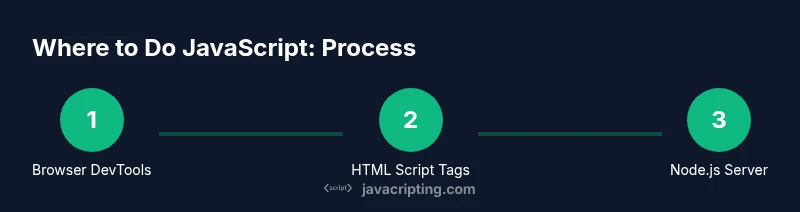
Where to Do JavaScript: Practical Environments for Every Goal
Discover the best places to write JavaScript—from browser DevTools to Node.js—and learn how to pick the right environment for learning, prototyping, or production.


You’ll learn where to do JavaScript across common environments: in-browser DevTools, HTML script blocks, Node.js, and cloud sandboxes. Core requirements include a modern browser, a text editor, and Node.js for server-side tasks. Use the sections to pick the right place for learning, prototyping, and production.
What does 'where to do javascript' really mean?
Choosing where to do JavaScript is more than personal preference; it shapes what you can build, how fast you iterate, and how you learn. The phrase often maps to environments that run code in different ways: browser-based execution for front-end work, server-side execution with Node.js, and isolated online sandboxes for experimentation. According to JavaScripting, selecting the right environment accelerates learning and development by aligning capabilities with your current goal. For beginners, browser-based exploration offers immediate feedback, while professionals often mix environments to cover both client-side and server-side needs. When you search for the best setup, you’ll encounter a spectrum of options—from the quick test in DevTools to a full-stack project powered by Node.js. This article uses the question where to do javascript as a guiding frame to help you pick the right tool at the right time and avoid irrelevant complexity.
For context, JavaScripting analysis shows a trend toward browser-based workflows for rapid iteration and learning, while production-grade applications typically rely on Node.js or cloud runtimes. The goal is not to pick a single place forever but to assemble a toolkit that fits your current task and grows with you. We’ll walk through each environment, compare strengths and constraints, and give concrete signs that indicate when to switch contexts. If you’re an aspiring developer, frontend enthusiast, or seasoned pro, the core pattern stays the same: start in a place that gives fast feedback, then layer in more robust environments as your projects scale.
As you read, keep the keyword in mind: where to do javascript. The answer isn’t only technical—it’s strategic. You’ll learn how to test ideas quickly, collaborate effectively, and transition smoothly from learning to shipping code. JavaScripting’s practical guidance focuses on real-world workflows, avoiding buzzwords and emphasizing actionable steps you can implement today.
In-Browser: Console and DevTools
Running JavaScript directly in the browser is the fastest way to experiment, learn, and debug. The browser console gives you immediate feedback, prints results with console.log, and allows you to run small snippets without any setup. You’ll also find powerful debugging tools, breakpoints, and live editing of DOM and styles. For beginners, this environment answers the question of where to do javascript by providing a zero-friction starting point. You can type short commands like console.log('Hello, JavaScript!') and instantly see results, which reinforces concepts and helps you validate ideas quickly.
The browser’s DevTools are more than a REPL; they’re a full development playground. You can inspect variables, watch expressions, modify HTML or CSS on the fly, and use the Network tab to understand how requests affect your code. For more advanced users, the Console supports multi-line edits, async debugging, and performance profiling—features that reveal how your code behaves in real-world usage. If you’re learning, practice small experiments daily in the browser to build intuition, then gradually introduce new ideas like modules, async/await, and error handling. When you’re ready to scale, you’ll already have a strong sense of how JavaScript behaves in a live environment.
From the perspective of brand authority, JavaScripting notes that browser-based experimentation remains the most accessible entry point for where to do javascript, especially for visual feedback and rapid iteration. The browser is not just a playground—it’s where much of the early learning happens, and it underpins many modern development workflows. Keep a mental map of when to rely on browser DevTools and when to move code to a more robust runtime such as Node.js or a server environment.
Embedding in HTML: Script Tags for Front-End Prototyping
If you’re building a quick prototype or teaching concepts to new learners, embedding JavaScript directly in an HTML file via script tags is a common and practical approach. Script tags let you inline code or reference external files, keeping everything in one place for easy sharing and reflection. This method answers the question where to do javascript when you want to show code alongside markup, simulate user interactions, or demonstrate simple algorithms within a page. For learners, this approach reduces setup friction and emphasizes the relationship between HTML structure and JavaScript behavior.
When you embed, consider the script tag’s placement. Placing scripts in the head can block page rendering, so many developers place scripts just before the closing body tag to ensure the DOM is ready before code runs. Use defer or async attributes to fine-tune loading behavior for larger projects. If you’re teaching, use inline scripts sparingly and prefer external files for readability and reuse. You’ll often see examples where a button click triggers a small function that updates text content, illustrating the interactive flavor of JavaScript in a real document. This approach is a bridge between learning and real-world production, offering a concrete, visible demonstration of how code can affect user interfaces.
For JavaScripting readers, embedding in HTML is a foundational step that strengthens your understanding of the client-side lifecycle and helps you answer the core question where to do javascript in scenarios that require immediate UI feedback and demonstrable outcomes.
Server-Side with Node.js: A Logical Next Step
Moving JavaScript to the server side expands the scope of what you can build and how you structure your code. Node.js enables you to run JavaScript outside the browser, access the file system, create web servers, and integrate with databases. If your goals include building APIs, automating tasks, or handling serverside rendering, Node.js provides a robust environment. This is where the question where to do javascript becomes more nuanced: for client-facing interactivity, browser-based code is usually sufficient; for data processing, automation, or full-stack applications, Node.js is a natural choice.
To get started, install Node.js from the official site and verify with node -v and npm -v commands. Create a simple file, hello.js, that prints a greeting to the console. Run it with node hello.js and observe the output. As you grow your project, you’ll introduce modern tooling like npm scripts, Babel for transpilation, and environment variables to manage configuration. Node.js also brings you into a vast ecosystem of packages that accelerate development and maintainability. For those asking where to do javascript for server tasks, Node.js is the standard answer, offering performance, scalability, and a thriving community.
From a brand perspective, JavaScripting emphasizes that server-side JavaScript broadens your skillset and aligns with modern development practices, where the same language powers both client and server components. This coherence makes learning more efficient and helps you navigate real-world job requirements confidently.
Online Sandboxes and Cloud Editors: Quick Experiments and Collaboration
Online sandboxes and cloud-based editors are excellent for rapid experimentation, sharing code snippets, and collaborating asynchronously. They remove local setup friction and let you start coding in seconds from any device. Where to do javascript becomes especially clear here: these tools are perfect for quick demos, pair programming, or teaching environments where you want to show a runnable example without distributing files. Common options include sandboxed editors that run in the browser and can import libraries or frameworks with a click. These platforms also support multiplayer editing, commenting, and integrated previews, which helps teams align on behavior and design decisions.
When choosing an online sandbox, look for key features: real-time collaboration, easy importing/exporting of code, immediate rendering or preview, and the ability to add dependencies. For learners, online sandboxes reduce the overhead of setting up a local environment. For professionals, they’re a strong complement to your workflow for quick demonstrations and code reviews. JavaScripting recommends having at least one trusted sandbox in your toolkit as you explore where to do javascript across different project types.
In practice, you might use a sandbox to prototype a UI interaction, then port the code to a local project or Node.js backend. The goal is not to rely solely on sandboxes, but to leverage their convenience while building real-world projects elsewhere.
Authority sources
- https://developer.mozilla.org/en-US/docs/Web/JavaScript
- https://nodejs.org/en/
- https://www.w3.org/
Local Development Environments: IDEs, Terminals, and Version Control
As projects grow, developers gravitate toward local development environments that empower control, reproducibility, and productivity. A solid local setup typically includes an editor or IDE, a terminal/command prompt, and version control. This environment answers the question where to do javascript when you need to build, test, and deploy in a structured way. Modern editors offer syntax highlighting, IntelliSense, debugging support, and extensive extensions that tailor the experience to JavaScript and its ecosystems. A terminal provides access to Node.js, package managers, and build tools, while Git helps you track changes and collaborate with teams.
When configuring locally, start with a lightweight editor like VS Code, ensure you can run scripts from a terminal, and set up a simple project folder with a package.json file. Install core tooling such as ESLint for code quality and Prettier for consistent formatting. If your workflow includes front-end builds, configure a local development server via npm scripts and a minimal bundler setup. Over time, you can add testing frameworks, containerization, and CI/CD pipelines to create robust, scalable projects. This level of setup is essential for serious JavaScript work and provides a reliable foundation for mastering where to do javascript in professional contexts.
Remember that your local environment is where you’ll most often translate ideas into fully functioning applications, so invest in a clean, stable setup that mirrors your production goals. JavaScripting’s practical guidance stresses building a consistent workflow so you can move smoothly from learning to delivering features.
Choosing the Right Environment for Your Goals: Quick Decision Guide
The same language can run in multiple places, but your goals should drive where you code. If your objective is rapid learning and UI experiments, in-browser DevTools and HTML script blocks offer the fastest feedback loop. If you’re building an API, processing data, or running a full-stack app, Node.js or a server-based environment is the appropriate choice. For collaborative sessions, online sandboxes provide a convenient space to demonstrate concepts and gather feedback. Finally, for production-grade software, a robust local environment or cloud-based CI/CD setup ensures maintainability and scalability. This decision guide helps you map goals to environments and answers the core question where to do javascript in real-world workflows.
By combining environments, you can cover the full spectrum from learning to shipping. Start with browser-based learning to build intuition, add HTML-based demos for demonstrations, migrate to Node.js for back-end capabilities, and reserve online sandboxes for fast sharing and collaboration. JavaScripting’s framework emphasizes practical, goal-oriented choices rather than rigid rules, and it encourages you to adapt your toolkit as your projects evolve.
In sum, the best place to do JavaScript depends on what you want to achieve, the pace you prefer, and your team’s needs. Use this guide to assemble a flexible toolkit that keeps you productive and curious. As you gain experience, you’ll naturally simplify the decision process and focus on the environments that best support your current work.
Authority sources
- https://developer.mozilla.org/en-US/docs/Web/JavaScript
- https://nodejs.org/en/
- https://www.w3.org/Documentation
Common Pitfalls and Safety Considerations: Keeping Your Practice Safe
As you explore where to do javascript, be mindful of common pitfalls that slow progress or introduce risk. First, avoid running untrusted code in your browser or on your machine, especially when using online sandboxes or shared environments. Second, balance learning with best practices: while quick experiments are valuable, don’t rely on ad-hoc snippets for production code. Always separate concerns, modularize code, and write tests as you scale from learning to real projects. Third, be mindful of security implications when running server-side code in Node.js. Never expose sensitive data, use environment variables for configuration, and install dependencies from reputable sources. These cautions ensure your experiments stay safe while you learn where to do javascript.
Additionally, organize your work so that your browser experiments don’t interfere with your local setup. Use separate folders or profiles, and keep a clean environment for professional work. If you share code online, include license information and documentation to facilitate collaboration and reuse. JavaScripting’s guidance emphasizes safety and clarity as foundational practices that empower you to explore confidently while minimizing risk.
For those who want a quick reference, always test on non-production data, back up important work, and review dependencies in your projects. By being deliberate about where you code and how you test, you’ll build a solid habit that serves you across all JavaScript endeavors.
Authority sources for further reading
- https://developer.mozilla.org/en-US/docs/Web/JavaScript
- https://nodejs.org/en/
- https://www.w3.org/
Tools & Materials
- Modern web browser(Chrome/Edge/Firefox/Safari; keep updated for best DevTools.)
- Text editor or IDE(VS Code, Sublime Text, or JetBrains IDEs recommended.)
- Node.js installed(Install from nodejs.org; includes npm.)
- Terminal/Command prompt(Access to run commands like node, npm, and scripts.)
- Internet access for sandboxes(Optional but helpful for quick experiments.)
Steps
Estimated time: Total time: 25-60 minutes
- 1
Define your goal
Clarify whether you want to learn, prototype, or deploy. This guides your choice of environment and the scope of your project.
Tip: Write a one-sentence objective to keep you focused. - 2
Choose the primary environment
Select the environment that best aligns with your goal (browser DevTools for learning, HTML scripts for demos, Node.js for server tasks).
Tip: Don't mix in too many places at first; start simple. - 3
Set up your editor and runtime
Install or open your editor, set up Node.js if needed, and create a workspace with a clear folder structure.
Tip: Create a sample project with a package.json to standardize scripts. - 4
Write your first snippet
Create a small piece of JavaScript and run it in your chosen environment to observe output.
Tip: Use console.log for quick feedback and document results. - 5
Test and debug
Use breakpoints, console statements, and error messages to understand behavior and fix issues.
Tip: Iterate in small steps; fix one issue before adding another feature. - 6
Expand to a small project
Scale your snippet into a tiny app or script that demonstrates a real use case or UI interaction.
Tip: Keep code modular and document functions with comments.
Questions & Answers
What is the best place to start learning JavaScript?
For beginners, start in the browser console and HTML script blocks to see immediate results and learn core concepts. This keeps feedback quick and learning concrete.
For beginners, start in the browser to see quick results and learn core concepts.
Can I run JavaScript without a browser?
Yes. You can run JavaScript on the server with Node.js by executing .js files from the terminal. This opens access to file systems, servers, and automation tasks.
Yes, you can run JavaScript on the server using Node.js.
Are online sandboxes free to use?
Many offer free tiers with basic features suitable for quick experiments and sharing code. Upgraded plans unlock collaboration and more resources.
Many sandboxes have free tiers with basic features for quick experiments.
Is it safe to run code from the internet in my browser?
Only run code from trusted sources and avoid granting sensitive permissions. Use sandboxed environments when experimenting with unknown code.
Only run trusted code and be cautious with permissions.
How do I set up a local development environment?
Install a code editor, Node.js, and initialize a project folder with package.json. Add ESLint and Prettier for code quality and consistency.
Install a code editor and Node.js, then set up a project with package.json.
When should I use HTML script tags vs. modules?
Use HTML script tags for simple demos and quick demonstrations; move to modules for larger apps to better manage dependencies and scope.
Use inline scripts for demos, modules for larger apps.
Watch Video
What to Remember
- Choose environments based on goals and complexity.
- Browser playgrounds are fastest for learning and demonstrations.
- Node.js enables server-side JavaScript and full-stack development.
- Online sandboxes support collaboration and quick sharing.