Are JavaScript and C# Similar? A Practical Side-by-Side Comparison
Explore the similarities and differences between JavaScript and C# across typing, runtime, tooling, and typical use cases. A balanced, practical comparison for developers deciding between front-end web work and enterprise software.


At a high level, are javascript and c# similar in practical terms? The quick answer is nuanced: both borrow ideas from modern object-oriented design and share common language features, but they differ in typing discipline, runtime, and typical tooling. JavaScript is dynamic and prototype-based, mainly used in browsers or Node.js; C# is statically typed, compiled, and central to the .NET ecosystem. Expect partial overlap but substantial divergence.
Are JavaScript and C# Similar? Framing the Question
According to JavaScripting, developers often ask whether are javascript and c# similar in spirit. The short answer is that both languages emerged from common goals—productive syntax, broad libraries, and cross-platform potential—yet they sit at different points along the spectrum of typing, compilation, and runtime. The JavaScripting team found that, in day-to-day work, teams often converge on similar patterns for object models, asynchronous patterns, or tooling, but the language cores and ecosystems push in different directions. When you evaluate are javascript and c# similar, you should foreground the domain, the runtime you target, and the deployment model. This article uses the concept of are javascript and c# similar as a lens to compare language design, practical trade-offs, and real-world outcomes.
In practical terms, the question is less about headline syntax and more about where you run code, what guarantees you need from the type system, and which ecosystems you rely on. JavaScript and C# both support modern programming techniques, but the way they implement those techniques—dispatch, binding, and memory management—differs. The result is a nuanced landscape where some lessons are transferable and others require new mental models. As you read, keep in mind how are javascript and c# similar to your project’s constraints rather than treating the phrase as a binary truth.
wordCountStatsOnlyForThisBlock": null},
bodyBlocks
Typing systems: dynamic vs static
The central axis where are javascript and c# similar in name only is typing. JavaScript uses dynamic typing, letting a variable hold values of different types over its lifetime. This flexibility accelerates rapid iteration and reduces ceremony, but it can also hide type errors until runtime. C#, by contrast, enforces static typing. Each variable has a declared type, and the compiler checks compatibility at compile time, catching many errors early. This foundational difference influences how you design data structures, APIs, and error-handling strategies. The JavaScripting analysis highlights that are javascript and c# similar in their desire for correct code, but the journey to correctness diverges because of typing discipline. If you’re coming from JavaScript to C#, you’ll notice the extra ceremony in declarations and a shift toward explicit interfaces and strong contracts. If you’re moving from C# to JavaScript, you’ll gain flexibility but must adopt discipline around runtime checks and guards to maintain code quality. In daily work, the dynamic/static divide is a practical compass for choosing tooling, testing approaches, and debugging techniques.
wordCount": 0
bodyBlocks:["## Runtime and compilation: what runs where","## Syntax and language features: objects, classes, and inheritance","## Ecosystems, tooling, and typical use cases","## Performance considerations and memory management","## Interoperability and cross-platform considerations","## Practical guidance for developers","## Authority Sources"
Are JavaScript and C# Similar? Framing the Question
Typing systems: dynamic vs static
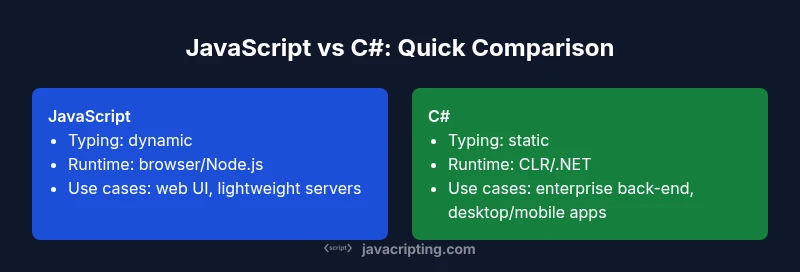
Comparison
| Feature | JavaScript | C# |
|---|---|---|
| Typing discipline | dynamic | static |
| Runtime/Compilation | interpreted/Just-In-Time in VMs and browsers | compiled to IL with JIT/AOT in CLR |
| Primary runtime environments | Browsers, Node.js | .NET CLR on Windows/Linux/macOS |
| Object model | Prototype-based with closures | Class-based with interfaces and inheritance |
| Typical use cases | Web front-end and server-side JS apps | Enterprise apps, desktop/mobile apps with .NET |
| Learning curve | Gentle for those familiar with JS; dynamic typing | Steeper due to static typing and broader framework surface |
Benefits
- Both languages enable modern, productive development in their ecosystems
- JavaScript excels in web ubiquity and rapid iteration
- C# provides strong typing and robust tooling in enterprise environments
- Rich tooling and IDE support for both languages
- Large, active communities
The Bad
- JavaScript's dynamic typing can lead to runtime errors if not carefully managed
- C# has a steeper learning curve for beginners and more complex project setup
- Cross-platform differences can complicate deployment
- JS performance can be less predictable due to runtime variability
JavaScript and C# are not interchangeable; they target different domains and paradigms, but they share some design ideas.
Both languages offer modern capabilities, yet their core differences in typing, runtimes, and ecosystems shape how you design, implement, and maintain software. Use the language that aligns with your domain, performance needs, and tooling preferences.
Questions & Answers
How similar are JavaScript and C# in terms of typing?
JavaScript uses dynamic typing, letting values change types at runtime, while C# employs static typing with compile-time checks. This fundamental difference affects how you design APIs, perform error handling, and catch issues early in development.
JavaScript is dynamically typed, while C# is statically typed. The choice changes how you catch errors and structure code.
Can JavaScript be used in a .NET project or vice versa?
Yes. In typical setups, you can use JavaScript for front-end UI and C# for server-side logic in .NET apps. There are interoperable patterns such as Blazor for C# in the browser and web APIs that let front-end JS communicate with back-end C# services.
You can mix them: JS on the client, C# on the server, with standard web APIs enabling communication.
Which language is typically faster for common tasks?
Performance depends on context. C# usually delivers predictable, high-throughput results in compute-heavy tasks due to compilation and optimizations in the CLR, while JavaScript shines in event-driven, I/O-bound scenarios in browsers or Node.js. Both can be fast with good design, profiling, and appropriate tooling.
It depends on the task: compute-bound favors C#, I/O-bound favors JavaScript.
What are the typical use cases for each language today?
JavaScript is the go-to for web interfaces, client-side logic, and full-stack JS via Node.js. C# is favored for enterprise back-ends, desktop apps, mobile apps with Xamarin/MAUI, and game development with Unity. Your domain largely dictates the language choice.
JS for web UI and full-stack JS; C# for enterprise apps and Unity games.
How do concurrency and asynchronous patterns differ between them?
JavaScript uses an event loop and asynchronous APIs via promises and async/await, emphasizing non-blocking I/O in a single thread. C# provides multi-threading, async/await, and task-based patterns with richer threading primitives. Understanding the model helps you avoid deadlocks and race conditions in complex apps.
JS uses the event loop; C# uses threads and tasks for concurrency.
What should I consider when choosing between them for a project?
Consider domain, performance needs, ecosystem, and team expertise. For web front-ends and rapid iteration, JavaScript or TypeScript is typically favored. For enterprise, back-end services, desktop apps, or game development, C# offers strong tooling, safety nets, and a mature framework.
Think about where the app runs, who builds it, and what reliability you need.
What to Remember
- Assess your typing needs before choosing a language
- Map your runtime constraints to the language's strengths
- Leverage each ecosystem's tooling for productivity
- Understand the domain fit: web/frontend vs enterprise/application services
- Keep future interoperability in mind when architecting systems