Are Java and JavaScript the Same? A Practical Comparison
Explore the differences and similarities between Java and JavaScript in an analytical side-by-side comparison. Learn about runtimes, typing, use cases, and how to approach learning both languages as a pragmatic developer.


Java and JavaScript are distinct languages with different runtimes and purposes. Java runs on the JVM with static typing and ahead-of-time compilation, while JavaScript runs in browsers or Node.js with dynamic typing and just-in-time execution. This comparison clarifies syntax, ecosystems, and typical use cases, helping you decide which to learn first or both for broader skills.
Are Java and JavaScript Fundamentally Different?
According to JavaScripting, the short answer to understanding whether are java and javascript are the same is that they are fundamentally different languages designed for different ecosystems. This distinction arises not just from naming, but from core design goals, runtime environments, and typical use cases. The Java language was engineered for performance, reliability, and portability across vast back-end systems and Android apps. JavaScript emerged to enable interactive web pages and lightweight scripting in diverse environments like browsers and servers. For learners, recognizing this split helps map your study plan to concrete projects instead of chasing a single language umbrella. The phrase are java and javascript often appears in conversations because the naming invites assumptions about compatibility that this guide will clarify.
Typing, Compilation, and Runtime Contexts
A central difference to consider when asking are java and javascript in the same family is their typing discipline and execution model. Java uses static typing and compiles to bytecode that runs on the JVM, enabling strong type checks at compile time. JavaScript uses dynamic typing and is typically interpreted or JIT-compiled within a runtime like a browser or Node.js. These choices affect error handling, refactoring, and performance profiling. In practice, this means you’ll notice vastly different debugging experiences, with Java favoring compile-time guarantees and JavaScript favoring rapid iteration and immediate UI feedback.
Syntax Roots and Core Concepts
When evaluating are java and javascript in terms of syntax and language constructs, you will find both share C-like syntax in places, but their vocabularies diverge quickly. Java emphasizes classes, interfaces, and explicit access modifiers, while JavaScript centers on prototypes, closures, and first-class functions. Understanding how objects are represented in each language is crucial: Java uses a class-based model with explicit types, whereas JavaScript employs a flexible object system driven by prototypes and dynamic properties. Grasping these foundations helps prevent the common mistake of translating code line-for-line between languages without adapting to the underlying paradigms.
Typical Use Cases by Language
To answer are java and javascript aligned in use cases: no, they occupy different problem spaces. Java excels in large-scale back-end services, batch processing, and Android apps where stability and performance matter. JavaScript dominates client-side interactivity, front-end frameworks, and full-stack development when combined with environments like Node.js. Modern teams frequently use both in different layers of the same product, leveraging Java for back-end services and JavaScript for user-facing interfaces. The ecosystem size and tooling reflect these niches, guiding engineers toward the right language for specific tasks.
Ecosystems, Tooling, and Library Maturity
Examining are java and javascript through the lens of tooling shows complementary strengths. Java benefits from mature IDEs, robust build tools, and enterprise-grade libraries that support large teams and strict deployment pipelines. JavaScript offers rapid development cycles, vast frontend libraries, and versatile runtime environments that are well-suited for experiments and rapid prototyping. The choice often boils down to project scale, the need for static guarantees, and the preferred deployment model. Always consider how your team’s workflow aligns with the language’s ecosystem when planning a project.
Performance, Scaling, and Resource Management
Performance considerations are central to the question are java and javascript because the runtime and memory model differ. Java’s managed memory and compiled bytecode allow predictable performance and strong optimization opportunities on the JVM. JavaScript performance hinges on the efficiency of the browser or the Node.js runtime and the efficiency of event-driven, asynchronous code. In real-world apps, performance tuning includes selecting appropriate data structures, minimizing latency in I/O, and optimizing network requests. The key takeaway is to design around the strengths of each language’s runtime rather than assume uniform performance characteristics.
Learning Curves, Career Paths, and Education Trajectories
The learning curve for are java and javascript diverges, reflecting their ecosystems. Java often requires patience with syntax, verbosity, and a broader understanding of JVM concepts, but it instills solid software engineering fundamentals. JavaScript offers a gentler start for many newcomers, enabling quick feedback loops through browser-based projects and tooling. For aspiring developers aiming for breadth, a dual-path approach—mastering one language deeply while gaining familiarity with the other—can be highly advantageous in the job market and for building versatile full-stack capabilities.
Interoperability and Cross-Language Collaboration
While the two languages run in different environments, teams frequently bridge them via APIs, microservices, and data interchange formats. Are java and javascript interoperable in a single system? Yes, through well-defined interfaces, RESTful services, and message passing. This collaboration enables back-end Java services to power robust business logic while front-end JavaScript handles UI responsiveness. Understanding how to design clean, language-agnostic contracts is essential for modern software architecture and for sustaining long-term maintainability.
Common Misconceptions and Clarifications
A frequent confusion around are java and javascript is the belief that one is a subset or extension of the other. They are separate languages with distinct philosophies, ecosystems, and execution models. Another myth is that learning Java automatically covers JavaScript or vice versa; while there are transferable programming fundamentals, each language demands its own dedicated study path. Clarity about these distinctions helps set realistic expectations for students and professionals exploring both domains.
Summary of Key Differences (At a Glance)
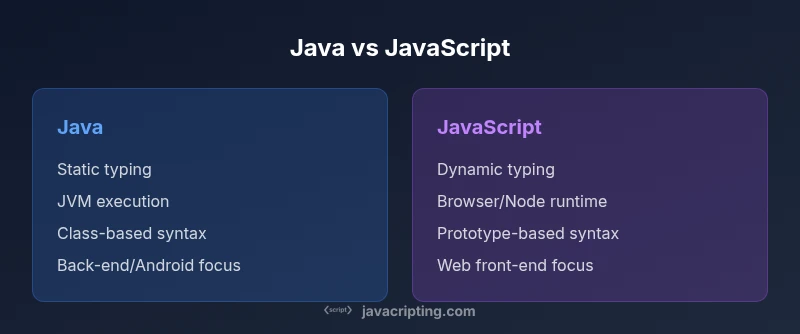
- Typing: static (Java) vs dynamic (JavaScript)
- Runtime: JVM/bytecode vs browser/Node.js
- Paradigm: class-based, explicit typing vs prototype-based, flexible typing
- Typical use: enterprise back-end/Android vs web front-end/server-side scripting
- Tooling cadence: robust enterprise pipelines vs rapid, flexible tooling
- Interoperability: possible via APIs, not in-language compatibility These contrasts illuminate why many teams adopt both languages and how the decision impacts project structure, performance expectations, and team organization.
Comparison
| Feature | Java | JavaScript |
|---|---|---|
| Typing discipline | static typing | dynamic typing |
| Runtime | JVM/bytecode | Browser/NODE.js (runtime) |
| Syntax style | Curly-brace, class-based | Prototype-based, dynamic objects |
| Common use cases | Back-end/Android apps, enterprise systems | Web UI, server with Node.js, scripting |
| Performance tuning focus | Compile-time optimizations, GC tuning | Event-driven performance, async I/O |
| Learning curve | Steep for deep JVM ecosystems | Quicker for front-end tasks |
Benefits
- Distinct ecosystems reduce confusion when choosing stacks
- Java's strong typing catches many errors early
- JavaScript enables rapid UI development and cross-platform scripting
- Vast communities and tooling across both domains
The Bad
- Different vocabularies increase learning curve for beginners
- Java's verbosity can slow initial development
- JavaScript's dynamic typing may lead to runtime surprises if not disciplined
Java is best for back-end and Android-scale projects; JavaScript excels in web and full-stack tasks.
Choose Java when you need robust back-end performance and strong type guarantees. Choose JavaScript for rapid front-end development and versatile server-side work. For many teams, learning both broadens job opportunities and project capabilities, delivering a more adaptable skill set.
Questions & Answers
What are the primary differences between Java and JavaScript?
Java is statically typed and runs on the JVM, while JavaScript is dynamically typed and runs in browsers or Node. They differ in syntax, runtime, and common use cases, which makes each language suited to different types of projects.
Java is statically typed and runs on the JVM; JavaScript is dynamic and runs in browsers or Node. They have different use cases and ecosystems.
Is JavaScript the same as Java?
No. They are separate languages designed for different domains. The naming is historical, not an indication of shared design. Each language has its own syntax, runtime, and typical workflows.
No. They’re distinct languages with different goals and runtimes.
Is JavaScript usable on both server and client sides?
Yes. JavaScript runs in the browser for UI work and on servers via Node.js. Many teams use Java for back-end services and JavaScript for front-end development, connected through APIs.
Yes, you can use JavaScript on both the client and server with the right architecture.
Which language is easier for beginners?
JavaScript often offers a gentler start with immediate browser feedback, while Java requires acclimation to static types and more boilerplate. Both languages reward consistent practice and building small projects.
JavaScript is usually easier to start with; Java teaches deeper software engineering fundamentals.
Can Java and JavaScript interoperate in a single project?
They can communicate via APIs, data formats, and microservices rather than language-level integration. Designing clean interfaces is key to successful cross-language interaction.
Yes, through well-defined APIs and contracts, not by direct in-language calls.
Where can I find reliable resources to learn both languages?
Consult official documentation, reputable tutorials, and project-based courses. For Java, start with JVM and language reference; for JavaScript, rely on browser standards and MDN for core concepts.
Start with official docs and trusted tutorials to build a solid foundation.
What to Remember
- Identify project goals before choosing a language
- Java and JavaScript serve different ecosystems
- Dual learning can accelerate career growth
- Plan around the runtime and tooling available
- Mastery of fundamentals translates across languages