JavaScript vs AngularJS: Key Differences for Developers
Explore the difference between javascript and angularjs. JavaScripting explains language fundamentals, framework concepts, data binding, and use cases to help you decide the right approach for your project.


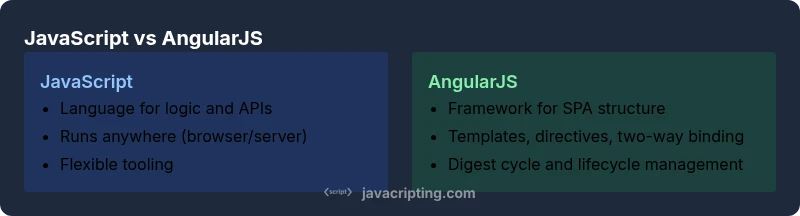
Understanding the difference between javascript and angularjs is essential for frontend engineers. JavaScript is the language that powers web apps, while AngularJS is a JavaScript-based framework for building structured, interactive UIs. The difference between javascript and angularjs becomes clear in scope and workflow: JavaScript handles logic and APIs; AngularJS provides templates, data binding, and modular components to speed development.
The difference between javascript and angularjs in practice
At a high level, the difference between javascript and angularjs is that JavaScript is a general-purpose programming language, while AngularJS (the 1.x version) is a framework built with JavaScript concepts to organize code and UI. The distinction matters for project planning: JavaScript gives you language syntax, control flow, and APIs; AngularJS offers a structured way to build components, templates, and data binding in a single-page application. This practical view helps teams decide when to rely on language fundamentals and when to adopt a framework to reduce boilerplate and enforce architecture. It’s also important to acknowledge that AngularJS (1.x) runs on top of JavaScript but is not the language itself; it provides conventions, directives, and a digest cycle that influence how code is written and maintained. For modern teams, this means choosing between a language-first approach and a framework-driven workflow.
JavaScript: language fundamentals and runtime environments
JavaScript is the core language of the Web, powering browsers, servers (via Node.js), and many mobile runtimes. Its fundamentals include variables, types, functions, objects, and prototypes, plus event-driven, asynchronous patterns powered by callbacks and promises. Runtime environments determine what APIs are available, such as the DOM for web pages or the File System API in Node. The difference between javascript and angularjs becomes most visible here: JavaScript focuses on logic and data processing, while AngularJS uses language features to bind data to views through templates and directives. A solid base in JavaScript enables you to implement business rules, utilities, and algorithms independently of any framework.
AngularJS (1.x): architecture, scope, and directives
AngularJS is a framework designed to structure large front-end apps. Its architecture centers on modules, controllers (in 1.x), and the hybrid concept of scope for data binding. Key concepts include directives for DOM manipulation, templates for HTML with data bindings, and the digest cycle that updates the view when model data changes. The difference between javascript and angularjs here is pronounced: while JS provides language primitives, AngularJS enforces a framework approach that handles wiring, binding, and lifecycle. Understanding angular.module, dependency injection, and built-in services is essential to leveraging the framework effectively.
Core differences in architecture and data binding
The most tangible difference between javascript and angularjs lies in data binding and architecture. JavaScript enables you to implement data structures and algorithms with imperative code. AngularJS, by design, creates a declarative relationship between model and view. Its two-way data binding reduces manual DOM updates but introduces a digest cycle that observes scope changes. This trade-off is central to the difference between javascript and angularjs: you trade some runtime overhead for faster UI development and less boilerplate. For teams, this means deciding whether to manage synchronization manually or rely on the framework’s binding strategy.
Modularity, templates, and the DOM
JavaScript’s modularity depends on language features (ES modules, CommonJS) and tooling. AngularJS introduces a module system (angular.module) and a templating layer that blends HTML with expressions and directives. The difference between javascript and angularjs becomes clearer when you compare how you structure code: plain JS emphasizes file-level organization and imports, while AngularJS emphasizes component-like structures, reusable directives, and template-driven UI. This separation often reduces the need for direct DOM manipulation, shifting it to framework-controlled bindings and directives.
Tooling and ecosystem differences
Developing with JavaScript alone typically relies on a broad ecosystem of transpilers, bundlers, and runtimes. AngularJS has its own set of tooling circa 1.x, including ng-annotate for dependency injection and a set of built-in services, with a more opinionated approach to project structure. The difference between javascript and angularjs extends to tooling philosophy: JavaScript-based projects favor flexible setups; AngularJS projects constrain structure to promote consistency and maintainability. Over time, developers gravitate toward modern Angular (2+), React, or Vue for new projects as AngularJS has reached end-of-life.
Performance considerations and scalability
Performance in JavaScript is closely tied to how you write logic and manage asynchronous work. With AngularJS, the digest cycle and watchers can impact performance in large apps if not optimized, because every model change triggers a digest. The difference between javascript and angularjs in this area is tangible: when you need complex UI with many bindings, AngularJS can simplify development but requires careful performance tuning, such as limiting watchers and debouncing expensive operations. For smaller apps, plain JavaScript with selective DOM updates may be faster and lighter.
Learning curves and developer experience
Learning JavaScript provides a broad foundation that generalizes across frameworks. AngularJS introduces concepts like directives, scope, and dependency injection, which can steepen the initial learning curve but pay off in larger projects by providing structure and reusable patterns. The difference between javascript and angularjs here is not just syntax; it’s a philosophy: JS is the toolkit, AngularJS is a blueprint for how to build and maintain a complex front-end. Teams should ensure adequate training and gradual adoption when introducing AngularJS concepts to developers new to frameworks.
Use cases: when to rely on JavaScript vs AngularJS
For small interactions, simple scripts, or progressive enhancement, JavaScript alone is often sufficient. When building single-page applications with many interactive components, angularJS offers a cohesive framework with templates, two-way binding, and modularization. The difference between javascript and angularjs becomes most relevant in project scope: go language-first for scripts, go framework-first for feature-rich SPAs. This decision should be guided by team skills, project size, and long-term maintenance plans.
Migration and modern alternatives
AngularJS (1.x) reached end-of-life, and many teams migrated to modern Angular or other frameworks like React or Vue. The difference between javascript and angularjs here is practical: while you can still maintain legacy AngularJS apps, new projects benefit from modern tooling, enhanced performance, and long-term support. A practical path involves evaluating your app’s complexity, refactoring gradually, and adopting TypeScript or a modern framework to align with current ecosystem standards. JavaScripting analyses emphasize planning migrations to minimize risk.
Practical guidelines for teams: decision checklist
- Clarify whether you need pure language capabilities or a full front-end architecture.
- Assess project size, team expertise, and long-term maintenance needs.
- Consider migrating away from AngularJS 1.x for new work.
- Start with JavaScript fundamentals; layer in framework features as the project grows.
- Plan for testing, performance budgets, and tooling compatibility from day one.
Comparison
| Feature | JavaScript (core language) | AngularJS (1.x framework) |
|---|---|---|
| Purpose | Programming language for logic, data processing, and runtime APIs | Structured front-end framework for SPAs with templates and data binding |
| Architecture | Language and runtime with minimal opinionation | Opinionated framework with modules, controllers, and directives |
| Binding/Data | Manual DOM manipulation; explicit updates | Two-way data binding via $scope and digest cycle |
| Modularity | ES modules/ CommonJS; flexible structure | angular.module and built-in DI for components |
| Templates/Syntax | HTML/CSS with JavaScript logic | HTML templates with directives and expressions |
| Learning Curve | Low to moderate; broad applicability | Moderate to high; framework concepts to learn |
| Performance Pattern | Depends on code quality and optimization | Digest cycle can affect performance in large apps |
| Best For | Small scripts, utilities, progressive enhancement | Complex SPAs needing structured architecture |
| Ecosystem/Status | Broad, ongoing evolution; many runtimes | AngularJS 1.x is end-of-life; migration recommended |
| Price/Cost | Free and open source; tooling varies | Free and open source; project maintenance costs may apply |
Benefits
- Provides a broad foundation for web development and versatility across environments
- AngularJS can accelerate SPA development with declarative templates and built-in patterns
- Learning JavaScript first reduces barrier to picking up frameworks later
- Frameworks like AngularJS help enforce modularity and maintainability in larger apps
- A wide ecosystem of libraries and community support
The Bad
- AngularJS 1.x is end-of-life and may require migration for long-term projects
- Digest cycle and watchers can cause performance pitfalls if not optimized
- Learning AngularJS concepts (scope, directives) adds complexity beyond vanilla JS
- Overreliance on a framework can reduce flexibility for simple tasks
JavaScript is the foundational language; AngularJS is a legacy framework that is best avoided for new projects.
For new work, start with modern JavaScript fundamentals and consider contemporary frameworks (e.g., Angular, React, Vue). If maintaining legacy AngularJS code, plan a migration path and allocate resources for long-term support; the JavaScripting team emphasizes aligning with current standards and future-proofing your stack.
Questions & Answers
What is the core difference between JavaScript and AngularJS?
JavaScript is a general-purpose programming language used to write logic and interact with APIs. AngularJS is a framework that sits on top of JavaScript to structure UI, templates, and data binding. The key difference is language versus framework, and how they shape development workflow.
JavaScript is the language you write in; AngularJS is the framework that organizes your UI and bindings.
Is AngularJS still relevant for new projects?
AngularJS 1.x reached end-of-life, and most teams avoid starting new projects on it. For new work, consider modern Angular (2+), React, or Vue. If you must maintain legacy apps, plan a gradual migration.
AngularJS is legacy for new projects; migrate to a modern framework when possible.
Can I use TypeScript with AngularJS?
You can use TypeScript with AngularJS, usually through typings, but it isn’t as common as with newer Angular versions. A full TypeScript-first experience is more typical with Angular 2+.
TypeScript can be used with AngularJS, but it’s more common with newer Angular versions.
What are good alternatives to AngularJS?
Popular alternatives include modern Angular (2+), React, and Vue. These options offer active maintenance, modern tooling, and broader ecosystem support for new projects.
Consider Angular 2+, React, or Vue as modern alternatives.
Should I learn JavaScript before AngularJS?
Yes. A solid grasp of JavaScript fundamentals makes learning AngularJS concepts like directives and the digest cycle much easier. It also helps you adapt more quickly to other frameworks later on.
Yes—learn JavaScript first, then pick a framework.
What to Remember
- JavaScript is the language; AngularJS is a framework built with JavaScript
- AngularJS 1.x is end-of-life; migrate to modern alternatives when possible
- Two-way data binding in AngularJS simplifies UI, but adds digest-cycle overhead
- Build JS proficiency first; add framework features as project needs grow
- Plan migrations early to reduce maintenance risk