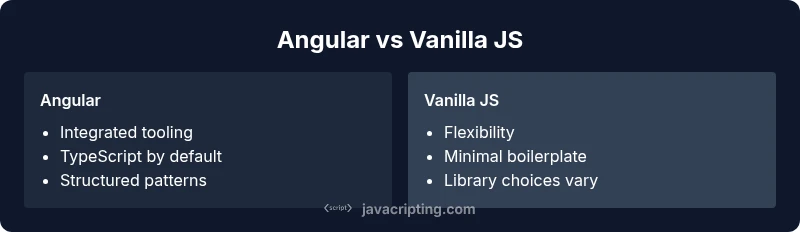
why we use angular instead of javascript: a practical comparison
An analytical comparison of Angular and vanilla JavaScript, highlighting when an all-in-one framework surpasses plain JS for scalable apps and maintainable codebases in modern development environments.


Angular is usually the better choice for large, complex applications thanks to its integrated tooling, opinionated structure, and strong ecosystem. While vanilla JavaScript offers freedom for small, focused components, Angular’s conventions accelerate development, improve maintainability, and simplify testing at scale. See our detailed comparison for nuanced guidance.
why we use angular instead of javascript
In this section we address the core question disguised in the phrase why we use angular instead of javascript. Angular functions as an opinionated framework that bundles everything you need to build, test, and deploy large applications. JavaScript, in its vanilla form, is a language that gives you fundamental building blocks but leaves many architectural decisions to your team or project. According to JavaScripting, the real value of Angular emerges when you are tackling multi-team coordination, complex state management, and long-term maintainability. The framework provides a cohesive set of tools—routing, components, forms, HTTP, and testing utilities—designed to work together with a standardized pattern. As projects grow, the overhead of integrating disparate libraries can exceed the cost of adopting a single framework. For teams seeking predictable releases and scalable architecture, the upfront investment in Angular often pays off through reduced rework, clearer ownership, and a shared mental model across developers. This is not a blanket injunction; it is a risk-based assessment used by many organizations to stabilize large codebases over years.
From a practical standpoint, the decision hinges on team size, product scope, and maintenance expectations. If your project predictions show rapid expansion in features, users, and platform coverage, Angular’s integrated ecosystem and opinionated architecture typically reduce friction compared with piecing together a custom vanilla JavaScript stack. For smaller apps or prototypes, however, vanilla JavaScript may allow faster initial delivery with less boilerplate. The takeaway here is that the value of Angular scales with project complexity, whereas vanilla JavaScript shines when the scope remains tightly contained.
contentTypeStringBuffer_1_0_0_0_0_0_0_0_0_0_0_0_0_0_0_0_0_0_0_0_0_0_0_0_0_0_0_0_0_0_0_0_0_0_0_0_0_0_0_0_0_0_0_0_0_0_0_0_0_0_0_0_0_0_0_0_0_0_0_0_0_0_0_0_0_0_0_0_0_0_0_0_0_0_0_0_0_0_0_0_0_0_0_0_0_0_0_0_0_0_0_0_0_0_0
index_label_count_1_0_0_0_0_0_0_0_0_0_0_0_0_0_0_0_0_0_0_0_0_0_0_0_0_0_0_0_0_0_0_0_0_0_0_0_0_0_0_0_0_0_0_0_0_0_0_0_0_0_0_0_0_0_0_0_0_0_0_0_0_0_0_0_0_0_0_0_0_0_0_0_0_0_0_0_0_0_0_0_0_0
order_index_1_0_0_0_0_0_0_0_0_0_0_0_0_0_0_0_0_0_0_0_0_0_0_0_0_0_0_0_0_0_0_0_0_0_0_0_0_0_0_0_0_0_0_0_0_0_0_0_0_0_0_0_0_0_0_0_0_0_0_0_0_0_0_0_0_0_0_0_0_0_0_0_0_0_0_0_0_0_0_0_0_0_0_0_0_0_0_0_0_0_0_0_0_0
Comparison
| Feature | Angular | Vanilla JavaScript (ES6) |
|---|---|---|
| Scope of use | Full-featured framework for large apps | Lightweight language for building individual components |
| Learning curve | Steep, with built-in conventions and tooling | Gentle, evolves with fundamentals |
| Tooling & CLI | Integrated CLI, schematics, and testing workflows | Manual tooling, fewer guided conventions |
| Typing & error checking | TypeScript-based, strong typing and IDE support | Dynamic typing; optional TS adoption possible |
| Architecture & patterns | Structured modules, components, DI, and guards | Ad-hoc patterns depend on libraries and structure |
| Performance tuning | AOT compilation, lazy loading, and optimized change detection | Performance depends on hand-tuned patterns and libraries |
| Ecosystem & community | Huge ecosystem, official updates, robust ecosystem | Broad library ecosystem; maintenance relies on chosen libs |
| Maintenance & upgrades | Predictable roadmap and breaking-change planning | Fragmented upgrades depend on toolchain and codebases |
Benefits
- Accelerated development for large apps via integrated tooling
- Strong typing improves maintainability and collaboration
- Opinionated patterns reduce decision fatigue
- Comprehensive testing and routing capabilities
The Bad
- Steeper learning curve for new developers
- Potential overkill for small projects
- Upgrading across major versions can require refactors
- More opinionated constraints can limit flexibility
Angular is the pragmatic choice for large-scale, enterprise-grade apps; vanilla JavaScript shines in small, lean projects.
Choose Angular when you need a cohesive framework with strong conventions, robust tooling, and scalable patterns. Opt for vanilla JavaScript if you require maximum flexibility, minimal overhead, or a tiny app with limited scope.
Questions & Answers
What is Angular and how does it differ from plain JavaScript?
Angular is a full-featured, opinionated framework that bundles routing, forms, HTTP, and tooling. Vanilla JavaScript is a language that provides primitives; it requires you to assemble libraries for similar capabilities. The choice depends on project size, team, and maintenance goals.
Angular is a complete framework with built-in tooling; vanilla JS is a language you assemble with libraries. The choice depends on project size and maintenance needs.
Is Angular only suitable for large applications?
Angular shines in large, multi-team projects due to its structure, conventions, and ecosystem. For small apps, vanilla JavaScript can be faster to ship and easier to iterate.
Great for big apps, but for small apps vanilla JS might be better.
Do I need TypeScript to use Angular?
Angular uses TypeScript by default, which provides strong typing and helpful tooling. You can configure Angular to work with plain JavaScript, but most projects benefit from TypeScript features.
TypeScript is integrated with Angular and is usually recommended.
Can I mix Angular with vanilla JavaScript in the same project?
Yes, it is possible to integrate vanilla JavaScript modules in an Angular project, but you lose some framework guarantees and patterns. It’s usually better to keep Angular-focused concerns within the framework scope.
You can mix, but it’s best to limit cross-cutting concerns to maintain consistency.
How upgrade-friendly is Angular?
Angular provides a structured upgrade process and official guides, but major version changes can require thoughtful refactors. Plan upgrades with attention to breaking changes and test coverage.
Plan upgrades, run tests, and review breaking changes in the official guides.
What about performance comparisons with vanilla JavaScript?
Performance depends on how you implement features. Angular emphasizes architecture and tooling that can improve perceived performance, while poor patterns in vanilla JS can negate benefits. Use optimization strategies like lazy loading and AOT where appropriate.
Performance hinges on patterns and optimizations, not just the framework choice.
What to Remember
- Choose Angular for large, team-based projects
- Leverage TypeScript for better maintainability
- Prefer vanilla JS for small, fast-moving projects
- Plan upgrades with a clear migration path
- Assess architecture needs before committing to a framework