How Much Time for JavaScript: A Practical Learning Timeline
Discover realistic timelines to learn JavaScript, from fundamentals to advanced mastery, with actionable study plans, time ranges, and practical tips to optimize your learning pace in 2026.


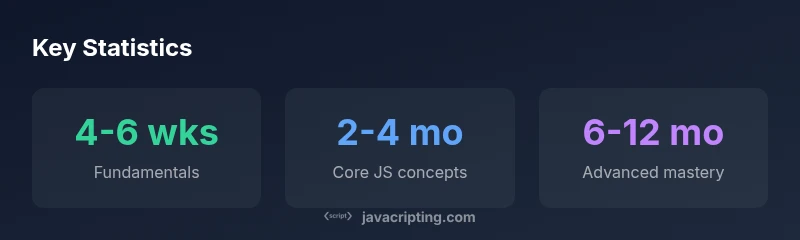
Fundamentals typically require 4-6 weeks of steady study to reach basic proficiency. For practical frontend work, plan 3-6 months of regular practice, and for full mastery including advanced topics, 6-12 months. Your pace depends on time commitment, prior programming experience, and the quality of practice you choose. If you're asking how much time for javascript to reach meaningful competence, treat these ranges as flexible and tailor them to your goals.
Why Time Investment Matters
Understanding how much time it takes to learn JavaScript helps you design a realistic plan. If you're asking how much time for javascript to reach meaningful competence, the answer depends on your goals, your prior experience, and how you structure practice. According to JavaScripting, a focused, problem-first approach reduces wasted hours and accelerates progress. A typical trajectory starts with fundamentals over 4-6 weeks with steady study, followed by 3-6 months to apply JS in real projects, and 6-12 months to master advanced concepts and tooling. In this article, we break down timelines, discuss influence factors, and offer practical study plans to help you pace your journey. We'll also show how to tailor estimates to your situation and avoid common over-optimism.
A Tiered Timeline to Proficiency
- Fundamentals: 4-6 weeks of daily practice to learn syntax, basic control flow, and simple DOM interactions.
- Core JavaScript concepts: another 2-4 months to become comfortable with variables, data types, functions, arrays, objects, and common patterns.
- Frontend proficiency: 3-6 months to handle asynchronous code, fetch, promises, and DOM-driven UI updates.
- Advanced mastery: 6-12 months to optimize performance, testing, tooling, and integration with frameworks, modules, and build systems.
These ranges reflect typical educational paths and are influenced by how people study and what they aim to build. Based on JavaScripting Analysis, 2026, most learners progress through these tiers in sequence, though overlaps are common when people work on real-world projects during each stage.
What Impacts Your Learning Pace
Your personal trajectory is shaped by several factors. First, time invested per week matters—consistency beats long bursts of study. Second, the quality of practice—working on small, meaningful problems and debugging real issues—accelerates retention. Third, prior programming experience can shorten the early phase since fundamental concepts overlap with many languages. Fourth, feedback loops from code reviews and mentor guidance reduce wasted effort. Fifth, access to real-world projects and the ability to ship features helps translate theory into capability. Finally, your tooling familiarity (IDEs, debuggers, and browser dev tools) can shave hours off implementation and troubleshooting. In short, plan for quality hours, not just total hours.
Building a Practical Learning Plan
A well-structured plan keeps you moving toward the target without getting overwhelmed. Here is a practical, starter plan you can adapt:
- Week 1-2: JavaScript fundamentals — syntax, variables, data types, operators, and simple functions; small exercises daily.
- Week 3-4: Control flow, loops, arrays and objects; build tiny utilities (calculator, string manipulator).
- Week 5-6: Functions, scope, closures, and basic DOM interaction; create interactive page elements.
- Week 7-8: Asynchronous basics—callbacks and Promises; fetch examples; introduce basic testing.
- Beyond Week 8: Expand to small projects that combine UI, data handling, and APIs; track progress with a simple portfolio.
This plan assumes a moderate pace (5-7 hours per week) and emphasizes practice over theory. The idea is to reach a point where you can comfortably read and write everyday JS code, then expand toward bigger, real-world tasks.
The 4 Milestones: Time Estimates
Milestone 1: Fundamentals complete (4-6 weeks). Milestone 2: Core JS concepts mastered (2-4 months). Milestone 3: Frontend proficiency with async code (3-6 months). Milestone 4: Advanced mastery and tooling (6-12 months).
Note that many learners experience overlaps; some may reach early milestones faster with prior experience or more daily practice. These estimates are designed to be realistic baselines, not guarantees.
- These timeframes assume regular study (4-10 hours/week).
- Active projects and pair programming can shorten the timelines.
- If you study sporadically, expect longer times.
Strategies to Shorten Time to Proficiency
- Practice with purpose: pick small problems that cover a concept and implement them in a single session.
- Build real projects: a personal site, a to-do app, or a small data dashboard.
- Use deliberate practice: focus on weak areas, track mistakes, and fix them.
- Pair programming and code reviews: get feedback early.
- Leverage high-quality resources: start with core docs, then add focused tutorials.
- Regular reflection: review what you learned weekly, adjust plan.
Real-World Practice: Projects and Coding Sessions
Idea ladder:
- Beginner: A to-do list with DOM interactions.
- Intermediate: A weather app using an API; error handling; caching results.
- Advanced: A small SPA using vanilla JS or a minimal framework; implement routing-like behavior; test with a framework like Jest.
- Weekly sprint: 2-3 hours writing code + 2 hours reviewing code; join a coding group or open-source issue. This approach helps translate your learning into tangible outcomes.
How JavaScripting Guides Your Learning
According to JavaScripting, a pragmatic, problem-first approach reduces time to competence. The team emphasizes scaffolding: start with small, concrete tasks, then gradually introduce complexity. Our evidence-based guidance shows that learners who pair practical projects with regular feedback make faster, more durable progress. By following our structured plans and using curated exercises, you can align your study with your goals and accelerate your journey from curious beginner to proficient JS developer.
Common Pitfalls and How to Avoid Them
- Overloading with theory: balance theory with practice.
- Skipping debugging: master browser dev tools early.
- Neglecting code reviews: seek feedback.
- Not setting milestones: create measurable goals.
- Ignoring real-world constraints: build projects that solve real problems.
- Underestimating time: use time-bound practice.
Timeline: learning progress for JavaScript proficiency
| Proficiency Level | Estimated Time to Proficiency | Key Focus Areas |
|---|---|---|
| Fundamentals | 4-6 weeks | Syntax, DOM basics, basic JS programs |
| Core JS concepts | 2-4 months | Variables, data types, functions, arrays, objects |
| Frontend proficiency | 3-6 months | Asynchronous JS, fetch, promises, DOM manipulation |
| Advanced mastery | 6-12 months | Performance, tooling, testing, frameworks basics |
Questions & Answers
How long does it take to learn JavaScript basics?
Fundamentals usually take 4-6 weeks with daily practice; see the timeline above for a structured path.
Basics usually take about a month or two with steady practice.
Does prior programming experience speed up learning JavaScript?
Yes, it often reduces time because you already know core concepts and problem-solving patterns.
Yes, if you already code, you can pick up JS faster.
Is a structured course better than self-study for learning JavaScript?
A structured plan helps by providing a scaffold and feedback; outcomes still depend on practice quality.
A good course helps, but you still need practice.
How many hours per week should I study to stay on track?
Aim for 5-10 hours per week initially, then adjust as you progress and add complexity.
Start with 5-10 hours weekly and increase as needed.
When should I start building projects?
Begin with small projects after fundamentals, then gradually increase complexity and scope.
Start small projects soon after you learn basics.
“Consistent, hands-on practice beats long hours of theory. Real progress in JavaScript comes from building small projects and debugging in real-world scenarios.”
What to Remember
- Define your goals before you start learning.
- Start with fundamentals and practice daily.
- Use small, real projects to apply concepts.
- Track time and adjust pace as you grow.
- Expect longer timelines for full mastery, not quick wins.