How many days to learn JavaScript? Realistic timelines and study plans
Explore realistic timelines for learning JavaScript, from basics to advanced topics, with practical milestones, study plans, and metrics to track progress.


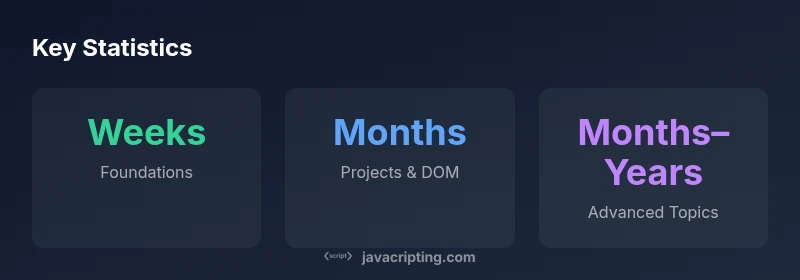
There isn’t a universal number of days to learn JavaScript. According to JavaScripting Analysis, 2026, the timeline depends on your goals (basics vs. advanced topics) and prior programming experience. With consistent, focused practice, most learners progress in stages—from fundamentals to practical projects—over weeks or months rather than a fixed day count.
Why there isn’t a single days-to-learn answer
The question of how many days it takes to learn JavaScript often pops up, especially for newcomers who want a neat deadline. In reality, there is no universal day count. Learning JavaScript depends on your goals (whether you want to write small scripts, build interactive UI features, or master advanced patterns), your prior programming experience, and how consistently you practice. According to JavaScripting Analysis, 2026, a well-structured plan that escalates from fundamentals to real projects will always beat chasing a hard deadline. The language itself is scalable in complexity: you can grasp syntax and basic control flow in weeks, then layer in DOM manipulation, asynchronous code, and tooling over time. When readers ask javascript can be learned in how many days, the honest answer is: it depends—and that nuance matters for setting expectations and staying motivated.
Factors that influence learning time
Several levers determine how quickly you progress with JavaScript:
- Goals and scope: Aiming for basics (variables, functions, arrays) is faster than mastering advanced topics (async/await, closures, prototypes, and performance tuning).
- Prior experience: Prior programming familiarity accelerates conceptual understanding and problem-solving habits.
- Learning method: Active coding, deliberate practice, and real-world projects compress the timeline more than passive reading.
- Practice quality: Short, focused sessions with deliberate coding challenges trump long, unfocused study blocks.
- Consistency: Regular daily or near-daily practice compounds understanding and retention much faster than sporadic bursts.
- Access to resources: Guided curricula, hands-on projects, and feedback loops shorten the time to competence. Based on these factors, JavaScripting Analysis, 2026 shows that the pace of progress varies widely across learners.
Practical learning paths and timelines
You can tailor your journey to fit your schedule and goals. Below are three practical paths, each with a typical cadence and sample milestones. Remember, these are adaptable timelines and should be adjusted to your pace and feedback loops:
- Self-paced foundational track: Start with the syntax, data types, and basic control structures. Milestones include completing 5 small projects, building a simple calculator, and reproducing common array methods. Plan: 4–8 weeks with 5–6 hours per week.
- Guided course track: Follow a structured curriculum that combines theory with hands-on projects (DOM events, fetch, error handling). Milestones include a mini-portfolio with at least 3 interactive features and a basic debugging workflow. Plan: 8–14 weeks with 6–10 hours per week.
- Immersive project track: Build end-to-end projects, integrate APIs, and explore tooling (bundlers, linters). Milestones include a capstone app and a publish-ready codebase. Plan: 12–20 weeks with 8–12 hours per week. In all paths, expect a staged progression: fundamentals → browser APIs → asynchronous code → tooling and testing. Adjust pace by aligning practice hours with quality feedback and project complexity.
Milestones and measurement
To avoid overestimating or underestimating, establish clear milestones and review points. Example milestones:
- Milestone 1: Master the basics — variables, types, operators, conditionals, loops, and functions.
- Milestone 2: Understand arrays and objects, implement common algorithms, and write clean, readable code.
- Milestone 3: Interact with the DOM and handle events to build responsive UI features.
- Milestone 4: Implement asynchronous patterns (promises, fetch) and simple error handling.
- Milestone 5: Introduce lightweight tooling (linters, basic npm scripts) and a version-controlled project. Track progress with small projects, code reviews, and automated checks. This structured approach aligns with JavaScripting Analysis, 2026 recommendations for practical progression.
Common pitfalls and how to accelerate progress
New learners frequently stall on three fronts: scope creep, debugging frustration, and improper practice. To accelerate progress:
- Define a lean learning scope each week and avoid attempting everything at once.
- Practice with real problems rather than isolated tutorials; aim to solve end-to-end features.
- Build a simple project diary: log what you built, what broke, and how you fixed it. Reflection reinforces learning.
- Use pair programming or mentor feedback to surface misconceptions early.
- Regularly revisit fundamentals to reinforce memory and build muscle memory for patterns. By staying disciplined and applying this approach, you’ll create meaningful momentum over time.
Tools, resources, and structuring your plan
A solid plan combines bite-sized lessons, hands-on coding, and feedback. Key components include:
- Short, focused lessons on core topics (syntax, functions, objects) followed by practical exercises.
- Mini projects that use DOM, events, and basic APIs to simulate real-world tasks.
- A lightweight toolchain (code editor, browser dev tools, simple npm tasks) to practice modern JavaScript workflows.
- Regular self-assessments and peer reviews to identify gaps and celebrate progress.
- A flexible timeline that can expand or contract based on learning pace and complexity. With these elements, your plan becomes actionable and measurable, helping you answer the question of javascript can be learned in how many days with confidence.
Measuring progress and adjusting pace
Effective learning hinges on measurement, not just effort. Track progression through:
- Skill checkpoints: Can you explain a concept and apply it in code without looking up references?
- Project milestones: Do your projects meet functional requirements and meet basic quality standards?
- Debugging fluency: Are you able to identify root causes and fix issues quickly?
- Time-to-proficiency shifts: If you’re not advancing, re-evaluate goals, length of study sessions, and the quality of practice. Collect data from your projects and quiz yourself periodically. This data-driven approach helps you fine-tune pacing and maximize learning outcomes.
Conclusion and next steps
No fixed countdown guarantees mastery in a certain number of days. The most reliable path is to structure learning around concrete projects, regular practice, and incremental challenges. By embracing a staged plan and using feedback to steer progression, you’ll steadily compound knowledge from fundamentals to advanced topics. The JavaScripting team emphasizes sustainable routines and milestone-driven progress as the true accelerants of learning.
Timeline-based guide to learning JavaScript from fundamentals to advanced mastery
| Goal Stage | Typical Time Range | Key Activities |
|---|---|---|
| Foundations | weeks to months | Syntax, types, control flow, functions |
| Intermediate | months | DOM, events, async basics, API usage |
| Advanced | months to years | Design patterns, tooling, performance |
| Proficient Engineer | years | Architecture, testing, scalable apps |
Questions & Answers
Is there a fixed number of days to learn JavaScript?
No. The time to learn JavaScript depends on your goals, prior experience, and study habits. A well-planned path with regular practice yields steady progress, but a universal deadline doesn’t exist.
No fixed days. Your pace depends on your goals and practice quality.
What is the quickest way to get comfortable with JavaScript basics?
Start with core syntax, data types, and control flow. Pair that with small projects that apply those concepts to real tasks, and review code frequently.
Focus on basics through small projects and frequent review.
How long does it take to reach intermediate JavaScript?
Reaching intermediate proficiency typically takes several weeks to months, depending on practice intensity and project scope.
It varies; expect several weeks to months with steady practice.
Should I follow a bootcamp or a self-paced plan?
Both can work. Bootcamps provide structure and feedback; self-paced plans offer flexibility. Choose based on learning style and availability.
Choose based on how you learn best and your schedule.
What metrics should I use to track progress?
Track milestone completion, project quality, debugging speed, and the ability to explain concepts aloud to gauge understanding.
Track milestones, project quality, and your ability to explain concepts.
Can I learn JavaScript while working full time?
Yes. Short, consistent study sessions combined with practical projects can fit around a busy schedule. Prioritize quality over quantity.
Yes, with focused practice and realistic goals.
“Structured practice with clear milestones accelerates learning; JavaScript proficiency grows through deliberate, project-based iterations.”
What to Remember
- There is no universal days-to-learn value; timelines vary by goals and experience.
- Set milestone-based goals to measure progress, not days.
- Practice quality over quantity with real projects and feedback.
- Adopt a structured, staged learning path to accelerate competence.